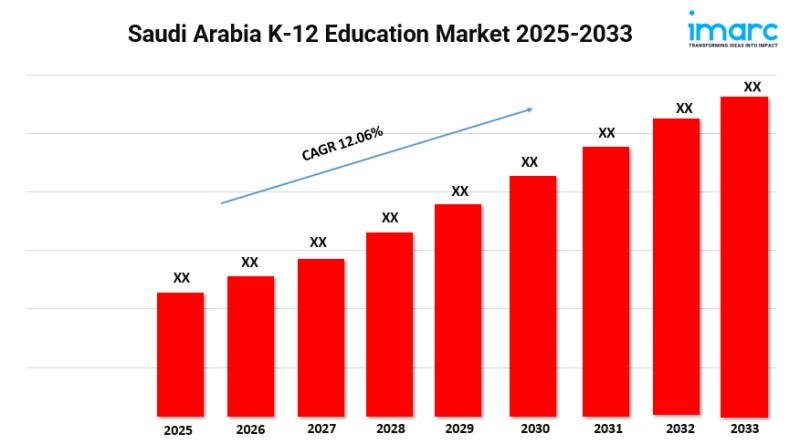
Saudi Arabia K-12 Education Market Overview
Market Size in 2024: USD 26,114.22 Million
Market Forecast in 2033: USD 72,766.68 Million
Market Growth Rate 2025-2033: 12.06%
According to IMARC Group’s latest research publication, “Saudi Arabia K-12 Education Market Size, Share, Trends and Forecast by Application, Institution, Delivery Mode, and Region, 2025-2033”, The Saudi Arabia K-12 education market size reached USD 26,114.22 Million in 2024. Looking forward, IMARC Group expects the market to reach USD 72,766.68 Million by 2033, exhibiting a growth rate (CAGR) of 12.06% during 2025-2033.
Download a sample PDF of this report: https://www.imarcgroup.com/saudi-arabia-k-12-education-market/requestsample
Growth Factors in the Saudi Arabia K-12 Education Market
● Government Support and Vision 2030 Initiatives
The Saudi Arabian government is committed to education reform through Vision 2030. This plan aims to diversify the economy and build a knowledge-based society, making education a key focus. The government has invested heavily to update curricula, train teachers, and expand school facilities. For example, the King Abdullah Project for General Education Development has equipped over 400,000 teachers with smart classrooms and digital tools. This helps promote new teaching methods. By focusing on education, the government also encourages private sector involvement. This creates chances for new schools and international partnerships to meet growing demand.
● Population Growth and Rising Demand
Saudi Arabia’s fast-growing population, especially its youth, boosts demand for K-12 education. With millions of school-age children, the need for quality education is urgent. This is especially true in urban areas like Riyadh and Jeddah. This trend drives the growth of both public and private schools. For example, more affluent families want premium education. This leads to higher enrollment in private international schools that offer programs like the International Baccalaureate. This rise in demand pushes schools to innovate and expand. They must meet diverse educational needs while dealing with the limits of current facilities.
● Increasing Preference for Private and International Schools
The growing interest in private and international schools is changing K-12 education in Saudi Arabia. Parents, especially expatriates and wealthy locals, want schools that offer quality education, bilingual programs, and recognized curricula like American or British systems. Schools like the British International School of Jeddah and GEMS Education have taken advantage of this trend. They provide top-notch facilities and extracurricular activities. Since the government removed foreign ownership limits in 2017, international investors have entered the market. They are opening new schools and boosting competition. This shift shows a rising demand for education that meets global standards, which is fueling market growth.
Key Trends in the Saudi Arabia K-12 Education Market
● Digital Transformation and EdTech Integration
The integration of educational technology (EdTech) is reshaping K-12 education in Saudi Arabia. The “Madrasati” platform is a learning management system designed for the region. It has nearly reached all students, allowing for digital and remote learning. Schools are using tools like interactive whiteboards, e-books, and virtual classrooms to boost engagement. For instance, during the COVID-19 pandemic, many used Classera, a well-known e-learning system. It helped connect teachers, students, and parents. This trend shows a push for digital literacy. It ensures students are ready for a tech-driven future. Schools also gain from data analytics to tailor learning experiences.
● Curriculum Diversification and STEM Focus
Saudi Arabia’s K-12 sector is changing. Schools are using different curricula. They focus on STEM: Science, Technology, Engineering, and Mathematics. The government’s Vision 2030 aims for a knowledge-based economy. As a result, schools are updating their programs to include critical thinking and problem-solving skills. International schools with American, British, or IB programs are becoming popular. Public schools are also starting to teach English from first grade to boost global competitiveness. Tatweer Educational Technologies has launched smart classrooms through its Future Gate initiative. This program supports STEM learning and prepares students for careers in fields like technology and engineering.
● Growth of Private Sector and Public-Private Partnerships
The private sector’s role in K-12 education is growing. This change comes from supportive government policies and public-private partnerships (PPPs). The government aims to raise private school enrollment to 25% by 2030. This goal has led to partnerships, such as GEMS Education teaming up with Hassana Investment. They plan to invest heavily in new schools over the next ten years. These collaborations improve infrastructure and bring global expertise to the market. We see this trend in cities like Riyadh. New residential areas now include private schools. This gives parents more educational choices and sparks innovation through private sector involvement.
Buy Full Report: https://www.imarcgroup.com/checkout?id=36393&method=1315
Saudi Arabia K-12 Education Industry Segmentation:
The report has segmented the market into the following categories:
Application Insights:
● Elementary School (K-5)
● Middle School (6-8)
● High School (9-12)
Institution Insights:
● Public
● Private
Delivery Mode Insights:
● Online
● Offline
Regional Insights:
● Northern and Central Region
● Western Region
● Eastern Region
● Southern Region
Competitive Landscape:
The competitive landscape of the industry has also been examined along with the profiles of the key players.
Future Outlook
The Saudi Arabia K-12 education market is set for growth. Vision 2030 emphasizes human capital development and digital change. This focus will likely boost private education. Demographic pressures will lead to new schools and upgrades to existing ones. Collaborations with global providers, like Niagara College Canada, will improve curriculum and teacher training. However, challenges exist. The digital divide and unequal access to quality education in urban and rural areas need attention. With ongoing government support and private investment, the market will become a vibrant, tech-driven system. This will prepare students for a competitive global landscape.
Ask Analyst for Sample Report: https://www.imarcgroup.com/request?type=report&id=36393&flag=C
Research Methodology:
The report employs a comprehensive research methodology, combining primary and secondary data sources to validate findings. It includes market assessments, surveys, expert opinions, and data triangulation techniques to ensure accuracy and reliability.
Note: If you require specific details, data, or insights that are not currently included in the scope of this report, we are happy to accommodate your request. As part of our customization service, we will gather and provide the additional information you need, tailored to your specific requirements. Please let us know your exact needs, and we will ensure the report is updated accordingly to meet your expectations.
About Us:
IMARC Group is a global management consulting firm that helps the world’s most ambitious changemakers to create a lasting impact. The company provide a comprehensive suite of market entry and expansion services. IMARC offerings include thorough market assessment, feasibility studies, company incorporation assistance, factory setup support, regulatory approvals and licensing navigation, branding, marketing and sales strategies, competitive landscape and benchmarking analyses, pricing and cost research, and procurement research.
Contact Us:
IMARC Group
134 N 4th St. Brooklyn, NY 11249, USA
Email: sales@imarcgroup.com
Tel No:(D) +91 120 433 0800
United States: +1-631-791-1145
This release was published on openPR.