Vadzo Imaging explains the imaging architecture decisions that define autonomous navigation reliability, presenting the FALCON-2020MRS USB camera, FALCON-900MGS USB camera, FALCON-234CGS USB camera, and FALCON-234MGS USB camera as purpose-matched embedded vision AGV camera solutions covering mapping, real-time obstacle detection, and edge AI guidance across AMR and AGV platforms.
FORT WORTH, TX / ACCESS Newswire / June 2, 2026 / Vadzo Imaging, a provider of embedded vision camera for OEMs and system integrators, is addressing the three design decisions that consistently determine whether an embedded vision AGV camera succeeds or fails at the system integration stage: frame rate relative to platform velocity, exposure latency relative to navigation loop timing, and field of view relative to detection distance and corridor width. These are not abstract parameters. They determine whether a warehouse AGV stops in time, whether an AMR maps its environment accurately, and whether an obstacle detection camera flags a pallet at 3 m/s before the robot reaches it.
For engineers building autonomous navigation platforms, selecting an embedded vision camera is not a single-axis decision. A high-resolution sensor that captures every floor feature in a mapped environment may introduce read latency that the navigation control loop cannot absorb at full frame rate. A wide-FOV lens that covers an entire aisle cross-section may trade angular resolution for the edge detail that real-time obstacle classification algorithms require at speed. Vadzo’s USB camera series, spanning 20MP high-resolution rolling shutter imaging to 2MP global shutter capture at 120fps, addresses each tradeoff with matched hardware, not generalized solutions.
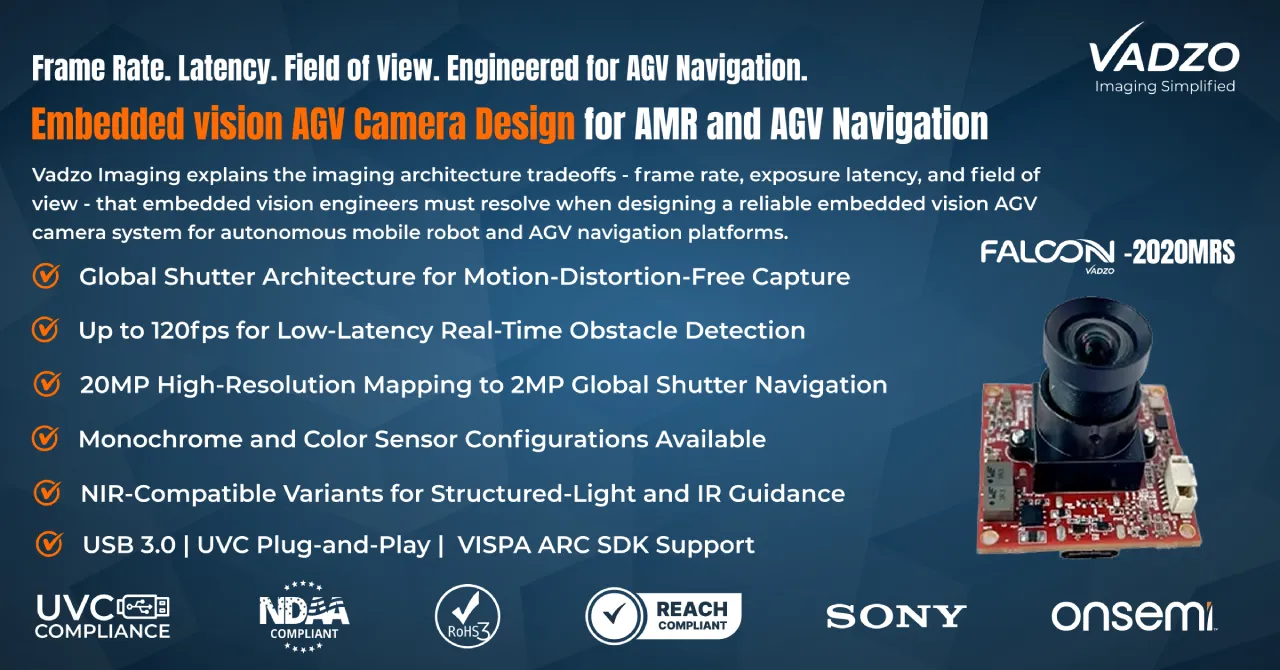
Why Frame Rate and Latency Define Embedded Vision AGV Camera Selection
In AGV navigation, the imaging pipeline sits inside the control loop. Every millisecond of sensor latency from photon capture to frame delivery at the host adds directly to the robot’s response delay. At 1.5 m/s, a 33ms frame interval (30fps) means the navigation system works with image data already 49.5mm behind the robot’s current position. At 120fps, that positional lag drops to 12.5mm. For an AMR perception camera operating in tight warehouse aisles or high-traffic autonomous mobile robot environments, that difference is the margin between a controlled stop and a collision.
Frame rate is also coupled to shutter architecture. A global shutter robotics camera exposes all pixels simultaneously, producing a geometrically consistent frame regardless of how fast the platform or subject moves. A rolling shutter sensor reads rows sequentially, and at AGV operating speeds, this introduces progressive image distortion that compounds navigation and detection errors. For applications where the robot or target is continuously in motion, global shutter capture is the correct sensor architecture. For controlled-velocity mapping passes or stationary inspection tasks, a high-resolution rolling shutter sensor offers spatial detail that 2MP alternatives cannot match. Vadzo’s Embedded Vision AGV camera portfolio spans both architectures, matching sensor type to the specific navigation or inspection task.
Field of View Tradeoffs in AMR Navigation Camera and Mobile Robot Vision System Design
Field of view selection in a mobile robot vision system is a system-level decision, not a lens selection. A 120° wide-angle lens on a 2MP sensor distributes approximately 17 pixels per degree of scene angle. At a 3-meter detection distance, each pixel subtends around 31mm of scene width, sufficient for corridor navigation and broad obstacle avoidance, but insufficient for reading 10mm-character barcode labels or detecting narrow cable bundles on the floor at approach velocity.
Narrower fields of view, 60° to 90°, concentrate resolution on a smaller scene area, enabling finer feature detection at distance and improving exposure stability in mixed-lighting warehouse environments. The correct FOV depends on the detection task. Navigation and broad obstacle classification favor a wider FOV with sufficient pixel density for the detection range. Feature-level tasks, such as barcode reading, label verification, and docking target localization, require a narrower FOV with higher pixel density per unit scene area. Vadzo’s Embedded Vision AGV camera products support both configurations through M12 lens holder compatibility and OEM optical customization.
“Warehouse automation engineers, AMR developers, and AGV system integrators are not looking for a camera spec sheet; they are trying to move goods faster, reduce system downtime, and hit navigation accuracy targets that their customers demand. The imaging hardware is one piece of that outcome. Our job at Vadzo is to make sure that piece never becomes the bottleneck, whether that means matching the right frame rate to a platform’s operating velocity, selecting a shutter architecture that holds up at production throughput, or tuning the field of view for a specific corridor geometry. We do not hand engineers a camera and walk away. We work through the application with them.” – Alwin Vincent, Product Manager, Vadzo Imaging.
FALCON-2020MRS: 20MP AR2020 Monochrome USB 3.0 Camera for High-Resolution AGV Mapping
Warehouse-scale environment mapping and high-resolution floor feature detection require spatial detail that 2MP sensors cannot deliver. The FALCON 2020MRS is Vadzo’s 20MP AR2020 Monochrome USB 3.0 Camera, built on the onsemi HyperLux AR2020 sensor. At 20 megapixels, this 1080p AR2020 USB Camera, configurable to 1080p via Region of Interest cropping for higher frame-rate operation, delivers the spatial resolution needed for centimeter-accurate map generation, floor marking detection, and large-area scene reconstruction in AGV platforms with controlled-velocity mapping workflows. When paired with structured mapping passes, rolling shutter behavior is predictable and manageable, and the 20MP resolution advantage over lower-resolution alternatives translates directly to map fidelity.
Key specs: 20MP (5120×3840) | onsemi HyperLux LP AR2020 | Rolling Shutter | 1/1.8″ 1.4μm Pixel | USB 3.0 | S-Mount (M12) | −30°C to 70°C
FALCON-900MGS: 3MP IMX900 Monochrome USB 3.0 Camera for High-Resolution Global Shutter AGV Inspection
For AGV-integrated inspection stations and structured-light perception systems that demand motion integrity alongside spatial resolution above 2MP, the FALCON-900MGS closes that gap as a 3MP IMX900 Monochrome USB 3.0 Camera built on the Sony Pregius S IMX900 sensor. At 3.2MP (2064×1552) with a 2.25μm BSI pixel, this IMX900 Global Shutter USB 3.0 Camera provides measurably higher spatial resolution than 2MP global shutter alternatives. Its back-illuminated pixel architecture delivers NIR sensitivity that front-illuminated sensors cannot match, making it purpose-built for laser line profiling, IR-based docking guidance, and near-infrared illumination environments in low-light warehouse deployments. This is the Embedded Vision AGV camera for inspection-integrated AGV cells where resolution, NIR sensitivity, and global shutter integrity must coexist.
Key specs: 3MP (2064×1552) | Sony IMX900 Pregius S | Global Shutter | 1/3.1″ 2.25μm BSI Pixel | USB 3.0 | NIR | S-Mount (M12) | −30°C to 70°C
FALCON-234CGS: AR0234 Color Global Shutter USB 3.0 Camera for AGV Navigation and Color Marker Detection
AGV navigation systems using color-coded floor markers, colored lane tapes, or colored fiducial targets need an AGV vision camera that preserves color fidelity at platform operating velocities. The FALCON-234CGS is Vadzo’s AR0234 Color Global Shutter USB 3.0 Camera, delivering 2MP (1920×1080) at up to 120fps with full global shutter capture. As a low-latency AGV camera for color marker tracking, lane following, and forward-facing obstacle detection, the FALCON 234CGS provides the frame rate and motion accuracy that edge AI AGV camera deployments require. The same platform qualifies as a robotics camera in collaborative robot workcells, a kiosk camera in interactive embedded vision systems, and an industrial automation camera in color-label inspection lines, all from a single USB 3.0 module.
Key specs: 2MP (1920×1200) | onsemi AR0234 | Global Shutter | 1/2.6″ 3.0μm Pixel | USB 3.0 | S-Mount (M12) | −40°C to 85°C
FALCON-234MGS: 2MP AR0234 USB 3.0 Camera for Monochrome Navigation and NIR Guidance
When spectral efficiency takes priority over color output in structured-light 3D profiling, barcode reading, NIR docking guidance, or binary-feature autonomous navigation, a monochrome global shutter camera delivers superior photon sensitivity by eliminating the quantum efficiency loss inherent in a Bayer color filter array. The FALCON-234MGS is Vadzo’s 2MP AR0234 USB 3.0 Camera in monochrome global shutter configuration, providing the same 120fps global shutter architecture as the FALCON 234CGS with maximized NIR sensitivity. As an AMR USB camera for structured-light SLAM, laser triangulation, and IR-illuminated AGV navigation camera tasks where color output is unnecessary, the FALCON 234MGS addresses the Embedded Vision AGV camera requirements that demand sensitivity and motion integrity simultaneously. It equally serves as a medical device camera in platforms requiring motion-artifact-free monochrome imaging.
Key specs: 2MP (1920×1200) | onsemi AR0234 | Global Shutter | 1/2.6″ 3.0μm Pixel | USB 3.0 | NIR | S-Mount (M12) | −40°C to 85°C
Vispa ARC SDK: Imaging Control for AGV and AMR Integration
All four FALCON USB embedded vision camera products are supported by Vadzo’s Vispa ARC SDK, which provides programmatic control over streaming, exposure, gain, white balance, Region of Interest configuration, and firmware updates. The SDK supports C, C++, and Python across Windows, Linux, and Android platforms, enabling robotics engineers and edge AI system architects to build and deploy custom AGV vision applications with direct control over all imaging parameters. For teams using standard driver frameworks, all four FALCON products operate natively under UVC, V4L2, and DirectShow without any proprietary driver dependency, reducing integration overhead in embedded Linux AGV platforms and accelerating time to deployment.
AGV and AMR Applications for the FALCON Embedded Vision AGV Camera Portfolio
AGV Warehouse Navigation and Obstacle Detection: FALCON 234CGS, FALCON 234MGS
Floor marker tracking, obstacle detection, docking guidance, and real-time lane following in warehouse AGV deployments require global shutter capture at 120fps with minimal sensor latency. The FALCON 234CGS (AR0234 Color Global Shutter USB 3.0 Camera) and FALCON 234MGS (AR0234 Monochrome Global Shutter USB 3.0 Camera) satisfy this requirement as an AGV USB camera for forward-facing and downward-facing navigation tasks. Both support autonomous navigation camera deployments in automated warehouse and distribution center environments.
High-Resolution Environment Mapping: FALCON 2020MRS
Generating high-fidelity floor maps, detecting floor-level features, and building centimeter-accurate environment models benefit from 20MP spatial resolution, where controlled-velocity mapping passes are part of the AGV operational workflow. The FALCON 2020MRS 4K AR2020 Rolling Shutter USB Camera delivers this resolution as a global shutter AGV camera alternative for mapping-intensive tasks when rolling shutter behavior is managed through workflow design.
Inspection-Integrated AGV and Structured-Light Perception: FALCON 900MGS
AGV platforms with integrated quality inspection and SLAM systems using structured light or laser line profiling need spatial resolution above 2MP with global shutter integrity and NIR sensitivity. The FALCON 900MGS IMX900 USB 3.0 Camera satisfies this as the Embedded Vision AMR Camera for combined navigation and inline inspection tasks. Its BSI pixel architecture makes it the first choice in NIR-illuminated warehouse and manufacturing environments.
Additional applications for the FALCON series span traffic monitoring camera deployments in smart facility infrastructure, smart parking camera systems, security camera and surveillance camera installations in embedded edge AI platforms, and drone camera configurations in UAV-based aerial inspection systems.
What the FALCON Series Shares: Vadzo’s OEM Commitment to AGV Engineers
Across all four FALCON embedded vision AGV camera products, Vadzo provides a consistent set of OEM services that embedded vision engineering teams rely on beyond the hardware itself. Full OEM camera customization covers board redesigns, firmware modifications, lens holder and filter changes, and enclosure design. ISP tuning is calibrated for specific AGV operating environments across onsemi AR2020, Sony IMX900, and onsemi AR0234 sensors. Volume pricing, production support, and direct applications engineering assistance for design-in and production ramp are available on request from Vadzo Imaging at http://www.vadzoimaging.com.
Frequently Asked Questions (FAQs)
1) What frame rate does an Embedded Vision AGV camera need for reliable real-time obstacle detection at warehouse AGV speeds?
Frame rate selection for an embedded vision AGV camera depends directly on platform velocity and the acceptable detection latency in the navigation control loop. At typical warehouse AGV speeds between 1.0 and 2.0 m/s, a 60fps global shutter camera reduces per-frame positional uncertainty to roughly 17mm workable for broad obstacle avoidance. For tighter safety margins, 120fps cuts that uncertainty to under 9mm. Vadzo’s FALCON-234CGS and FALCON-234MGS, both 2MP AR0234 Global Shutter USB 3.0 Camera products, achieve 120fps at full 1920×1080 resolution over USB 3.0, providing the temporal resolution needed for forward-facing obstacle detection in high-throughput AMR navigation camera deployments without compromising per-frame image integrity at speed. Vispa ARC SDK allows engineers to tune exposure and ROI settings to further reduce effective read latency inside the embedded pipeline.
2) When should AGV engineers choose a 20MP rolling shutter camera over a 2MP global shutter camera for navigation system design?
The choice between a 20MP AR2020 Monochrome USB 3.0 Camera and a 2MP global shutter camera depends on the specific navigation task. Vadzo’s FALCON-2020MRS delivers 20MP spatial resolution suited to detailed environment mapping, floor marking detection, and large-area scene reconstruction where the robot operates at controlled velocities or performs stationary capture. For continuous real-time navigation and obstacle avoidance while the AGV platform is actively moving, a 2MP AR0234 USB 3.0 Camera with global shutter capture at 120fps eliminates the motion artifacts that accumulate in rolling shutter sensors at operating velocity. In multi-camera AGV system designs, both approaches are combined: high-resolution mapping on one sensor channel and global shutter real-time navigation on another, each handled by a purpose-matched camera.
3) Which Vadzo embedded vision AGV camera is best suited for NIR-based docking guidance and structured-light SLAM applications?
If your AGV system relies on laser line profiling, IR docking targets, or structured-light SLAM, the FALCON 900MGS IMX900 Global Shutter USB 3.0 Camera is where we point engineers first. It runs on the Sony IMX900 Pregius S sensor, and that BSI pixel design genuinely matters here. Back-illuminated architecture captures NIR illumination with higher quantum efficiency than front-illuminated alternatives, not marginally better, but measurably so. The 3MP (2064×1552) resolution also gives you more scene detail per frame than a 2MP global shutter sensor, which counts when the same camera needs to handle both navigation and inline inspection in an AGV cell. On top of that, Vadzo tunes the ISP specifically to your NIR wavelength and ambient lighting conditions, so you are not starting integration from a generic baseline.
4) Can Vadzo customize the FALCON series embedded vision AGV camera for a specific OEM robot platform or enclosure requirement?
Yes, and this is something Vadzo handles regularly. Board-level redesigns for custom carrier integration, firmware changes for specific trigger modes or application control, lens holder swaps, optical filter changes for spectral tuning, all of it is on the table across the full FALCON lineup. Volume production support and applications engineering assistance come with it, not as an add-on. For teams putting together multi-sensor AMR perception systems, Vadzo’s engineering team can work through sensor selection, optics matching, and edge AI pipeline integration with you directly. The goal is straightforward: get your team to a working, integrated system without burning engineering time on hardware fundamentals that Vadzo has already solved. Engineering samples and full technical documentation are available on request.
5) How does field of view selection affect embedded vision AGV camera performance in narrow-aisle warehouse AMR deployments?
The field of view in an embedded vision AGV camera directly determines how much scene area the sensor covers per pixel at a given detection distance. In narrow-aisle AMR deployments where corridor widths typically range from 1.2m to 2.4m, a wide-angle lens may cover the full aisle width at 3m but allocates fewer pixels per obstacle surface, reducing feature discrimination at approach velocity. A narrower FOV concentrates pixel density on a smaller scene area, improving edge detail and classification confidence. Vadzo’s FALCON 234CGS AR0234 Color Global Shutter USB 3.0 Camera and FALCON 234MGS AR0234 Monochrome Global Shutter USB 3.0 Camera both support lens customization for specific FOV requirements and mounting configurations. Vadzo’s applications engineering team assists OEM teams in matching lens selection to detection range, corridor geometry, and downstream vision algorithm requirements for reliable AMR perception camera performance in each specific deployment.
Availability
Vadzo Imaging develops high-performance embedded vision camera for OEMs and system integrators building next-generation intelligent systems. The company’s USB camera series spans 2MP global shutter capture at 120fps to 20MP high-resolution configurations, covering industrial automation, robotics, autonomous navigation, smart city infrastructure, and edge AI applications. Beyond hardware, Vadzo provides end-to-end imaging expertise, including sensor integration, ISP tuning, firmware development, and OEM camera customization services that accelerate development and deployment at scale. Vadzo’s embedded vision camera interfaces include USB, MIPI, GigE, Wi-Fi, and SerDes. Visit http://www.vadzoimaging.com to explore the full product portfolio.
Media Contact
Alwin Vincent
Vadzo Imaging
Email: [email protected]
LinkedIn: Vadzo Imaging
YouTube: Vadzo Imaging
X: Vadzo Imaging
SOURCE: Vadzo Imaging