The Asset Lifecycle Management (ALM) market refers to the use of software, technologies, and services to manage an organization’s physical assets throughout their entire lifecycle – from acquisition and deployment to maintenance and retirement – in order to maximize performance, efficiency, and return on investment. ALM solutions help businesses track asset status, optimize utilization, minimize downtime, ensure compliance, and make data driven decisions using real time monitoring and analytics.
ALM plays a crucial role in industries such as manufacturing, energy and utilities, transportation and logistics, healthcare, oil and gas, construction, and government services. As digital transformation accelerates, the adoption of advanced technologies such as the Internet of Things (IoT), predictive analytics, cloud based platforms, and artificial intelligence (AI) is reshaping how enterprises manage assets.
Download Free Sample@ https://www.cervicornconsulting.com/sample/2411
________________________________________
Market Size and Growth Outlook
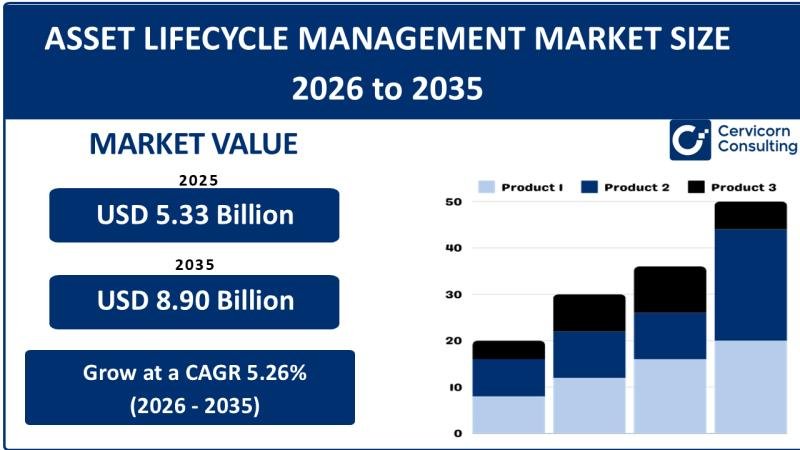
According to the Cervicorn Consulting report, the global Asset Lifecycle Management market was valued at approximately USD 5.33 billion in 2025 and is projected to reach around USD 8.90 billion by 2035, expanding at a compound annual growth rate (CAGR) of 5.26% during the forecast period 2026-2035.
This steady growth is driven by the increasing need for operational efficiency, real time asset tracking, predictive maintenance, and the desire to reduce total cost of ownership (TCO) – especially in asset intensive industries. ALM solutions help organizations transition from reactive to proactive maintenance, improve asset performance, and support sustainability objectives.
________________________________________
Current Market Trends
1. Cloud Based ALM Adoption
Cloud based ALM solutions are growing rapidly owing to their scalability, lower upfront costs, remote accessibility, and real time data synchronization across geographies – making them attractive for global enterprises.
2. IoT and Predictive Maintenance Integration
IoT sensors and connected devices enable real time asset monitoring, while predictive analytics anticipate failures before they occur. This trend reduces unplanned downtime and optimizes maintenance scheduling, significantly improving asset uptime and reliability.
3. Mobile Access and Remote Monitoring
Mobile accessibility allows technicians to receive asset data, maintenance requests, work orders, and diagnostic information on the go, further enhancing productivity and responsiveness.
4. ERP and ALM Integration
Integration of ALM solutions with enterprise resource planning (ERP) systems provides a unified view of asset performance, operational costs, and financial data – enabling better decision making and alignment with business goals.
5. Focus on Lifecycle Extension
With rising investment in asset intensive industries, companies are emphasizing strategies to extend asset lifecycles through holistic lifecycle insights and automation, improving ROI and asset longevity.
________________________________________
Market Drivers
1. Digital Transformation and Automation
The growing drive towards digitalization and smart manufacturing is motivating organizations to adopt ALM solutions that provide data driven insights into asset performance, utilization, and maintenance history.
2. Increasing Demand for Predictive and Prescriptive Maintenance
Predictive maintenance helps reduce unplanned failures and maintenance costs. ALM solutions that incorporate machine learning and AI for predictive analytics are gaining traction as they deliver measurable efficiency improvements.
3. Sustainability and Compliance Requirements
Regulatory compliance and environmental, social, and governance (ESG) mandates are compelling organizations to track asset usage, emissions, waste, and lifecycle documentation to ensure regulatory adherence and sustainability reporting.
4. Cost Optimization in Asset Intensive Industries
Industries such as manufacturing, energy, transportation, and oil & gas require optimized asset performance to reduce operating costs, minimize downtime, and enhance productivity – driving demand for ALM solutions.
5. Infrastructure Development and Industrial Growth
With increased investment in infrastructure and industrial expansion, particularly in regions like Asia Pacific and North America, enterprises seek ALM solutions to manage assets efficiently across complex and distributed environments.
________________________________________
Market Restraints
1. High Initial Costs
Implementing ALM solutions may require significant investment in software subscription, integration with existing systems, training, and infrastructure upgrades, which can be a barrier for small and medium enterprises (SMEs).
2. Data Security and Privacy Issues
As ALM systems increasingly rely on digital data and cloud platforms, concerns around cybersecurity, sensitive data protection, and compliance with data privacy regulations can slow adoption.
3. Integration Complexities
Integrating new ALM technologies with legacy systems and disparate data sources can be technically challenging and resource intensive for organizations.
4. Skilled Workforce Shortage
A shortage of qualified professionals skilled in IoT, predictive analytics, and ALM technology deployment and maintenance can inhibit technology adoption.
________________________________________
Market Opportunities
1. Growth in Emerging Economies
Rapid industrialization and infrastructure development in regions like Asia Pacific and Latin America provide significant opportunities for ALM solution providers, especially in sectors such as energy, manufacturing, transportation, and construction.
2. Sustainability and Circular Economy Initiatives
Organizations pursuing sustainability goals and circular economic models will increasingly rely on ALM systems to optimize asset resource usage, reduce waste, and enhance recycling and reuse practices.
3. Technological Advancements in AI and Analytics
Further innovation in AI, machine learning, and data analytics will improve predictive maintenance, decision support, and autonomous asset optimization-creating opportunities for advanced ALM systems.
4. Scalability Through Cloud Computing
The rise of scalable cloud based platforms gives enterprises access to ALM tools without large capital expenditures on on premise infrastructure, particularly benefiting SMEs and globally distributed organizations.
Download Free Sample@ https://www.cervicornconsulting.com/sample/2411
________________________________________
Market Segmentation
The global Asset Lifecycle Management market is segmented based on solution type, deployment, organization size, industry vertical, and region.
By Solution Type
• Software – Asset performance management, EAM (Enterprise Asset Management), MRO (Maintenance, Repair & Overhaul), asset inventory and tracking, analytics dashboards.
• Services – Consulting, implementation, training and support, managed services.
By Deployment Type
• On Premise – Preferred by organizations with stringent security and compliance needs; offers control but requires higher infrastructure investment.
• Cloud Based – Gaining popularity due to scalability, flexibility, accessibility, and remote asset monitoring capabilities.
By Organization Size
• Small and Medium Enterprises (SMEs) – Increasing adoption with cloud based solutions for cost effective asset management and productivity improvements.
• Large Enterprises – Need comprehensive ALM systems to manage complex, high value assets across global operations.
By Industry Vertical
• Manufacturing – Ensures machinery uptime, predictive maintenance, and efficient production operations.
• Energy & Utilities – Supports grid modernization, compliance, and asset performance optimization.
• Transportation & Logistics – Enhances fleet management, scheduling, and supply chain effectiveness.
• Oil & Gas – Reduces unplanned downtime and ensures safety and environmental compliance.
• Healthcare – Helps manage medical equipment and facilities cost effectively.
• Construction – Tracks heavy machinery use, maintenance, and operational forecasting.
• Government – Manages public infrastructure, transportation networks, and public utilities.
________________________________________
Regional Market Insights
Asia Pacific
Asia Pacific leads the global ALM market, accounting for the largest share, driven by rapid industrialization, digital transformation, and increased adoption of IoT and cloud technologies. Countries such as China, India, and Japan are major contributors to market growth.
North America
North America is a significant and aggressive market, supported by advanced industrial infrastructure, early adoption of technology, and strong investment in cloud based ALM solutions. The United States and Canada are key drivers in the region.
Europe
Europe has a robust ALM market, propelled by stringent regulatory frameworks, sustainability initiatives, and high demand for operational efficiency in sectors such as energy, transportation, and manufacturing.
LAMEA (Latin America, Middle East & Africa)
The LAMEA region is gradually growing, with increasing modernization of assets and rising interest in digital asset management – although economic challenges may slow broader adoption.
Get the Full Report @ https://www.cervicornconsulting.com/asset-lifecycle-management-market
________________________________________
Key Market Players
The asset lifecycle management market is highly competitive and characterized by strong global players investing in technological innovation and strategic partnerships. Major companies include:
• IBM Corporation
• SAP SE
• Oracle Corporation
• Siemens AG
• Infor
• Schneider Electric
• ABB Ltd.
• Bentley Systems
• IFS AB
• Hexagon AB
• AVEVA Group
• Dassault Systèmes
• GE Digital
• AspenTech
• Siemens Digital Industries Software
These companies are focusing on cloud expansion, AI based analytics, and integrated solutions to strengthen their competitive positions.
________________________________________
Future Growth Potential
The future outlook for the asset lifecycle management market is positive, driven by continued investment in digital transformation and advanced ALM technologies. With the evolution of AI enabled predictive analytics, digital twin technology, and real time IoT monitoring, organizations will increasingly leverage ALM solutions to improve operational performance, prolong asset lifecycles, and achieve sustainability objectives.
Emerging use cases in autonomous assets, smart infrastructure, and connected supply chains will present new growth avenues. As cloud computing becomes more pervasive and affordable, even smaller organizations will adopt sophisticated ALM systems, further broadening market reach.
________________________________________
Frequently Asked Questions (FAQ)
1. What is the asset lifecycle management market size?
The global asset lifecycle management market was valued at approximately USD 5.33 billion in 2025 and is expected to reach around USD 8.90 billion by 2035.
2. What is driving growth in the ALM market?
Key drivers include digital transformation, IoT integration, predictive maintenance, cost optimization, and sustainability initiatives.
3. Which region leads the market?
Asia Pacific currently leads the asset lifecycle management market, driven by industrialization and technology adoption.
4. What industries are adopting ALM solutions?
Key industries include manufacturing, energy and utilities, transportation and logistics, oil and gas, healthcare, construction, and government.
5. What are the main solution types in the market?
The market is segmented into software (including predictive maintenance, EAM, and analytics) and services (consulting, implementation, and support).
6. What are the challenges in adopting ALM?
Challenges include high upfront costs, data security concerns, integration with legacy systems, and a shortage of skilled professionals.
7. Who are the leading companies in the ALM market?
Major players include IBM, SAP, Oracle, Siemens, Infor, Schneider Electric, and ABB, among others.
________________________________________
Conclusion
The asset lifecycle management market is poised for steady growth over the next decade, driven by digital transformation, cost optimization needs, and rising demand for predictive, cloud based asset management solutions. As businesses continue to seek operational efficiency and sustainability, ALM solutions will remain critical for managing assets effectively throughout their lifecycle – enhancing performance, reducing maintenance costs, and supporting strategic decision making.
Buy now at a 15% discount price: https://www.cervicornconsulting.com/buy-now/2411
Office No – 609, 6th Floor, 129/A Dattawadi, Sinhgad Road, Pune – 411030, India
Cervicorn Consulting is a global market research and consulting firm that provides syndicated research reports, industry insights, and customized consulting services across multiple sectors. The company focuses on delivering strategic market intelligence to help organizations make informed business decisions and identify emerging growth opportunities.
This release was published on openPR.