The global gamification market is rapidly evolving as businesses increasingly adopt game-design elements to enhance user engagement, motivation, and customer experience. Gamification refers to the integration of features such as points, badges, leaderboards, rewards, and challenges into non-gaming environments like education, healthcare, marketing, and corporate training.
By tapping into human psychology-such as competition, achievement, and recognition-gamification has proven to be a powerful tool for influencing behavior and improving outcomes. Organizations are leveraging gamification to increase employee productivity, boost customer loyalty, and improve learning experiences.
With the rise of digital platforms, mobile applications, and immersive technologies, gamification is becoming a core strategy for organizations seeking to enhance user interaction and retention.
Download Sample Report: https://www.acumenresearchandconsulting.com/request-sample/3808
________________________________________
Market Size and Growth
The global gamification market has experienced strong growth and is projected to expand significantly over the coming years.
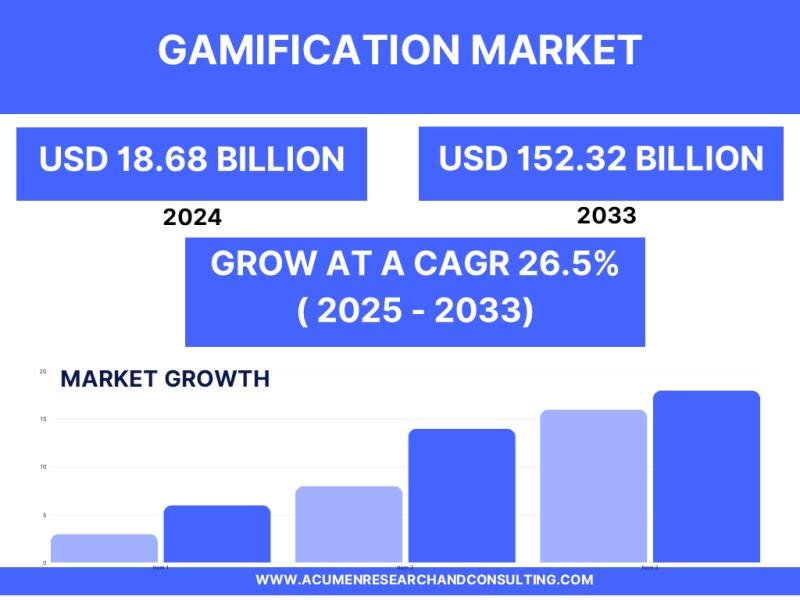
• Market size in 2024: USD 18.68 billion
• Forecast by 2033: USD 152.32 billion
• CAGR (2025-2033): 26.5%
This rapid growth is driven by increasing demand for interactive and engaging digital experiences across industries.
North America led the market in 2024 with revenue of approximately USD 7.1 billion, while Asia-Pacific is expected to witness the fastest growth with a CAGR of nearly 27.9%.
The high growth rate highlights the expanding adoption of gamification solutions in enterprise applications, customer engagement platforms, and digital learning environments.
________________________________________
Current Market Trends
1. Integration with AI and Data Analytics
Gamification platforms are increasingly leveraging artificial intelligence and data analytics to deliver personalized experiences. AI enables real-time feedback, adaptive challenges, and targeted rewards that enhance user engagement.
2. Growth of Digital Learning and EdTech
The adoption of gamification in education and corporate training is rising rapidly. Gamified learning platforms improve knowledge retention, engagement, and skill development.
3. Rise of AR and VR Technologies
The integration of augmented reality (AR) and virtual reality (VR) is transforming gamification by creating immersive and interactive environments. These technologies enhance learning and training experiences across industries.
4. Mobile-First Gamification
With the increase in smartphone usage globally, gamification solutions are being designed primarily for mobile platforms, enabling broader reach and accessibility.
5. Gamification in Health and Wellness
Healthcare providers are using gamification to encourage healthy behaviors, track patient progress, and improve treatment adherence.
________________________________________
Market Drivers
1. Rising Demand for User Engagement
Organizations are increasingly focusing on improving customer and employee engagement, making gamification a key strategy.
2. Growth in Smartphone and Internet Penetration
The expansion of mobile connectivity and internet access has enabled widespread adoption of gamified applications globally.
3. Adoption of Remote Work and Digital Learning
The shift toward remote work and online education has increased demand for gamified solutions to maintain motivation and productivity.
4. Increased Focus on Customer Retention
Businesses are using gamification to enhance customer loyalty through rewards programs, challenges, and interactive experiences.
5. Technological Advancements
Innovations in cloud computing, AI, and AR/VR technologies are enhancing the capabilities of gamification platforms.
________________________________________
Market Restraints
1. High Implementation Costs
Developing and maintaining gamified systems can be expensive, particularly for small and medium-sized enterprises.
2. Risk of User Fatigue
Overuse or poorly designed gamification elements can lead to reduced effectiveness and user disengagement.
3. Data Privacy Concerns
Gamification platforms often collect user data, raising concerns about privacy and data security.
4. Complexity in Design
Designing effective gamification systems requires expertise in both psychology and technology, which can be challenging for organizations.
________________________________________
Market Opportunities
1. Expansion in Healthcare and Education
Gamification offers significant opportunities in healthcare and education by improving patient outcomes and enhancing learning experiences.
2. Integration with Emerging Technologies
The use of AI, machine learning, and AR/VR presents new opportunities for creating immersive and personalized gamified experiences.
3. Growth in Emerging Markets
Developing regions such as Asia-Pacific offer substantial growth potential due to increasing digital adoption and smartphone penetration.
4. Corporate Training and HR Applications
Gamification is increasingly used in employee onboarding, training, and performance management, driving productivity and engagement.
Browse Press Releases: https://www.acumenresearchandconsulting.com/press-releases/gamification-market
________________________________________
Market Segmentation
The gamification market is segmented based on several key factors:
By Component
• Solution
• Service
The service segment dominates the market, accounting for around 59% of the share, as organizations rely on expert providers for implementation and management.
By Deployment
• Cloud
• On-premises
On-premises deployment holds a significant share due to better data control and security.
By Enterprise Size
• Small & Medium Enterprises (SMEs)
• Large Enterprises
Large enterprises dominate due to higher investment capacity and broader application of gamification across business functions.
By Application
• Marketing
• Sales
• Product development
• Human resources
• Others
Marketing and sales applications are major contributors, as gamification enhances customer engagement and brand loyalty.
By Industry
• Retail
• Education
• IT & Telecom
• BFSI
• Healthcare
• Media & Entertainment
• Others
________________________________________
Regional Market Insights
North America
North America dominates the gamification market due to early adoption of advanced technologies and strong presence of key players.
Asia-Pacific
Asia-Pacific is the fastest-growing region, driven by:
• Increasing smartphone penetration
• Growing internet access
• Expansion of digital education initiatives
Europe
Europe is a significant market, supported by increasing adoption of gamification in corporate training and education.
Latin America and Middle East & Africa
These regions are gradually adopting gamification solutions, driven by improving digital infrastructure and growing awareness.
Get the Full Report@ https://www.acumenresearchandconsulting.com/gamification-market
________________________________________
Key Market Players
The gamification market is highly competitive, with several global companies focusing on innovation and strategic partnerships. Key players include:
• Microsoft
• SAP
• BI WORLDWIDE
• Verint
• Aon
• Centrical
• Influitive
• Tango Card
• Hoopla
• IActionable
These companies are investing in advanced technologies and expanding their product portfolios to gain a competitive edge.
________________________________________
Future Market Growth Potential
The future of the gamification market is highly promising, driven by technological innovation and evolving consumer behavior.
1. AI-Powered Gamification
AI will enable personalized user experiences, predictive analytics, and adaptive learning systems.
2. Expansion of Immersive Technologies
AR and VR will play a crucial role in creating engaging and interactive environments.
3. Increased Adoption Across Industries
Gamification will continue to expand into sectors such as healthcare, education, retail, and finance.
4. Growth of Mobile and Cloud Platforms
Mobile-first strategies and cloud-based solutions will enhance scalability and accessibility.
5. Focus on Behavioral Analytics
Organizations will use gamification to analyze user behavior and improve decision-making processes.
Overall, the market is expected to transform how organizations interact with users, making experiences more engaging, interactive, and data-driven.
________________________________________
Frequently Asked Questions (FAQ)
1. What is gamification?
Gamification is the use of game-like elements such as points, rewards, and leaderboards in non-gaming environments to increase engagement and motivation.
2. What is the market size of gamification?
The market was valued at USD 18.68 billion in 2024 and is projected to reach USD 152.32 billion by 2033.
3. What is the growth rate of the market?
The market is expected to grow at a CAGR of 26.5% from 2025 to 2033.
4. What are the key drivers?
Key drivers include increasing demand for user engagement, growth in digital learning, and rising smartphone penetration.
5. Which region dominates the market?
North America currently dominates the market, while Asia-Pacific is the fastest-growing region.
6. What are the major applications?
Major applications include marketing, sales, employee training, and customer engagement.
7. Who are the major players?
Leading companies include Microsoft, SAP, BI WORLDWIDE, Verint, and Aon.
Purchase this Premium Report@ https://www.acumenresearchandconsulting.com/buy-now/0/3808
201, Vaidehi-Saaket, Baner – Pashan Link Rd, Pashan, Pune, Maharashtra 411021
Acumen Research and Consulting (ARC) is a global provider of market intelligence and consulting services to information technology, investment, telecommunication, manufacturing, and consumer technology markets. ARC helps investment communities, IT professionals, and business executives to make fact based decisions on technology purchases and develop firm growth strategies to sustain market competition. With the team size of 100+ Analysts and collective industry experience of more than 200 years, Acumen Research and Consulting assures to deliver a combination of industry knowledge along with global and country level expertise.
This release was published on openPR.