Sony® Pregius S™ IMX900 Sensor | Global Shutter USB 3.2 Gen 1 Camera | Quad HDR & Quad Shutter Control | Enhanced NIR Sensitivity | UVC Plug and Play Camera | VISPA ARC SDK for C/C++/Python
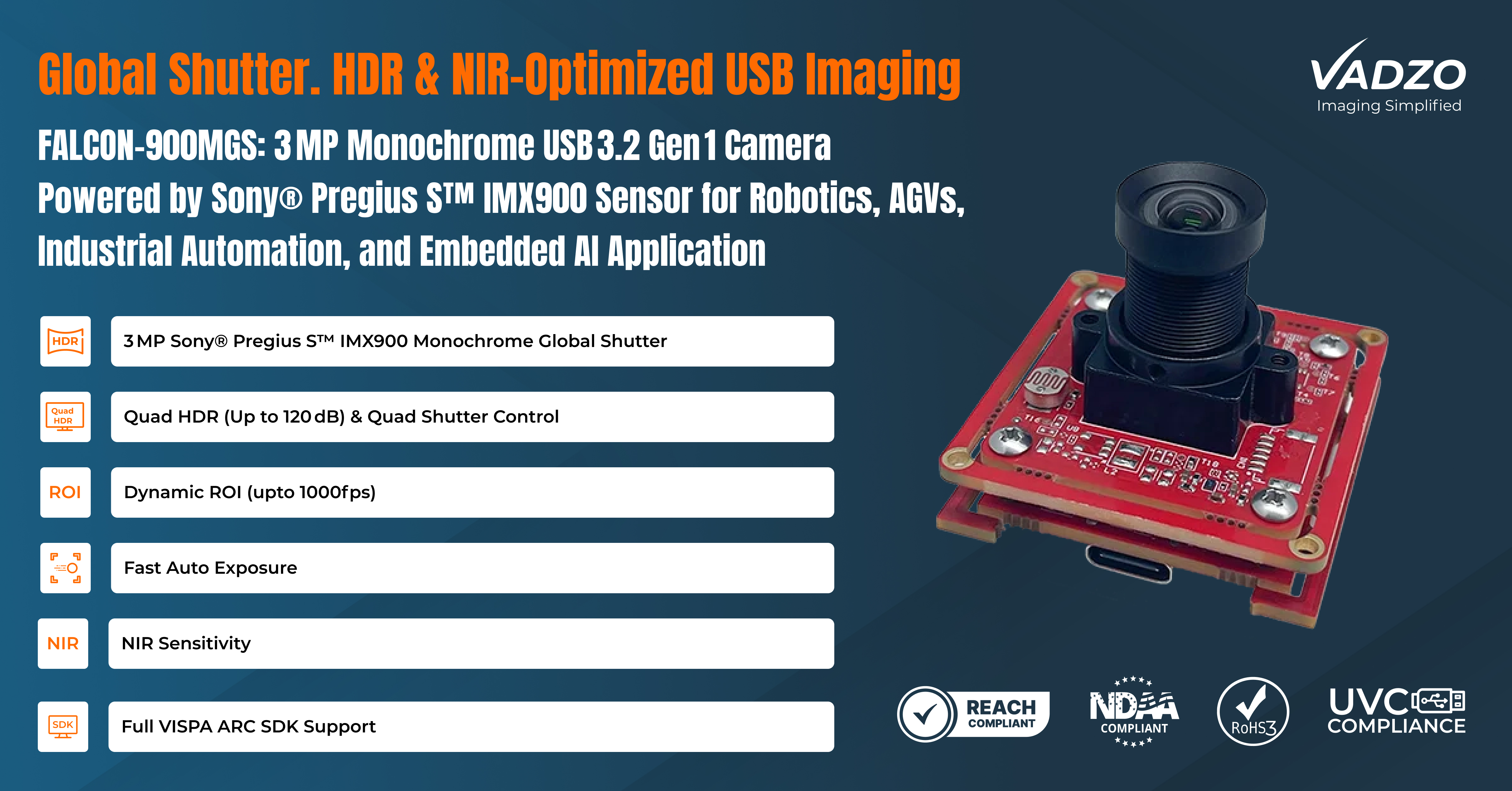
FORT WORTH, TX / ACCESS Newswire / March 25, 2026 / Vadzo Imaging, a global leader in embedded vision, today announces the launch of the Falcon‑900MGS, a 3.2MP monochrome global shutter USB 3.2 Gen 1 camera built on the Sony® Pregius S™ IMX900. The IMX900 sensor is Sony’s fourth-generation stacked global shutter CMOS sensor, which makes the Falcon‑900MGS genuinely distinctive: It combines true global shutter, quad HDR up to 120 dB, and enhanced NIR sensitivity in a single compact USB module. For embedded vision developers, industrial automation engineers, and robotics and UAV OEMs, the Falcon‑900MGS delivers a level of imaging versatility in a plug-and-play USB camera that was previously only accessible in larger, more complex machine vision systems.
Key Capabilities of Sony Pregius S IMX900 USB 3.2 Gen 1 UVC Camera
True Global Shutter – Rolling shutter sensors capture images row by row. When a subject or the camera itself moves during readout, each row records a slightly different moment, producing skew, wobble, and distortion that degrades measurement accuracy and triggers AI inference failures. The IMX900 captures all 3.2MP pixels simultaneously in a single exposure, producing geometrically accurate frames regardless of subject speed or platform motion. For robotic arms, AGV navigation, conveyor inspection, and UAVs in flight, every frame is trustworthy.
Quad HDR Up to 120 dB – The Falcon‑900MGS supports advanced quad HDR modes combining multiple exposures per frame, preserving detail simultaneously in bright highlight areas and deep shadow regions. Fast auto-exposure adapts to changing illumination conditions without manual intervention. Most global shutter sensors achieve HDR through limited dual-exposure modes that cap dynamic range well below 120 dB. The IMX900’s stacked architecture enables quad HDR at full global shutter fidelity, without the motion artifacts that multi-exposure HDR typically introduces on rolling shutter sensors.
Enhanced NIR Sensitivity – The IMX900 delivers strong near-infrared sensitivity, enabling reliable imaging under IR illumination in conditions where visible light is absent, insufficient or deliberately avoided. This extends the Falcon‑900MGS’s operational envelope into applications including biometric vein pattern recognition, material sorting under structured NIR illumination, night-time aerial inspection, and machine vision environments where IR lighting is used to eliminate ambient light variability. Critically, the IMX900 achieves this NIR performance without sacrificing visible light sensitivity.
Quad Shutter Control – Beyond global shutter, the Falcon‑900MGS USB 3.2 Gen 1 UVC camera supports quad shutter control modes, giving developers precise control over exposure timing, trigger synchronization, and multi-camera coordination. Hardware GPIO triggers enable external synchronization with strobes, PLCs, and other sensors for coordinated multi-camera inspection setups and time-critical embedded vision deployments. This level of shutter control is typically found in dedicated machine vision cameras at significantly higher cost and complexity. The Falcon‑900MGS brings it to a UVC-compliant USB module.
Plug-and-Play Integration With VISPA ARC SDK
Full UVC compliance delivers driverless operation on Linux, Windows and Android. Backward compatibility with USB 2.0 hosts ensures deployment flexibility across a wide range of embedded platforms.
For developers requiring sensor-level control beyond UVC defaults, VISPA ARC SDK provides complete programmatic access to streaming configuration, dynamic ROI, binning, windowing, exposure and gain management, trigger synchronization, and firmware updates. APIs are available in C, C++, C#, and Python across Windows, Linux, and Android, enabling production-grade integration and full lifecycle management for OEM deployments.
Applications
Industrial Automation and Inspection: PCB and semiconductor inspection, surface defect detection, precision metrology, and inline quality control where rolling shutter distortion would compromise measurement accuracy and repeatability.
Robotics and Autonomous Systems: Pick-and-place automation, visual servoing, AMR and AGV navigation, and real-time robotic guidance in motion-rich environments where geometric frame accuracy directly determines system reliability.
Edge AI and Embedded Vision: Real-time AI inference on resource-constrained platforms using dynamic ROI and binning to minimize bandwidth and CPU load. NIR-illuminated biometrics, vein pattern recognition, and material sorting under structured IR illumination.
UAV and Aerial Platforms: Distortion-free aerial imaging for inspection, mapping, and surveillance where platform motion would produce rolling shutter artifacts in standard cameras. Global shutter combined with quad HDR manages the high-contrast lighting transitions common in aerial scenes.
Collaborative Robotics and 3D Reconstruction: Motion-free simultaneous capture for structured-light 3D scanning, collaborative robot vision, and part inspection where rolling shutter skew would corrupt depth reconstruction accuracy.
Scientific and Laboratory Imaging: High-speed motion capture, laboratory instrumentation, production diagnostics, and research imaging requiring global shutter fidelity and configurable capture parameters.
Frequently Asked Questions
Q: What makes Sony® Pregius S™ different from previous Sony global shutter sensors?
Pregius S™ is Sony’s fourth-generation stacked global shutter CMOS architecture. Stacking the pixel array and signal processing on separate silicon layers allows Sony to optimize each independently, delivering higher light efficiency, lower read noise, and better dynamic range than flat global shutter architectures at the same pixel pitch. For the IMX900 specifically, this enables 3.2MP global shutter imaging in a 1/3.1″ format with quad HDR and enhanced NIR sensitivity, a combination that previous Pregius generations could not achieve without tradeoffs in noise performance or dynamic range.
Q: Why does global shutter matter for robotics and industrial inspection?
Rolling shutter sensors capture images row by row; any motion during readout produces skew and distortion that degrades measurement accuracy and can cause AI inference failures. Global shutter captures all pixels simultaneously, producing geometrically accurate frames regardless of motion speed. For any application where the camera or subject is moving, such as robotic arms, conveyor systems, AGVs, UAVs, global shutter is the baseline requirement for reliable vision, not an optional upgrade.
Q: How does quad HDR work alongside global shutter on the IMX900 USB 3.2 Gen 1 Camera?
Multi-exposure HDR on rolling shutter sensors introduces motion artifacts between exposures because rows are captured at different times. The IMX900’s global shutter captures all pixels simultaneously, eliminating inter-exposure motion artifacts and enabling clean quad HDR up to 120 dB. The result is accurate detail across the full contrast range of a scene in a single frame, without the ghosting or blur that affects HDR on rolling shutter sensors in motion environments.
Q: What NIR applications is the Falcon‑900MGS Sony IMX900 USB 3.2 Gen 1 UVC camera suited for?
The IMX900’s enhanced NIR sensitivity enables reliable imaging under IR illumination across applications including biometric vein pattern recognition, material and product sorting under structured NIR illumination, night-time inspection and surveillance, and machine vision environments where IR lighting is used to eliminate ambient light variability. The sensor maintains this NIR sensitivity without sacrificing visible light performance.
Q: How does dynamic ROI reduce load for edge AI applications?
Configurable ROI, binning, and windowing limit image data to the area of interest, reducing USB 3.2 Gen 1 bandwidth and host CPU processing to only what the application requires. This enables real-time AI inference on resource-constrained platforms, including NVIDIA Jetson Nano and Raspberry Pi, without compromising global shutter accuracy or HDR quality – a meaningful advantage for embedded deployments where processing budget is as constrained as power budget.
Q: How does Vadzo support OEM integration?
VISPA ARC SDK provides full sensor-level control via APIs in C, C++, C#, and Python across Windows, Linux, and Android. Vadzo’s customization program supports board form factor redesign from 38mm × 38mm to 32mm × 32mm and beyond, firmware modifications for custom feature sets, and integration of additional sensors including IMU, ToF, and mmWave radar. Enclosure design for IP-rated and non-IP-rated configurations is also available. Contact [email protected] for customization scope and lead time.
Availability
The Falcon‑900MGS IMX900 USB 3.2 Gen 1 UVC Camera is available now for evaluation and production orders. Evaluation kits including camera, M12/S-Mount lens, USB cable, and VISPA ARC SDK documentation ship within 3 business days with no minimum order quantity. Contact Vadzo at http://www.vadzoimaging.com or +1 817-678-2139 to request an evaluation kit or discuss OEM integration requirements.
About Vadzo Imaging
Vadzo Imaging is a global leader in embedded vision solutions, providing developers and OEMs with high-performance cameras and imaging platforms for robotics, industrial automation, UAVs, edge AI, and medical devices. Products are optimized for NVIDIA Jetson, Raspberry Pi, Qualcomm RB series, and NXP i.MX platforms. Vadzo supports customers with hardware customization, firmware development, and VISPA ARC SDK to accelerate vision product development. Learn more at http://www.vadzoimaging.com.
Media Contact:
Alwin Vincent
Vadzo Imaging
Phone: +1 817-678-2139
Email: [email protected]
LinkedIn: Vadzo Imaging
YouTube: Vadzo Imaging
X: Vadzo Imaging
SOURCE: Vadzo Imaging