Market Overview
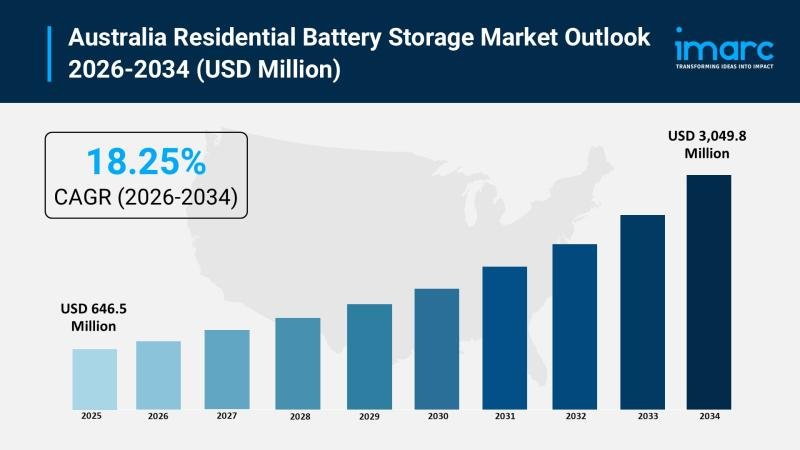
The Australia residential battery storage market size reached USD 646.5 Million in 2025 and is projected to reach USD 3,049.8 Million by 2034, exhibiting a growth rate (CAGR) of 18.25% during 2026-2034. The market is primarily driven by high rooftop solar adoption and supportive state-level incentive schemes, with feed-in tariff adjustments and cost-reduction trends further fueling product adoption. Increasing grid reliability concerns are elevating overall system demand, while energy price volatility, policy incentives, and growing consumer interest in energy independence are collectively strengthening market participation. The convergence of smart home energy management technology integration, emerging Virtual Power Plant aggregation models, and ongoing battery chemistry innovation positions the sector for robust, sustained expansion throughout the forecast period.
Request for a sample report PDF: https://www.imarcgroup.com/australia-residential-battery-storage-market/requestsample
Australia Residential Battery Storage Market Summary
• Strong growth is being driven by rapid rooftop solar adoption across households, making battery storage a natural extension of solar systems
• Increasing electricity price volatility and cost-saving awareness are pushing consumers toward energy self-sufficiency
• Government incentives, rebates, and feed-in tariff changes are accelerating battery adoption
• Rising concerns around grid reliability and outages are boosting demand for backup energy solutions
• Market segmentation includes battery type (lithium-ion dominant), capacity range, ownership models, and sales channels
• Consumers are shifting toward integrated home energy management systems combining solar + storage
• Competitive landscape includes battery manufacturers, solar installers, energy retailers, and tech-enabled startups
• Emerging technologies such as virtual power plants (VPPs) and vehicle-to-grid (V2G) are reshaping market dynamics
• Residential battery penetration remains relatively low, indicating significant untapped market potential
How AI is Reshaping the Australia Residential Battery Storage Market
Artificial intelligence is increasingly central to the Australia residential battery storage market, enabling manufacturers, energy retailers, grid operators, and homeowners to maximize system performance, optimize energy cost savings, and integrate distributed storage assets into a smarter, more responsive national energy network.
• Smart Energy Optimization: AI enables real-time control of battery charge/discharge and appliance usage, helping households maximize solar consumption and reduce electricity costs.
• Predictive Solar & Battery Management: Machine learning forecasts solar output, weather, and pricing trends to optimize when energy is stored, used, or exported.
• Virtual Power Plants (VPPs): AI aggregates thousands of home batteries into a unified system, enabling grid support and allowing households to earn from energy trading.
• Battery Health Monitoring: AI tracks performance and predicts degradation, improving lifespan, reliability, and maintenance efficiency.
• Personalized System Sizing: AI tools analyze energy usage and solar capacity to recommend optimal battery sizes, improving ROI and user satisfaction.
• Real-Time Energy Insights: Integration with IoT and smart meters gives homeowners detailed visibility into energy generation, storage, and consumption.
• Grid Stability Support: AI helps grid operators use residential batteries to manage demand, stabilize voltage, and reduce infrastructure strain.
Key Trends Shaping the Australia Residential Battery Storage Market:
• Rooftop solar growth is the foundational demand driver for residential battery adoption, with Australian homeowners in New South Wales, Queensland, and South Australia increasingly evaluating integrated solar-plus-storage solutions as declining feed-in tariffs reduce the financial benefit of grid export – shifting the value proposition firmly toward energy self-consumption and on-site storage that delivers measurable savings against consistently rising electricity retail prices.
• Government incentive programs are materially accelerating adoption trajectories, with Australia’s Clean Energy Council reporting that over 28,000 residential battery systems were installed in 2024 – a 30% year-on-year increase – bringing total household battery installations to 121,551, driven in part by zero-interest loans in the Australian Capital Territory and ongoing programs including South Australia’s Home Battery Scheme and Victoria’s Solar Homes Program.
• A landmark federal subsidy commitment signals major policy support for the sector, with the Australian Labor Party pledging a AUD 2.3 billion national home battery subsidy program in April 2025 – targeting the installation of one million units by 2030 through rebates of up to AUD 4,000 per system – directly addressing the cost barrier that currently limits battery adoption to only 2.5% of solar-equipped Australian homes.
• Smart home energy management integration is elevating system value propositions, as AI and machine learning-powered platforms automate consumption optimization, solar dispatch, and appliance scheduling – transforming residential batteries from passive backup devices into intelligent energy management hubs that deliver continuous financial returns and enhance household energy resilience throughout the daily demand cycle.
• Virtual Power Plant participation is reshaping the household energy value model, as utility and technology partnerships enable battery-owning homeowners to connect their stored energy to broader grid networks – earning financial returns by contributing capacity during peak demand events while supporting renewable energy integration and grid stability objectives aligned with Australia’s national clean energy transition goals.
• Lithium-ion battery cost reductions and technological innovation are broadening the addressable market, with advances in energy density, modular system architecture, mobile app integration, and AI-driven optimization continuously improving battery performance and return on investment – making residential storage increasingly compelling for the large segment of Australian solar households that have not yet adopted storage due to upfront cost concerns.
• New product launches are expanding system flexibility and consumer choice, with Anker SOLIX entering the Australian market in March 2025 through a partnership with Blue Sun Group – introducing the SOLIX X1 system featuring modular capacity from 5 kWh to 180 kWh and AC coupling for retrofit compatibility, targeting the approximately 90% of Australian homes that currently do not adopt energy storage due to high costs and limited system flexibility.
Browse the full report with TOC and list of figures: https://www.imarcgroup.com/australia-residential-battery-storage-market
Market Growth Drivers
Surging Electricity Prices, Solar Self-Consumption Shift, and Policy-Driven Cost Reduction
The Australia residential battery storage market growth is anchored in the persistent upward trajectory of household electricity prices – with Australian homeowners facing average annual electricity bills of approximately AUD 2,500 – creating powerful financial incentives to maximize solar self-consumption and reduce grid dependence through residential battery investment. The progressive reduction and restructuring of feed-in tariffs across major states has shifted the solar economics equation decisively in favor of on-site storage, driving homeowners to evaluate battery systems as essential complements to existing rooftop solar installations. Government incentive programs at both federal and state levels are directly addressing the upfront cost barrier that has constrained adoption – with the proposed national home battery subsidy program, zero-interest loan schemes, and state-level rebate initiatives collectively accelerating the transition toward broader household energy storage penetration throughout the 2026-2034 forecast period.
Technological Advancement, VPP Aggregation, and Grid Reliability Imperatives
Rapid innovation in lithium-ion battery chemistry, modular system design, AI-powered energy management, and smart home integration is continuously improving the performance, usability, and financial returns of residential battery systems – broadening consumer appeal beyond early adopters to mainstream Australian households seeking long-term energy cost management and resilience. The emergence of Virtual Power Plant aggregation models is transforming the residential battery value proposition by enabling homeowners to generate additional revenue streams from stored energy – aligning individual financial incentives with national grid stability and renewable energy integration objectives. Increasing frequency of grid reliability events, combined with Australia’s ambitious clean energy transition targets and record-high renewable electricity generation on the national grid, further reinforces the strategic importance of distributed residential storage as a core infrastructure component of Australia’s evolving decentralized energy system.
Market Segmentation
IMARC Group’s research categorizes the Australia residential battery storage market as follows:
By Battery Type:
• Lithium-ion Batteries
• Lead-acid Batteries
• Others
By Capacity:
• Below 5 kWh
• 5-10 kWh
• 10-20 kWh
• Above 20 kWh
By Ownership Model:
• Customer-owned Systems
• Third-party Owned/Leasing Models
By Sales Channel:
• Direct Sales
• Distributors/Dealers
• Online Retail
By Application:
• Backup Power Supply
• Solar Energy Storage
• Off-grid Systems
• Others
By Region:
• Australia Capital Territory & New South Wales
• Victoria & Tasmania
• Queensland
• Northern Territory & Southern Australia
• Western Australia
Key Players
The Australia residential battery storage market features competition among global battery manufacturers, energy service companies, utility-backed VPP operators, and emerging fintech-enabled energy platforms offering integrated solar-plus-storage solutions. The market research report provides a comprehensive analysis of the competitive landscape including key player positioning, market structure, top winning strategies, competitive dashboards, and detailed company profiles.
Key Aspects Required for Australia Residential Battery Storage Market
• Demand is driven primarily by solar-equipped households and energy-conscious consumers
• Strong linkage between solar PV installations and battery adoption rates
• Product segmentation includes lithium-ion, lead-acid, and emerging battery chemistries
• Increasing preference for modular and scalable battery systems
• Consumers prioritize energy independence, cost savings, and backup reliability
• Growing demand for real-time monitoring and mobile-based energy control apps
• Competitive landscape includes global battery brands, local installers, and integrated energy providers
• Distribution channels include direct sales, solar installers, utilities, and online platforms
• Expansion of bundled offerings (solar + battery + energy plans)
• Rising investment in home electrification and decarbonization solutions
• Supply chain includes battery manufacturers, inverter providers, installers, and software providers
• Increasing role of government subsidies in lowering upfront installation costs
• Growing adoption in urban and suburban regions, especially high solar penetration states
• Integration with EV charging infrastructure and smart grids
• Rising demand for resilient power systems during extreme weather events
• Expansion of energy-as-a-service business models
• Increasing focus on battery recycling and sustainability practices
Recent News and Developments
• April 2025: The Australian Labor Party proposed the “Cheaper Home Batteries Program”, a AUD 2.3 billion initiative offering rebates of up to AUD 4,000 per household battery system. The scheme aims to reduce upfront costs by ~30% and support installation of up to one million home batteries by 2030.
• July 2025: The national home battery subsidy program was officially launched, significantly accelerating residential battery adoption and making storage systems more financially accessible for households.
• September 2025: Australia witnessed strong momentum in residential battery adoption, with distributed battery capacity projections rising to 3.0-3.5 GW, reflecting growing consumer shift toward energy storage and self-consumption.
• September 2025: The Small-scale Renewable Energy Scheme (SRES) expansion enabled broader eligibility for home battery systems, with over 124,000 installations recorded by November 2025, many retrofitted to existing rooftop solar setups.
• December 2025: The federal battery subsidy program was expanded significantly, increasing total funding allocation to AUD 7.2 billion, reinforcing long-term government commitment to residential energy storage adoption.
• December 2025: Australia recorded a historic surge in home battery installations, with over 183,000 units installed in just six months, exceeding the total installations of the previous four years combined.
• January 2026: Total household battery installations surpassed 200,000 units, driven by subsidy schemes and rising demand for energy independence and backup solutions.
• February 2026: Reports indicated that Australian households installed as many batteries in late 2025 as in the previous five years combined, highlighting an unprecedented demand surge fueled by subsidies and rising electricity costs.
• March 2026: The federal rebate program continued to deliver strong results, with approximately 280,000 residential batteries installed nationwide since mid-2025, confirming the effectiveness of policy-driven adoption.
• March 2026: Broader energy market trends, including increased renewable energy generation and battery storage integration, contributed to expected reductions in electricity prices, further strengthening the value proposition of residential battery systems.
Note: If you require any specific information that is not covered currently within the scope of the report, we will provide the same as a part of the customization.
Speak to an analyst for a customized sample report: https://www.imarcgroup.com/request?type=report&id=34494&flag=C
Contact Us
IMARC Group
134 N 4th St., Brooklyn, NY 11249, USA
Email: sales@imarcgroup.com
Tel. No.: (D) +91 120 433 0800
United States: +1-201-971-6302
About Us
IMARC Group is a global management consulting firm that helps the world’s most ambitious changemakers to create a lasting impact. The company provides a comprehensive suite of market entry and expansion services. IMARC offerings include thorough market assessment, feasibility studies, company incorporation assistance, factory setup support, regulatory approvals and licensing navigation, branding, marketing and sales strategies, competitive landscape and benchmarking analyses, pricing and cost research, and procurement research.
This release was published on openPR.