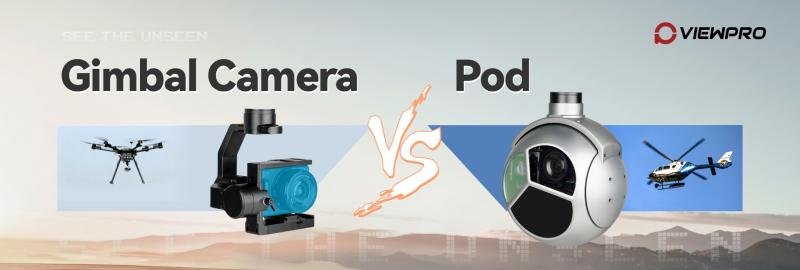
Image: https://www.viewprouav.com/uploads/Gimbal-Camera-vs.Pod_.jpg
What’s the difference between gimbal camera and pod? According to traditional view of UAV industry, here are the differences:
Feature
Gimbal Camera
Pod
Core Functionality
Provides camera stabilization to reduce vibration and shake
Integrates multiple devices (e.g., cameras, sensors) for stable shooting and multi-task execution
Design
Typically separate camera and gimbal system, simple and portable
An integrated, sealed/semi-sealed unit, often containing multiple sensors and cameras
Stability
Primarily relies on the gimbal system to provide three-axis stabilization
The pod provides more comprehensive stability, possibly incorporating additional sensors and adaptive systems
Application Scenarios
Drones, handheld devices, film production, commercial drones, etc.
Military, law enforcement, aerial reconnaissance, high-end film production, long-duration surveillance tasks, etc.
Portability
Lightweight and portable, adaptable to a variety of platforms and environments
Typically bulkier and fixed to aircraft or other platforms
Functionality
Primarily offers camera stabilization, with some models featuring additional functions (e.g., tracking, angle adjustment)
Integrates various sensors and task execution systems, offering features like tracking, targeting, and thermal imaging
Price & Complexity
Relatively simple and cost-effective
More complex, generally more expensive, with a wide range of functions
Summary:
Gimbal Camera: Gimbal cameras are primarily designed to provide stabilization for the camera, ensuring smooth and clear footage. Their portability and versatility make them suitable for various platforms, such as drones, handheld devices, and film production. Common terms include Gimbal Camera or Stabilized Camera.
Pod: Pods not only include cameras and gimbal systems but also integrate multiple sensors (such as thermal imaging, radar, etc.), capable of performing a variety of tasks like target tracking, aiming, and environmental monitoring. Pods are widely used in high-end fields such as military, law enforcement, and aerial reconnaissance, and are typically mounted on aircraft. Common terms include Pod, Turret, or Camera Pod, and when a gimbal is included, it is called a Gimbaled Pod.
Key Differences Between Gimbal Camera and Pod:
* Functionality & Complexity: Gimbal cameras focus on image stabilization, making them suitable for a wide range of flexible applications. Pods, however, are integrated, multi-functional systems that include a variety of sensors and task execution capabilities, designed for more complex and specialized uses.
* Application Scenarios: Gimbal cameras are commonly used for general filming and portable tasks, while pods, with their higher integration and powerful capabilities, are typically deployed in military, law enforcement, and advanced surveillance applications.
* Portability: Gimbal cameras are lightweight and flexible, adaptable to different platforms, whereas pods are typically bulkier and fixed, designed for long-term and professional use in specific environments.
However, with the popularization of civilian UAV in recent years, gimbal camera and pod are not so well-defined in this industry. Viewpro, as a representative of industrial UAV paylaod manufacturer, has redefined pod and gimbal cameras with the cutting-edge integration capability. “The Z series with box shape design, is gimbal camera. The U and Q series which are with ball shape are pods.” Introdduced by Steven, CTO of Viewpro. Thousands of Viewpro products are now serving in various civilian domains all around the word.
This Article is From ViewPro Another Website: What are the Differences Between Gimbal Camera and Pod? [https://www.viewproonline.com/blogs/industry-news/gimbal-camera-vs-pod-a-comprehensive-comparison-and-application-analysis]
Media Contact
Company Name: ViewproUAV
Email:Send Email [https://www.abnewswire.com/email_contact_us.php?pr=what-are-the-differences-between-gimbal-camera-and-pod]
Country: China
Website: https://www.viewprouav.com/
Legal Disclaimer: Information contained on this page is provided by an independent third-party content provider. ABNewswire makes no warranties or responsibility or liability for the accuracy, content, images, videos, licenses, completeness, legality, or reliability of the information contained in this article. If you are affiliated with this article or have any complaints or copyright issues related to this article and would like it to be removed, please contact retract@swscontact.com
This release was published on openPR.