U.S. Gaming Market Projected to Reach USD 108.1 Billion by 2034, Driven by E-Sports Expansion, Mobile Gaming Adoption, and AR/VR Innovation
The rapid growth of mobile gaming platforms, increasing participation in competitive e-sports tournaments, and the integration of augmented reality (AR) and virtual reality (VR) technologies are significantly transforming the landscape of the United States gaming market, driving innovation, user engagement, and revenue expansion across console, PC, mobile, and cloud-based gaming segments nationwide.
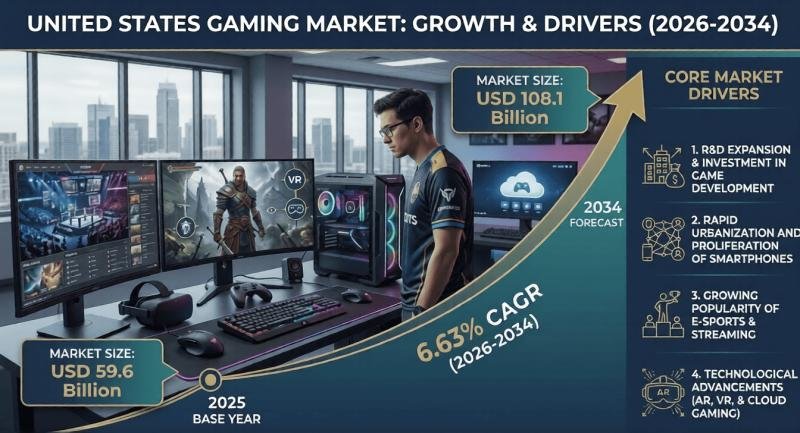
BROOKLYN, NY – (February 27, 2026) – According to a comprehensive new market research study published by IMARC Group, the United States gaming market is projected to reach a valuation of USD 108.1 Billion by 2034. The report reveals that the market was valued at USD 59.6 Billion in 2025. This growth trajectory represents a compound annual growth rate (CAGR) of 6.63% during the forecast period from 2026 to 2034.
The U.S. gaming industry continues to evolve as a major pillar of the digital entertainment economy, spanning console gaming, PC gaming, mobile gaming, cloud gaming, and e-sports. Rising smartphone penetration, improved internet connectivity, growing urbanization, and immersive gameplay experiences are driving consistent expansion.
Explore Growth Opportunities in the United States Gaming Market – Grab Your Sample Report for Evaluation: https://www.imarcgroup.com/united-states-gaming-market/requestsample
Key Market Statistics 2026-2034
• Market Size 2025: USD 59.6 Billion
• Projected Market Size 2034: USD 108.1 Billion
• Compound Annual Growth Rate (CAGR) 2026-2034: 6.63%
• Publisher: IMARC Group
Key Trends and Growth Drivers Shaping the U.S. Gaming Market 2026:
The report highlights several transformative trends and growth drivers supporting the expansion of the U.S. gaming sector:
• Mobile Gaming Dominance: The proliferation of smartphones and tablets has significantly increased casual and competitive gaming participation.
• Rise of E-Sports and Streaming Platforms: Professional gaming tournaments, live streaming, and digital content monetization are expanding audience engagement.
• Integration of AR and VR Technologies: Immersive gameplay experiences are enhancing user engagement and expanding premium gaming segments.
• Cloud Gaming Expansion: Subscription-based and cloud-enabled platforms are reducing hardware dependency and broadening accessibility.
• Digital Distribution and In-Game Monetization: Microtransactions, downloadable content (DLC), and subscription models are boosting recurring revenue streams.
Secure Your Complete Market Report – Buy Now: https://www.imarcgroup.com/checkout?id=9497&method=3990
United States Gaming Market Segmentation Insights 2026
The IMARC Group report delivers in-depth insights into the U.S. gaming market size by device type, platform, revenue model, and regional outlook, helping investors and stakeholders identify high-growth opportunities.
Breakup by Device Type
• Consoles – High-performance gaming systems offering immersive graphics, exclusive titles, and premium multiplayer experiences.
• Mobiles and Tablets – Fastest-growing segment driven by smartphone penetration, casual gaming apps, and in-app purchases.
• Computer – Popular among competitive gamers, offering advanced graphics customization and e-sports compatibility.
Breakup by Platform
• Online – Multiplayer gaming, cloud streaming, digital downloads, and subscription-based gaming ecosystems.
• Offline – Physical game copies and single-player experiences without continuous internet connectivity.
Breakup by Revenue Type
• In-Game Purchase – Microtransactions, cosmetic upgrades, battle passes, and downloadable expansion content.
• Game Purchase – One-time payment model for full-access digital or physical game ownership.
• Advertising – Revenue generated through in-app ads, rewarded videos, and branded integrations.
Breakup by Type (Genre)
• Adventure / Role-Playing Games – Story-driven gameplay with character development, missions, and immersive virtual worlds.
• Puzzles – Casual, skill-based games focusing on problem-solving and short gameplay sessions.
• Social Games – Multiplayer games emphasizing social interaction, collaboration, and online connectivity.
• Strategy – Tactical planning games requiring resource management and competitive decision-making skills.
• Simulation – Real-life scenario-based games replicating sports, driving, construction, or lifestyle activities.
• Others – Includes action, sports, arcade, and emerging hybrid gaming genres.
Breakup by Age Group
• Adult – Core revenue-driving segment with higher spending on premium and competitive games.
• Children – Rapidly expanding segment focused on educational, creative, and parental-controlled gaming.
Breakup by Region
• Northeast – Strong digital infrastructure and growing e-sports participation rates.
• Midwest – Expanding gaming communities and increasing mobile gaming adoption.
• South – High population growth driving console and online gaming demand.
• West – Technology hub with strong presence of major gaming developers and innovators.
Accelerated Shift Toward Immersive and Digital-First Gaming Ecosystems
The U.S. gaming industry is increasingly adopting next-generation technologies including AR, VR, artificial intelligence (AI), and real-time cloud streaming. These innovations are reshaping gameplay experiences, enabling hyper-personalization, and improving content recommendation systems.
Simultaneously, blockchain-based gaming assets, digital collectibles, and metaverse-driven virtual environments are gaining traction, expanding monetization and engagement opportunities for developers and publishers.
Get a Customized Market Report – Connect with an Expert Analyst: https://www.imarcgroup.com/request?type=report&id=9497&flag=C
United States Gaming Market News
• June 2024: Relax Gaming’s U.S.-focused brand, RLX Gaming, partnered with BetMGM to officially launch operations in Pennsylvania, marking its second state-level expansion in the United States gaming market and strengthening its footprint in the regulated online gaming ecosystem.
• May 2024: Evolution, a leading B2B provider of online gaming solutions, introduced its Video online game across the United States, expanding its portfolio of digital gaming offerings and enhancing player engagement nationwide.
• January 2024: Betr Holdings, Inc. secured additional market access agreements to expand its online sportsbook and gaming presence in Pennsylvania, along with launching online sportsbook operations in Colorado and Kentucky, reinforcing its multi-state growth strategy within the United States gaming market.
Market Intelligence to Support Strategic Planning
Executives engaging with this report typically arrive with one of these pressing questions:
1. Which gaming segments will generate the highest revenue growth through 2034?
2. How will AR, VR, and cloud gaming impact traditional console and PC gaming markets?
3. What monetization models will dominate the U.S. gaming ecosystem?
4. Which U.S. regions present the strongest growth potential for e-sports and mobile gaming?
5. How can gaming companies enhance user retention and lifetime value (LTV)?
Author IMARC Group
IMARC Group is a leading global market research company providing data-driven insights and expert consulting services to businesses seeking to achieve their strategic objectives. With a multidisciplinary team of industry experts, IMARC delivers reliable market intelligence across sectors including Chemicals and Materials, Healthcare, Technology, Agriculture, and Retail.
Contact Us:
IMARC Group
Email: sales@imarcgroup.com
Tel No:(D) +91 120 433 0800
United States: +1-201971-6302
This release was published on openPR.