Embedded AI Market
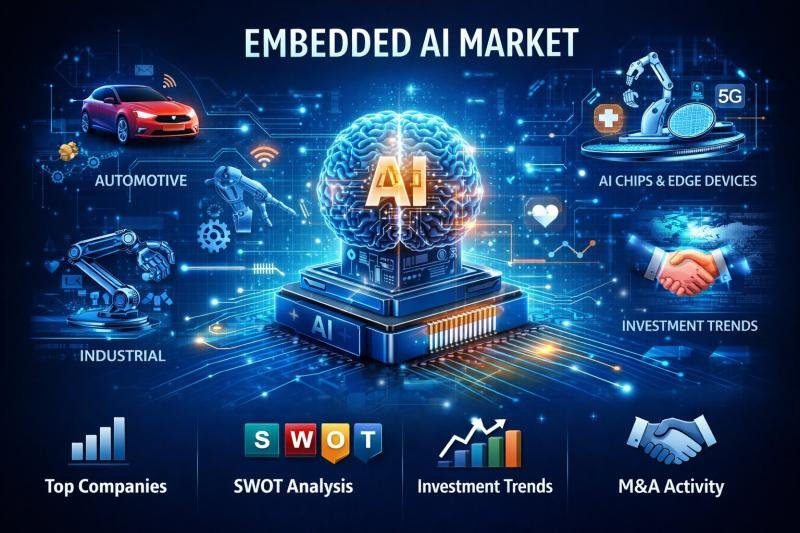
The Embedded AI Market is rapidly transforming industries by enabling intelligent decision-making directly on devices without relying on cloud connectivity. By integrating artificial intelligence capabilities into hardware such as sensors, microcontrollers, and edge devices, embedded AI is powering applications across automotive, consumer electronics, healthcare, and industrial automation. As demand for real-time processing, low latency, and enhanced data privacy grows, embedded AI is becoming a critical component of next-generation digital systems.
➤ Request Free Sample PDF Report @ https://www.researchnester.com/sample-request-5715
Top Companies & Their Strategies
1. NVIDIA
NVIDIA is a dominant force in embedded AI, particularly through its Jetson platform, which enables AI at the edge for robotics, autonomous machines, and smart cities. Its strength lies in high-performance GPUs and a robust AI software ecosystem. NVIDIA’s focus on developer tools and AI frameworks enhances adoption across industries. Its leadership in AI hardware innovation gives it a strong competitive advantage.
2. Intel
Intel offers embedded AI solutions through its processors, Movidius vision processing units (VPUs), and OpenVINO toolkit. The company’s strategy focuses on enabling AI across edge devices with optimized hardware and software integration. Intel’s global presence and established enterprise relationships strengthen its market position. Its investments in edge computing and AI acceleration technologies further enhance its capabilities.
3. Qualcomm
Qualcomm is a key player in embedded AI, particularly in mobile and IoT devices. Its Snapdragon platforms integrate AI engines that enable on-device intelligence for smartphones, automotive systems, and wearables. Qualcomm’s strength lies in energy-efficient processing and strong presence in consumer electronics. Its leadership in 5G technology also supports advanced embedded AI applications.
4. Texas Instruments
Texas Instruments provides embedded processors and microcontrollers with integrated AI capabilities. Its focus on industrial and automotive applications gives it a strong foothold in these sectors. The company’s cost-effective solutions and long product lifecycles make it attractive for embedded system developers. Its extensive portfolio supports a wide range of use cases.
➤ Explore detailed profiles of top players and new entrants in this space – access your free sample report → https://www.researchnester.com/sample-request-5715
5. STMicroelectronics
STMicroelectronics is known for its microcontrollers and sensors with embedded AI capabilities. Its STM32 platform enables edge AI applications in IoT, industrial automation, and consumer devices. The company’s strength lies in low-power processing and strong presence in Europe and Asia. Its focus on integrating AI into microcontrollers enhances its competitive positioning.
6. ARM Holdings
ARM Holdings provides the underlying architecture for many embedded AI devices. Its IP-based business model enables widespread adoption across the semiconductor ecosystem. ARM’s focus on energy-efficient processing and scalable designs makes it a key enabler of embedded AI. Its partnerships with chip manufacturers strengthen its global reach.
7. Google
Google is advancing embedded AI through its Edge TPU and TensorFlow Lite platforms. Its strategy focuses on enabling AI inference on edge devices with optimized performance. Google’s strength lies in its AI expertise and developer ecosystem. Its integration of AI tools with cloud services enhances its value proposition.
8. Apple
Apple integrates embedded AI into its devices through its Neural Engine, enabling features such as facial recognition and on-device processing. Its strength lies in vertical integration of hardware and software, ensuring optimized performance and user experience. Apple’s focus on privacy and on-device intelligence differentiates it in the market.
➤ View our Embedded AI Market Report Overview here: https://www.researchnester.com/reports/embedded-ai-market/5715
SWOT Analysis
Strengths
Leading companies in the embedded AI market benefit from strong expertise in semiconductor design, AI algorithms, and hardware-software integration. Their ability to deliver real-time processing and low-latency performance enhances the value of embedded AI solutions. Many players have established global supply chains and partnerships, enabling scalability and market reach. Additionally, continuous innovation in AI chips and edge computing strengthens their competitive advantage.
Weaknesses
Despite their strengths, embedded AI solutions face challenges related to high development costs and complexity. Designing and deploying AI models on resource-constrained devices requires specialized expertise. Some companies also face limitations in interoperability and standardization across platforms. Additionally, dependence on semiconductor supply chains can create vulnerabilities in production and delivery.
Opportunities
The growing adoption of IoT, smart devices, and autonomous systems presents significant opportunities for embedded AI providers. Increasing demand for real-time analytics, predictive maintenance, and intelligent automation is driving market growth. Emerging applications in healthcare, automotive, and smart cities offer new avenues for innovation. Expansion into emerging markets, where digital transformation is accelerating, provides additional growth potential.
Threats
The embedded AI market faces intense competition among semiconductor companies and technology providers. Rapid technological advancements require continuous investment in R&D to remain competitive. Regulatory challenges related to data privacy and AI ethics can impact adoption. Additionally, geopolitical tensions and supply chain disruptions pose risks to the semiconductor industry.
➤ Interested in a customized SWOT for your target competitor? Request your tailored assessment → https://www.researchnester.com/sample-request-5715
Investment Opportunities & Trends
The embedded AI market is attracting significant investment as industries prioritize edge intelligence and real-time decision-making. Several key trends are shaping the investment landscape:
1. Growth of Edge AI and IoT Integration
Investments are increasingly focused on integrating AI capabilities into edge devices and IoT systems. Companies like NVIDIA and Intel are leading this trend by developing powerful edge AI platforms. This integration enables real-time analytics and reduces reliance on cloud infrastructure.
2. AI Chip Innovation and Custom Silicon
The development of specialized AI chips is a major investment area. Qualcomm and Apple are investing heavily in custom silicon to optimize performance and energy efficiency. This trend is driving innovation in embedded AI hardware.
3. Expansion in Automotive and Industrial Applications
Automotive and industrial sectors are attracting significant investment due to the adoption of autonomous systems and smart manufacturing. Texas Instruments and STMicroelectronics are well-positioned to capitalize on these opportunities. Embedded AI is enabling advanced driver assistance systems (ADAS) and predictive maintenance solutions.
4. Mergers and Acquisitions (M&A) Activity
The market has seen increased M&A activity as companies seek to expand their AI capabilities and product portfolios. Semiconductor firms and technology companies are acquiring startups specializing in AI chips, edge computing, and software optimization. ARM Holdings continues to play a central role in enabling ecosystem-wide innovation through partnerships and collaborations.
5. Startup Funding and Ecosystem Development
Venture capital is flowing into startups focused on edge AI, low-power processing, and AI model optimization. These startups are addressing challenges such as scalability, cost efficiency, and deployment complexity. The rise of AI development platforms and tools is also attracting investment.
6. Regional Expansion and Emerging Markets
Asia-Pacific is emerging as a key region for embedded AI adoption, driven by strong semiconductor manufacturing and growing demand for smart devices. Companies are expanding their presence in this region to capture new opportunities. Government initiatives supporting AI and digital transformation are further driving investment.
7. Product Innovation and AI Model Optimization
Recent product launches have focused on improving AI model efficiency and enabling deployment on resource-constrained devices. Google continues to innovate with tools like TensorFlow Lite, enabling developers to deploy AI models on edge devices. Advances in model compression and optimization are enhancing performance and scalability.
➤ Request Free Sample PDF Report @ https://www.researchnester.com/sample-request-5715
➤ Related news:
https://www.linkedin.com/pulse/what-driving-rapid-expansion-b2b-saas-market-rida-patel-q8dvf/
https://www.linkedin.com/pulse/stem-cell-assay-market-size-regional-status-outlook-2026-2035-patel-jv7qf/
Contact Data
AJ Daniel
Corporate Sales, USA
Research Nester
77 Water Street 8th Floor, New York, 10005
Email: info@researchnester.com
USA Phone: +1 646 586 9123
Europe Phone: +44 203 608 5919
About Research Nester
Research Nester is a one-stop service provider with a client base in more than 50 countries, leading in strategic market research and consulting with an unbiased and unparalleled approach towards helping global industrial players, conglomerates and executives for their future investment while avoiding forthcoming uncertainties. With an out-of-the-box mindset to produce statistical and analytical market research reports, we provide strategic consulting so that our clients can make wise business decisions with clarity while strategizing and planning for their forthcoming needs and succeed in achieving their future endeavors. We believe every business can expand to its new horizon, provided a right guidance at a right time is available through strategic minds.
This release was published on openPR.