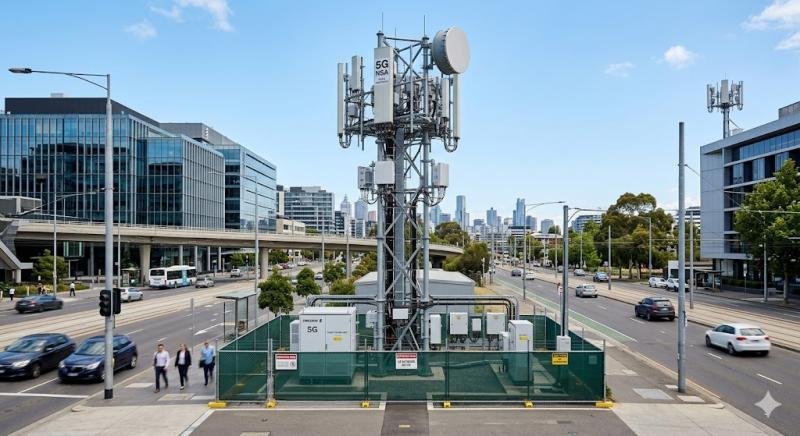
5G Infrastructure Market
“The Global 5G Infrastructure Market is expected to grow at a CAGR of 76.29% during the forecast period 2024-2031”
DataM Intelligence unveils exclusive insights into the 5G Infrastructure Market 2026, highlighting emerging trends, growth drivers, and key regional opportunities worldwide. The report empowers manufacturers, suppliers, and industry professionals with data-driven intelligence to stay ahead of market shifts. It helps solve critical business challenges by identifying high-growth segments and reducing investment risks through actionable forecasts. With in-depth competitive benchmarking, it enables smarter strategies and confident decision-making.
Download your exclusive sample report today: (corporate email gets priority access):
https://www.datamintelligence.com/download-sample/5g-infrastructure-market?prasad
United States: Recent 5G Infrastructure Developments
✅ March 2026 – AT&T announces $250 billion network investment plan.
AT&T revealed a five‐year plan to invest $250 billion in U.S. telecom infrastructure, including significant build‐out of 5G networks alongside fiber and satellite links. The initiative aims to improve coverage in urban, suburban, and rural markets while supporting emerging AI‐driven and high‐capacity use cases.
✅ Early 2026 – Telecom operators intensify 5G deployment amid competition.
Major carriers including Verizon, T‐Mobile, and AT&T are expanding 5G coverage and upgrading mid‐band and millimeter‐wave infrastructure to handle growing data demand and differentiate service offerings. Increased leasing of tower sites reflects strong industry commitment to densifying 5G networks.
✅ Late 2025 – early 2026 – U.S. carriers pursue advanced 5G and SA rollout.
U.S. operators are accelerating deployment of 5G Standalone (SA) technology, which relies on dedicated 5G core networks to unlock full 5G performance, improve latency, and expand enterprise use cases as coverage approaches nationwide levels.
✅ 2026 – Satellite and non‐terrestrial networks complement 5G coverage.
Partnerships and technology development in satellite cellular connectivity (e.g., Starlink integrated with carrier networks) aim to reduce coverage gaps, extending 5G‐capable connectivity to remote or underserved areas.
Japan: Recent 5G Infrastructure Developments
✅ February 2026 – NTT Docomo maintains accelerated 5G base station rollout.
NTT Docomo reported that its 2026 fiscal year 5G base station deployment will continue at approximately three times the pace of the previous period, targeting broader urban coverage and improved throughput performance in major cities.
✅ Early 2026 – Local governments partner on expanded 5G infrastructure.
Regional authorities, such as Tokyo’s digital services bureau, have adopted collaborative models using public and private assets to accelerate 5G network construction, aiming to support smart city applications and enhanced connectivity for residents.
✅ 2026 – Satellite‐based NTN systems draw increasing attention.
Japan’s telecom sector is exploring Non‐Terrestrial Network (NTN) technologies, including satellites and high‐altitude platforms, to enhance coverage in terrain‐challenged and remote locations, supporting resilient communications beyond traditional terrestrial base stations.
✅ Early 2026 – Operators focus on 5G quality and SA deployment.
Telecom carriers are shifting deployment emphasis from pure 5G coverage counts toward quality of service and Stand Alone (SA) core adoption to deliver low‐latency, high‐capacity services for industrial and next‐generation digital use cases.
5G Infrastructure Market: Drivers
5G infrastructure deployment is expanding rapidly, driven by demand for high-speed connectivity and low-latency applications. Telecom operators are investing heavily to support IoT, autonomous systems, and smart industries. Enterprise adoption is unlocking new revenue streams beyond traditional telecom services. Government support and spectrum allocation are accelerating rollout timelines. This positions 5G as a backbone for digital transformation across sectors.
Get Customization in the report as per your requirements:
https://www.datamintelligence.com/customize/5g-infrastructure-market?prasad
5G Infrastructure Market: Major Players
HP, Intel, Oracle, Qualcomm Inc, Samsung, Ericsson, Huawei, Cavium, and Mediatek
The 5G Infrastructure Market is witnessing accelerated growth, driven by leading technology and telecom players such as HP, Intel, Oracle, Qualcomm Inc, and Samsung. These companies are enabling next-generation connectivity through advancements in cloud-native network architecture, high-performance chipsets, and scalable computing infrastructure. Their innovations are supporting faster data transmission, reduced latency, and enhanced network capacity, which are critical for emerging applications such as IoT, autonomous systems, and smart cities. This report provides strategic insights that help these organizations align with evolving spectrum policies, infrastructure investments, and enterprise demand, strengthening their competitive positioning within the 5G Infrastructure Market.
At an ecosystem level, telecom equipment providers and semiconductor innovators including Ericsson, Huawei, Cavium, and MediaTek are enhancing the deployment and scalability of 5G networks within the 5G Infrastructure Market. These companies contribute critical capabilities such as radio access networks, baseband processing, and system-on-chip solutions that enable seamless connectivity across devices and platforms. Their combined expertise ensures efficient network rollout, improved energy efficiency, and cost optimization for telecom operators. The synergy among these players fosters a highly competitive and innovation-driven environment, accelerating global 5G adoption and infrastructure expansion.
Segment Covered in the 5G Infrastructure Market:
By Communication Infrastructure
The market is segmented into radio access network (RAN) 30%, small cells 25%, macro cells 20%, distributed antenna systems (DAS) 15%, and network functions virtualization infrastructure (NFVI) 10%, with RAN dominating due to its central role in enabling wireless communication and network coverage. Small cells are rapidly growing to support dense urban connectivity and 5G deployment. Macro cells remain essential for wide-area coverage, while DAS improves indoor connectivity. NFVI is gaining traction with network virtualization and cloud-based architectures.
By Chip Set Type
Chip set types include radio frequency integrated circuits (RFIC) 35%, application specific integrated circuits (ASIC) 30%, millimeter wave technology chips 20%, and field programmable gate arrays (FPGA) 15%, with RFICs dominating due to their critical role in wireless communication and signal transmission. ASICs are widely used for performance optimization in telecom equipment. Millimeter wave chips are growing with 5G adoption, while FPGAs support flexibility and rapid prototyping. Increasing demand for high-speed connectivity drives segment growth.
By Application
Applications include consumer electronics 30%, industrial 20%, automotive 15%, public infrastructure 15%, building & construction 10%, retail 5%, and healthcare 5%, with consumer electronics dominating due to widespread use of connected devices and smartphones. Industrial applications are expanding with Industry 4.0 initiatives. Automotive and public infrastructure are growing with smart mobility and smart city projects. Increasing digital transformation across industries supports demand.
Regional Analysis
North America – 30% Share
North America leads with 30% share driven by early adoption of 5G technologies in the United States and Canada. RAN, small cells, and RFIC chipsets dominate. Consumer electronics and industrial applications lead demand. Strong telecom infrastructure and investments in network modernization support growth.
Europe – 25% Share
Europe holds 25% share due to strong telecom advancements in Germany, the UK, and France. RAN and DAS are widely deployed. RFIC and ASIC chipsets dominate. Consumer electronics and public infrastructure applications lead. Regulatory support and digital transformation initiatives drive market expansion.
Asia Pacific – 20% Share
Asia Pacific accounts for 20% share with rapid 5G deployment in China, Japan, South Korea, and India. Small cells and macro cells dominate infrastructure. RFIC and millimeter wave chips are widely used. Consumer electronics and industrial applications lead. Growing telecom investments support regional growth.
Latin America – 10% Share
Latin America holds 10% share with growing telecom infrastructure in Brazil and Mexico. Macro cells and RAN dominate. RFIC chipsets are widely used. Consumer electronics and public infrastructure applications lead. Expanding network coverage supports market development.
Middle East & Africa – 15% Share
The Middle East and Africa region records 15% share driven by telecom expansion in the UAE, Saudi Arabia, and South Africa. Macro cells and small cells dominate infrastructure. RFIC and ASIC chipsets lead. Public infrastructure and industrial applications are key contributors. Increasing investments in digital connectivity support market growth.
Buy Now & Unlock 360° Market Intelligence:
https://www.datamintelligence.com/buy-now-page?report=5g-infrastructure-market
Most Frequently Asked Questions in the 5G Infrastructure Market Research Industry:
➠ Who leads the 5G Infrastructure industry and what’s their competitive positioning regarding capacity, performance, and profitability?
➠ What growth opportunities and market challenges do 5G Infrastructure market vendors face?
➠ Which segments show the highest growth potential and market share distribution?
➠ What factors are driving or limiting 5G Infrastructure market growth?
➠ What are the dominant sales and distribution strategies in the 5G Infrastructure industry?
Request for 2 Days FREE Trial Access:
https://www.datamintelligence.com/reports-subscription?prasad
✅ Competitive Landscape
✅ Technology Roadmap Analysis
✅ Sustainability Impact Analysis
✅ KOL / Stakeholder Insights
✅ Consumer Behavior & Demand Analysis
✅ Import-Export Data Monitoring
✅ Live Market & Pricing Trends
Have a look at our Subscription Dashboard:
https://www.youtube.com/watch?v=x5oEiqEqTWg
Contact Us –
Company Name: DataM Intelligence
Contact Person: Sai Kiran
Email: Sai.k@datamintelligence.com
Phone: +1 877 441 4866
Website: https://www.datamintelligence.com
About Us –
DataM Intelligence is a Market Research and Consulting firm that provides end-to-end business solutions to organizations from Research to Consulting. We, at DataM Intelligence, leverage our top trademark trends, insights and developments to emancipate swift and astute solutions to clients like you. We encompass a multitude of syndicate reports and customized reports with a robust methodology.
Our research database features countless statistics and in-depth analyses across a wide range of 6300+ reports in 40+ domains creating business solutions for more than 200+ companies across 50+ countries; catering to the key business research needs that influence the growth trajectory of our vast clientele.
This release was published on openPR.