Millimeter Wave Technology
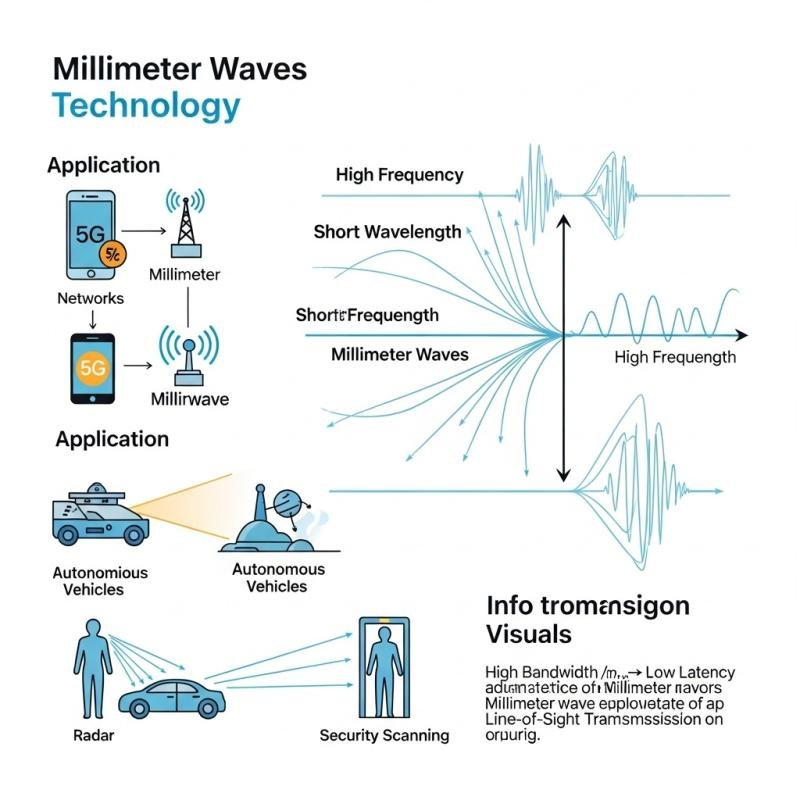
The global Millimeter Wave Technology Market reached US$2.44 billion in 2024, increasing from US$2.23 billion in 2023, and is expected to reach US$16.26 billion by 2033, growing at a CAGR of 18.6% during the forecast period 2025 to 2033. The market is experiencing rapid expansion as industries increasingly adopt high-frequency communication technologies to support next-generation wireless networks, high-speed data transmission, and advanced sensing applications. Millimeter wave technology operates within the 30 GHz to 300 GHz frequency spectrum and enables extremely high bandwidth, making it critical for emerging technologies such as 5G, autonomous vehicles, and high-resolution imaging systems.
Market growth is driven by the global deployment of 5G infrastructure, rising demand for ultra-high speed connectivity, and expanding applications in telecommunications, aerospace, defense, healthcare imaging, and security scanning. Continuous innovation in semiconductor technologies, antenna design, and integrated circuits is further enhancing system efficiency and reducing deployment costs. Several technology providers are actively investing in advanced millimeter wave chipsets, radar modules, and communication systems to strengthen market presence. Key companies shaping the competitive landscape include Qualcomm Technologies, Intel Corporation, Nokia Corporation, Samsung Electronics, and Keysight Technologies. These companies are focusing on developing high-performance millimeter wave components, beamforming solutions, and next-generation wireless communication platforms that are expected to accelerate the adoption of millimeter wave technology across multiple industries.
Download Free Sample PDF Of This Report (Get Higher Priority for Corporate Email ID):- https://www.datamintelligence.com/download-sample/millimeter-wave-technology-market?sai-v
The Millimeter Wave Technology market is gaining increasing attention as industries and communication networks demand ultra-high-speed data transmission, low latency connectivity, and high-capacity wireless infrastructure. Millimeter wave technology operates in the extremely high frequency spectrum typically between 30 GHz and 300 GHz, enabling the transmission of large volumes of data over short distances with minimal interference. It plays a critical role in advanced communication systems, including next generation wireless networks, high resolution radar systems, satellite communication, and advanced imaging applications. As global data traffic continues to surge and connected devices expand across sectors, millimeter wave solutions are becoming essential for enabling faster, more reliable, and highly efficient wireless communication environments.
For telecommunications providers, semiconductor manufacturers, and technology innovators, the millimeter wave technology ecosystem represents both a transformative connectivity solution and a significant innovation opportunity. Organizations investing in advanced antenna systems, beamforming technologies, integrated circuits, and high frequency components can accelerate the deployment of high-bandwidth wireless networks and next generation digital infrastructure. With the rapid expansion of 5G Technology, increasing adoption of Autonomous Vehicle Technology radar systems, and growing demand for high capacity wireless backhaul solutions, millimeter wave technology is expected to play a crucial role in supporting future communication networks and enabling advanced applications across telecommunications, automotive, aerospace, and defense sectors.
Key Developments
✅ February 2026: In the United States, Qualcomm introduced advanced millimeter wave 5G modem solutions designed to enhance high-frequency signal efficiency, enabling faster data transmission and improved network capacity for next-generation smartphones, fixed wireless access, and connected devices.
✅ January 2026: In the Asia-Pacific region, Samsung Electronics expanded its research and commercialization of millimeter wave technology for 5G and future 6G networks, focusing on improving beamforming capabilities and expanding high-speed connectivity in dense urban environments.
✅ December 2025: In Europe, Nokia advanced its millimeter wave radio access network portfolio by launching upgraded mmWave base station solutions designed to increase spectrum efficiency and support ultra-low latency communication for industrial automation and smart city infrastructure.
✅ November 2025: In the United States, Intel announced continued development of millimeter wave communication technologies to support high bandwidth wireless applications, including immersive extended reality services, high capacity wireless backhaul, and next generation edge computing.
✅ October 2025: In the United States, Verizon Communications expanded its millimeter wave-based 5G Ultra Wideband network coverage, enhancing high-speed connectivity in major metropolitan areas and supporting applications such as cloud gaming, augmented reality, and high-definition video streaming.
✅ September 2025: Across North America and Europe, leading telecommunications and semiconductor companies accelerated investments in millimeter wave technology development, focusing on improving antenna design, signal propagation efficiency, and integration of mmWave components in consumer electronics, automotive radar, and advanced wireless communication systems.
Competitive Landscape and Industry Partnerships
The Millimeter Wave Technology Market is characterized by the presence of established electronics manufacturers, telecommunications equipment providers, and specialized RF technology developers focusing on high-frequency communication solutions. Millimeter wave technology operates within the 30 GHz to 300 GHz spectrum and plays a critical role in enabling high-speed data transmission for applications such as 5G networks, satellite communications, automotive radar, and advanced sensing systems. Rapid growth in next-generation connectivity and wireless infrastructure is driving increasing investments in millimeter wave solutions.
Leading companies operating in the market include Keysight Technologies, Anritsu Corporation, Rohde & Schwarz GmbH & Co KG, NEC Corporation, L3Harris Technologies, Inc., Smiths Interconnect, Siklu Communication Ltd., E-Band Communications, LLC, Farran Technology Ltd., and SAGE Millimeter, Inc., among others. These companies are actively developing advanced test and measurement equipment, communication systems, RF components, and radar technologies designed to support high-frequency applications.
Market participants are investing in advanced semiconductor technologies, integrated RF modules, and high-precision testing platforms to enhance the performance and reliability of millimeter wave systems. Continuous innovations in antenna design, signal processing, and high-frequency integrated circuits are enabling improved efficiency and wider adoption of millimeter wave communication technologies across various industries.
Strategic collaborations between telecommunications providers, semiconductor manufacturers, and research institutions are accelerating the deployment of millimeter wave solutions, particularly in 5G infrastructure and high-capacity wireless backhaul networks. Partnerships are also supporting the development of advanced radar systems for automotive safety and defense applications.
As demand for ultra-high-speed connectivity and advanced sensing technologies continues to rise, companies operating in the millimeter wave technology market are expected to expand their product portfolios and strengthen strategic partnerships to support emerging applications across telecommunications, aerospace, automotive, and defense sectors.
Purchase Corporate License | Market Intelligence:https://www.datamintelligence.com/buy-now-page?report=millimeter-wave-technology-market?sai-v
Market Drivers
– Increasing demand for ultra-fast wireless communication with the rapid deployment of 5G networks that rely on millimeter wave frequencies to deliver extremely high data speeds and low latency connectivity.
– Growing adoption of millimeter wave radar in automotive safety systems such as Advanced Driver Assistance Systems (ADAS) and autonomous vehicles for precise object detection, collision avoidance, and adaptive cruise control.
– Increasing demand for high-capacity wireless backhaul and telecom infrastructure as mobile data traffic and bandwidth-intensive applications such as augmented reality, cloud gaming, and ultra-high-definition video streaming continue to grow.
– Advancements in semiconductor and antenna technologies are enabling compact millimeter wave components such as transceivers, sensors, and integrated RF modules for next-generation communication systems.
Rising use of millimeter wave radar and imaging technologies in aerospace, defense, and security applications for surveillance, imaging, and threat detection.
– Expanding adoption of millimeter wave sensors in industrial automation, robotics, and smart infrastructure for precise object detection and monitoring in complex environments.
– Growing deployment of millimeter wave scanners in airports and high-security areas for concealed object detection and enhanced public safety systems.
Industry Developments
– Development of advanced millimeter wave chipsets, antennas, and beamforming technologies to improve signal propagation, coverage, and data transmission speeds in next-generation wireless networks.
– Increasing investments by telecommunications and semiconductor companies to expand millimeter wave infrastructure supporting high-capacity wireless communication.
– Strategic collaborations between telecom providers, semiconductor manufacturers, and research institutions to accelerate innovation in millimeter wave communication systems.
– Expansion of testing and measurement solutions for high-frequency wireless devices to ensure reliability, performance, and regulatory compliance.
– Growing integration of millimeter wave radar sensors in automotive safety systems and autonomous driving technologies.
– Increasing use of millimeter wave sensing solutions in industrial automation, smart city infrastructure, and advanced robotics.
Regional Insights
North America 38% share: Driven by early commercialization of 5G millimeter wave networks, strong presence of leading semiconductor and telecom companies, and high adoption of automotive radar and defense technologies.
Europe 25% share: Supported by strong investments in smart mobility, automotive safety technologies, and expanding research programs focused on advanced wireless communication and industrial automation.
Asia Pacific 28% share: Fueled by large-scale deployment of 5G infrastructure, strong semiconductor and electronics manufacturing base, and rapid growth in connected devices and telecom equipment production.
Latin America 5% share: Boosted by gradual expansion of telecom infrastructure, increasing mobile broadband adoption, and rising investments in high-speed wireless connectivity.
Middle East & Africa 4% share: Driven by growing smart city initiatives, increasing government investments in digital infrastructure, and gradual adoption of advanced wireless communication technologies.
Speak to Our Analyst and Get Customization in the report as per your requirements:https://www.datamintelligence.com/customize/millimeter-wave-technology-market?sai-v
Key Segments
By Product
Scanner systems represent a significant segment in the millimeter wave technology market as they are widely used for high resolution imaging and security screening applications. These systems are commonly deployed in airports, transportation hubs, and public infrastructure to detect concealed objects and improve safety through advanced imaging capabilities. Radar and satellite communication systems also represent a major segment where millimeter wave frequencies enable high capacity data transmission, precise detection, and long range communication. These systems are increasingly used in defense, aerospace, and advanced communication networks to support reliable and high speed connectivity.
By Frequency Band
The 24 GHz to 57 GHz segment represents a major portion of the millimeter wave technology market due to its widespread use in automotive radar systems, short range communication, and certain wireless applications. The 57 GHz to 86 GHz band is another important segment as it supports high speed wireless communication technologies, including next generation broadband networks and high capacity backhaul links. The 86 GHz to 300 GHz band represents an advanced segment where extremely high frequency signals enable ultra high resolution imaging, scientific research applications, and emerging wireless technologies. Other frequency bands include specialized spectrum ranges used for experimental research, niche industrial applications, and advanced sensing technologies.
By License Type
Light licensed frequency millimeter wave represents an important segment where operators can access spectrum with simplified regulatory processes while maintaining interference protection. This licensing model supports faster network deployment and efficient spectrum utilization in wireless communication systems. Unlicensed frequency millimeter wave also represents a major segment where devices operate without formal licensing requirements, enabling rapid adoption of consumer and commercial wireless technologies. Fully licensed frequency millimeter wave represents another key segment where dedicated spectrum allocations provide reliable performance, controlled interference environments, and high quality service for critical communication infrastructure.
By Components
Antennas and transceiver components represent a critical segment in millimeter wave systems as they enable signal transmission and reception at extremely high frequencies while maintaining efficient performance. Frequency sources and related components also represent a significant segment where oscillators and synthesizers generate stable millimeter wave signals required for communication, sensing, and imaging systems. Communication and networking components represent another important segment supporting high speed data transfer and advanced wireless infrastructure. Imaging components represent a specialized segment used in security scanning, medical diagnostics, and industrial inspection systems. Sensors and controls represent another growing segment where millimeter wave technology supports accurate detection, automation, and monitoring in various industries. Other components include integrated circuits, signal processing modules, and supporting hardware required for advanced millimeter wave systems.
By Application
Mobile and telecom represents one of the largest application segments in the millimeter wave technology market as the technology plays a crucial role in enabling high speed wireless communication and next generation network infrastructure. Consumer and commercial applications also represent a major segment where millimeter wave technology is used in high speed data transfer devices, smart electronics, and wireless connectivity solutions. Healthcare represents another important application segment where millimeter wave imaging and sensing technologies support medical diagnostics and monitoring. Industrial applications represent a growing segment where millimeter wave systems are used for automation, quality inspection, and advanced sensing. Defense represents a significant application segment where the technology is used in radar systems, surveillance equipment, and secure communication networks. Other applications include scientific research, environmental monitoring, and emerging smart infrastructure technologies.
Unlock 360° Market Intelligence with DataM Subscription Services: https://www.datamintelligence.com/reports-subscription
Power your decisions with real-time competitor tracking, strategic forecasts, and global investment insights all in one place.
✅ Competitive Landscape
✅ Sustainability Impact Analysis
✅ KOL / Stakeholder Insights
✅ Unmet Needs & Positioning, Pricing & Market Access Snapshots
✅ Market Volatility & Emerging Risks Analysis
✅ Quarterly Industry Report Updated
✅ Live Market & Pricing Trends
✅ Import-Export Data Monitoring
Have a look at our Subscription Dashboard: https://www.youtube.com/watch?v=x5oEiqEqTWg
Contact Us –
Company Name: DataM Intelligence
Contact Person: Sai Kiran
Email: Sai.k@datamintelligence.com
Phone: +1 877 441 4866
Website: https://www.datamintelligence.com
About Us –
DataM Intelligence is a market research and consulting firm that provides end-to-end business solutions to organizations from research to consulting. We, at DataM Intelligence, leverage our top trademark trends, insights, and developments to emancipate swift and astute solutions to clients like you. We encompass a multitude of syndicate reports and customized reports with a robust methodology, ensuring that our clients receive tailored insights that address their specific business challenges and objectives.
Our research database features countless statistics and in-depth analyses across a wide range of 6300+ reports in 40+ domains, creating business solutions for more than 200+ companies across 50+ countries, catering to the key business research needs that influence the growth trajectory of our vast clientele.
This release was published on openPR.