Africa E-Commerce Market
Africa E-Commerce Market Overview
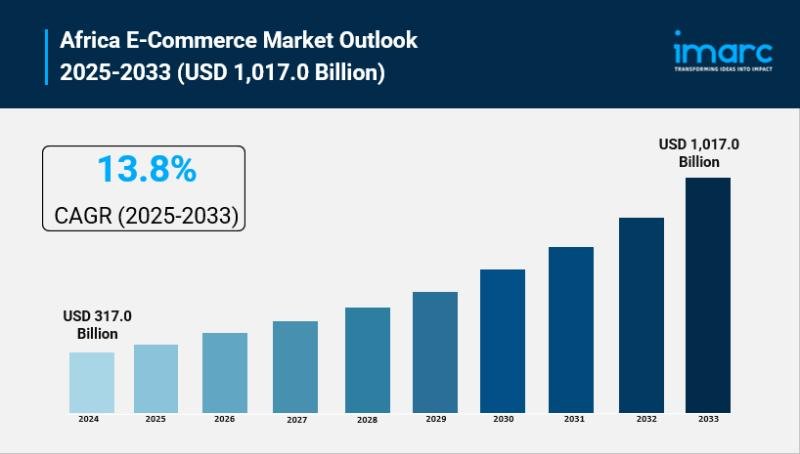
Market Size in 2024: USD 317.0 Billion
Market Size in 2033: USD 1,017.0 Billion
Market Growth Rate 2025-2033: 13.8%
According to IMARC Group’s latest research publication, “Africa E-Commerce Market: Industry Trends, Share, Size, Growth, Opportunity and Forecast 2025-2033”, the Africa e-commerce market size reached USD 317.0 Billion in 2024. Looking forward, IMARC Group expects the market to reach USD 1,017.0 Billion by 2033, exhibiting a growth rate (CAGR) of 13.8% during 2025-2033.
How AI is Reshaping the Future of Africa E-Commerce Market
● E-commerce players such as Jumia are using AI recommendations to drive ten- to fifteen-percent revenue upticks‚ making their recommendations feel spot on and increasing shopper excitement every time.
● AI chatbots reduce support queries on African e-commerce websites by 90%. Support teams can then focus on the difficult questions while customers love instant responses.
● More than 87 percent of Nigerian fintechs are blocking e-commerce fraud with AI‚ instantly securing payments and rapidly building buyers’ trust.
● AI shopping assistants cut checkout time and effort by over half across African sites making for a faster smoother hassle-free shopping experience.
● Over three-quarters of young Africans use AI tools weekly. This demand has prompted governments to support AI in e-commerce as a means of developing inclusive markets.
Grab a sample PDF of this report: https://www.imarcgroup.com/africa-e-commerce-market/requestsample
Market Growth Factors
One of the major drivers of e-commerce in Africa has been the penetration of mobile and internet connectivity across the continent. Mobile phones‚ in particular‚ have been the preferred means of accessing the internet‚ enabling online browsing‚ comparing‚ and purchases by consumers across urban and rural locations. More affordable‚ easily accessible data packages and enlarged networks have lowered the barrier to entry. The mobile-first ecosystem is user-friendly and more convenient for offline shoppers. With the introduction of mobile accessibility‚ platforms have improved their mobile site experience to cater to users. This has resulted in the adoption of mobile shopping in categories like fashion and electronics.
One of the major drivers of Africa’s e-commerce growth is the increase in the tech-savvy population to changing consumer preferences. A large share of the population in Africa is tech-savvy‚ consisting of a younger generation that uses social networks for product searches and online shopping conveniences. But this generation prizes customization‚ speed and innovation‚ pushing marketplaces to constantly change. Altered trust patterns‚ and a desire for variety over physical worlds‚ make this generation more connected to the virtual domain. Young consumers lead around social commerce trends and influencer-led purchases‚ creating a long-term ecosystem around products and services.
Digital payment and financial technology advances have enabled e-commerce to grow in many places. Mobile money‚ digital wallets‚ and real-time systems have meant that cash is no longer the dominant form of payment‚ with security and accessibility problems being solved in many locations. These allow for secure‚ instant payments even for the underbanked‚ increasing trust and the addressable market. They enable localization of the user experience for specific market needs‚ and platform and fintech partnerships enable simplified checkouts. This can have a wider impact on accessibility by allowing more individuals to participate in online shopping.
Ask analyst of customized report: https://www.imarcgroup.com/request?type=report&id=3842&flag=E
Market Segmentation
Breakup by Business Model:
● B2C
● B2B
● C2C
● Others
Breakup by Mode of Payment:
● Payment Cards
● Online Banking
● E-Wallets
● Cash-On-Delivery
● Others
Breakup by Service Type:
● Financial
● Digital Content
● Travel and Leisure
● E-Tailing
● Others
Breakup by Product Type:
● Groceries
● Clothing and Accessories
● Mobiles and Electronics
● Health and Personal Care
● Others
Breakup by Country:
● South Africa
● Nigeria
● Egypt
● Morocco
● Kenya
● Others
Recent Development & News
● February 2026: Jumia reports strong Q4 2025 results with revenue surging 34% year-over-year to $61.4 million, driven by marketplace growth including third-party sales and advertising, as the platform advances toward Adjusted EBITDA breakeven by late 2026 through cost efficiencies and focused operations in high-potential markets like Nigeria.
● February 2026: Mastercard expands its acceptance network across Africa by 45% in 2025, integrating more merchants and small businesses into digital payments to accelerate e-commerce adoption and support the continent’s growing online retail ecosystem with enhanced transaction security and accessibility.
● February 2026: South Africa’s e-commerce market approaches R100 billion in value, fueled by last-mile logistics innovations such as automation, improved fulfillment, and optimized delivery networks that enable faster scaling and higher reliability for platforms like Takealot amid rising mobile-first shopping demand.
About Us
IMARC Group is a global management consulting firm that helps the world’s most ambitious changemakers to create a lasting impact. The company provide a comprehensive suite of market entry and expansion services. IMARC offerings include thorough market assessment, feasibility studies, company incorporation assistance, factory setup support, regulatory approvals and licensing navigation, branding, marketing and sales strategies, competitive landscape and benchmarking analyses, pricing and cost research, and procurement research.
Contact Us
IMARC Group,
134 N 4th St. Brooklyn, NY 11249, USA,
Email: sales@imarcgroup.com,
Tel No: (D) +91 120 433 0800,
United States: +1-201971-6302
This release was published on openPR.