Revenue Cycle Management Market
Market Outlook and Forecast
The Revenue Cycle Management Market has become a crucial component of modern healthcare administration, enabling hospitals, clinics, and healthcare organizations to manage patient billing, claims processing, and payment collections more efficiently. Revenue cycle management (RCM) solutions streamline financial workflows across the healthcare ecosystem-from patient registration and insurance verification to coding, billing, and reimbursement. As healthcare providers face growing pressure to reduce administrative costs and improve financial performance, the demand for advanced RCM systems continues to rise.
Healthcare systems worldwide are undergoing rapid digital transformation, and revenue cycle management platforms are playing a vital role in optimizing financial operations. Providers are increasingly adopting integrated RCM solutions that automate repetitive tasks, reduce billing errors, and improve reimbursement accuracy. These technologies allow healthcare organizations to enhance operational efficiency while maintaining regulatory compliance and improving patient financial experiences.
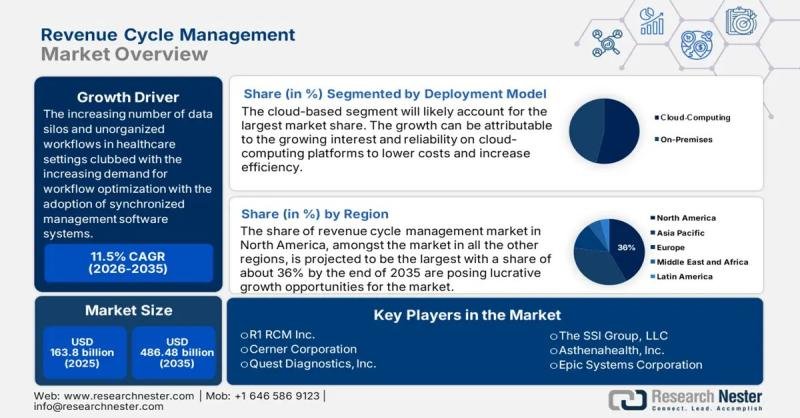
The Revenue Cycle Management Market size reached USD 163.8 billion in 2025, reflecting the widespread adoption of advanced billing and financial management solutions across the healthcare industry. Growing healthcare expenditures, increasing patient volumes, and the complexity of insurance reimbursement processes are encouraging providers to invest in efficient RCM platforms. By 2035, the market is projected to reach USD 486.48 billion, expanding at a compound annual growth rate of 11.5% between 2026 and 2035.
One of the major drivers shaping the Revenue Cycle Management Market is the rising demand for automation and artificial intelligence in healthcare administration. RCM platforms powered by machine learning algorithms can analyze claims data, detect billing errors, and predict reimbursement outcomes. This helps healthcare providers minimize claim denials and accelerate payment cycles.
Another key growth factor is the increasing shift toward value-based healthcare models. Under these models, healthcare providers are reimbursed based on patient outcomes rather than service volumes. Revenue cycle management systems help organizations track performance metrics, manage contracts with insurers, and ensure accurate reimbursement under complex payment structures.
Furthermore, the growing adoption of electronic health records (EHR) systems has strengthened the integration of clinical and financial workflows. Modern RCM platforms are designed to integrate seamlessly with EHR systems, enabling healthcare providers to streamline data sharing and improve billing accuracy.
➤ Request Free Sample PDF Report @ https://www.researchnester.com/sample-request-4849
Regional Performance Highlights
Regional trends are playing a significant role in shaping the development of the Revenue Cycle Management Market, with healthcare systems around the world adopting digital financial management solutions.
North America is expected to remain the leading region and is projected to account for approximately 36% of the global market share by the end of 2035. The region benefits from a highly developed healthcare infrastructure, advanced health information technology adoption, and a complex insurance reimbursement environment. Healthcare providers in the United States and Canada are increasingly investing in automated revenue cycle solutions to reduce administrative burdens and improve financial outcomes.
Europe is also expected to hold a significant share of the Revenue Cycle Management Market by 2035. Countries such as Germany, the United Kingdom, and France are actively implementing healthcare digitization initiatives that support the adoption of advanced financial management platforms. The integration of electronic health records, billing systems, and healthcare analytics is improving revenue cycle efficiency across the region.
Asia Pacific is anticipated to experience strong expansion and is expected to account for approximately 26% of the global market share by the end of 2035. Rapidly expanding healthcare infrastructure, rising healthcare spending, and increasing adoption of digital healthcare technologies are driving demand for revenue cycle management solutions. Emerging economies such as China, India, and Southeast Asian countries are investing heavily in healthcare IT systems to improve operational efficiency and financial transparency.
Additionally, healthcare providers in these regions are increasingly outsourcing revenue cycle management services to specialized providers, further accelerating the growth of the market.
➤ Gain access to expanded insights on competitive strategies, market size, and regional analysis. View our Revenue Cycle Management Report Overview here: https://www.researchnester.com/reports/revenue-cycle-management-market/4849
Market Segmentation
The Revenue Cycle Management Market can be segmented based on deployment model, end user, component, and application. These segments illustrate how different healthcare organizations adopt RCM solutions to optimize financial performance.
From a deployment perspective, the cloud-based segment is expected to dominate the market, accounting for more than 70% of the total market share by 2035. Cloud-based RCM solutions offer several advantages over traditional on-premise systems, including lower infrastructure costs, improved scalability, and easier integration with healthcare IT systems.
Healthcare providers are increasingly adopting cloud platforms to access real-time financial data, automate billing processes, and improve operational flexibility. Cloud-based systems also enable secure data storage and remote access, allowing healthcare administrators to manage revenue cycle processes from multiple locations.
Based on end users, the hospital segment is projected to account for approximately 54% of the total revenue share by 2035. Hospitals handle large volumes of patient data, complex billing processes, and multiple insurance reimbursement structures, making efficient revenue cycle management essential.
Hospitals rely on RCM solutions to streamline patient registration, insurance verification, coding, claims submission, and payment processing. These platforms help reduce administrative workload, minimize billing errors, and accelerate payment collection.
Other healthcare providers-including physician practices, diagnostic laboratories, and ambulatory surgical centers-are also increasingly adopting RCM platforms. These organizations are seeking automated solutions to manage billing complexities and maintain compliance with evolving healthcare regulations.
As healthcare systems continue to digitize their operations, revenue cycle management platforms are becoming integral to financial and operational efficiency across the healthcare ecosystem.
➤ Discover how the Revenue Cycle Management Market is evolving globally – access your free sample report → https://www.researchnester.com/sample-request-4849
Top Market Trends
1. Increasing Adoption of Artificial Intelligence and Automation
Artificial intelligence and automation technologies are transforming the Revenue Cycle Management Market by enabling healthcare organizations to streamline complex financial workflows. AI-powered RCM systems can automatically review claims, detect coding errors, and predict claim approval outcomes.
These capabilities help reduce claim denials and improve reimbursement rates. Automation tools also handle repetitive tasks such as eligibility verification, claims submission, and payment posting, allowing administrative staff to focus on higher-value activities.
Several healthcare technology providers have introduced AI-driven analytics platforms that provide real-time insights into revenue cycle performance, enabling healthcare organizations to identify inefficiencies and optimize financial strategies.
2. Growth of Outsourced Revenue Cycle Management Services
Many healthcare providers are increasingly outsourcing revenue cycle management processes to specialized service providers. Outsourcing allows hospitals and physician practices to reduce administrative costs while benefiting from the expertise of dedicated RCM professionals.
RCM outsourcing firms handle billing, coding, claims management, and reimbursement tracking, enabling healthcare providers to focus more on patient care. This trend is particularly common among small and mid-sized healthcare organizations that lack the resources to maintain in-house revenue cycle teams.
As healthcare regulations and insurance requirements continue to evolve, outsourcing providers are investing in advanced technologies to deliver efficient and compliant revenue cycle services.
3. Integration of Revenue Cycle Platforms with Healthcare IT Systems
Modern revenue cycle management platforms are increasingly integrated with electronic health records, practice management systems, and healthcare analytics tools. This integration allows healthcare providers to maintain accurate financial and clinical data across multiple systems.
Integrated RCM solutions enable real-time data exchange between clinical and financial workflows, reducing documentation errors and improving billing accuracy. Healthcare organizations are also using integrated analytics tools to track revenue cycle performance and identify opportunities for operational improvement.
These integrated platforms are helping healthcare providers create more efficient, data-driven financial management processes.
➤ Stay ahead of the curve with the latest Revenue Cycle Management Market trends. Claim your sample report → https://www.researchnester.com/sample-request-4849
Recent Company Developments
Several companies are actively shaping the competitive landscape of the Revenue Cycle Management Market through strategic partnerships, technology innovations, and service expansions.
1. Cerner Corporation has expanded its healthcare financial management solutions by introducing new cloud-based revenue cycle platforms designed to improve billing efficiency and interoperability with electronic health records.
2. McKesson Corporation – has invested in advanced analytics tools that help healthcare providers optimize claims management and reduce revenue leakage across the revenue cycle.
3. Optum Inc. – has strengthened its revenue cycle services portfolio by integrating artificial intelligence capabilities into its claims processing and payment management solutions.
4. Athenahealth – has introduced new cloud-based RCM tools designed to simplify medical billing processes and improve revenue visibility for healthcare organizations.
Experian Health has launched advanced patient financial management solutions aimed at improving payment transparency and enhancing the overall patient billing experience.
➤ Request Free Sample PDF Report @ https://www.researchnester.com/sample-request-4849
Related News –
https://www.linkedin.com/pulse/how-b2b-saas-market-redefining-enterprise-technology-priya-shelke-6ytlf/
https://www.linkedin.com/pulse/what-shaping-future-ultrasound-devices-market-priya-shelke-oqnrf/
Contact Data
AJ Daniel
Corporate Sales, USA
Research Nester
77 Water Street 8th Floor, New York, 10005
Email: info@researchnester.com
USA Phone: +1 646 586 9123
Europe Phone: +44 203 608 5919
About Research Nester
Research Nester is a one-stop service provider with a client base in more than 50 countries, leading in strategic market research and consulting with an unbiased and unparalleled approach towards helping global industrial players, conglomerates and executives for their future investment while avoiding forthcoming uncertainties. With an out-of-the-box mindset to produce statistical and analytical market research reports, we provide strategic consulting so that our clients can make wise business decisions with clarity while strategizing and planning for their forthcoming needs and succeed in achieving their future endeavors. We believe every business can expand to its new horizon, provided a right guidance at a right time is available through strategic minds.
This release was published on openPR.