Logistics Robots Market
Market Outlook and Forecast
The logistics robots market is experiencing a profound transformation as global supply chains increasingly adopt automation to improve efficiency, accuracy, and scalability. Rapid growth in e-commerce, warehouse modernization, and labor shortages in logistics operations are accelerating the adoption of robotics technologies across distribution centers and fulfillment hubs.
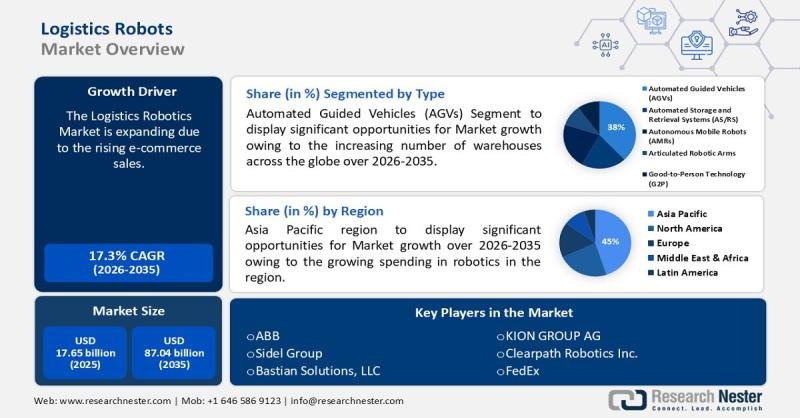
In 2025, the logistics robots market is valued at USD 17.65 billion and is projected to reach USD 87.04 billion by 2035, expanding at a compound annual growth rate (CAGR) of 17.3% during 2026-2035.
Logistics robots are autonomous or semi-autonomous machines designed to perform tasks such as goods transportation, sorting, picking, palletizing, and inventory management in warehouses and distribution facilities. These systems play a critical role in optimizing material handling operations, reducing operational costs, and improving order fulfillment speed.
The surge in global e-commerce activity has created an urgent need for automated logistics solutions. Retailers and logistics providers are facing increasing pressure to deliver faster shipping while managing high order volumes. Robotics technology is enabling companies to streamline warehouse workflows and maintain operational efficiency even during peak demand periods.
➤ Request Free Sample PDF Report @ https://www.researchnester.com/sample-request-6252
Regional Performance Highlights
North America represents one of the most technologically advanced markets for logistics robots. The region has witnessed widespread adoption of warehouse automation technologies among large retailers, third-party logistics providers, and manufacturing companies. The United States leads regional growth due to the strong presence of e-commerce giants, advanced distribution networks, and a growing focus on supply chain efficiency. Logistics companies across the region are investing heavily in robotics solutions to accelerate order fulfillment and reduce operational costs.
Additionally, increasing investments in smart warehouses and automated fulfillment centers are driving demand for robotics systems capable of handling complex logistics operations.
Europe demonstrates steady growth in the logistics robots market, supported by strong industrial automation capabilities and expanding e-commerce infrastructure. Countries such as Germany, the United Kingdom, and France are leading the adoption of warehouse robotics technologies. European companies are prioritizing automation to enhance operational efficiency while addressing labor shortages in logistics operations.
The region is also witnessing increased collaboration between robotics manufacturers and logistics providers to develop customized automation solutions. Additionally, sustainability initiatives are encouraging companies to implement robotics systems that optimize energy use and reduce warehouse operational footprints.
Asia Pacific is emerging as the largest regional market, expected to account for approximately 45% of global share by 2035. Rapid industrialization, expanding manufacturing sectors, and the explosive growth of e-commerce platforms are fueling strong demand for logistics robots across the region. Countries such as China, Japan, South Korea, and India are investing heavily in smart logistics infrastructure. Warehousing companies in these markets are adopting robotics technologies to manage increasing product volumes and improve supply chain efficiency.
China, in particular, has become a major hub for robotics innovation, with several domestic companies developing advanced automation systems for logistics operations. Government initiatives supporting digital transformation and smart manufacturing are further accelerating adoption across the region.
➤ Gain access to expanded insights on competitive strategies, market size, and regional analysis. View our Logistics Robots Market Report Overview here: https://www.researchnester.com/reports/logistics-robots-market/6252
Market Segmentation
By robot type, the automated guided vehicles (AGVs) segment is expected to dominate the logistics robots market, accounting for more than 38% of total market share by 2035. AGVs are widely used in warehouses and manufacturing facilities to transport materials between different operational zones. These vehicles navigate using sensors, magnetic strips, or laser guidance systems, enabling efficient movement of goods without human intervention. Businesses are increasingly adopting AGVs to reduce manual handling, improve safety, and enhance operational efficiency. Modern AGVs are equipped with advanced navigation systems that allow them to operate in dynamic environments while avoiding obstacles and optimizing travel routes. The palletizing and de-palletizing segment is another key application area within the logistics robots market. These robotic systems are designed to automate the stacking and unstacking of goods on pallets, a task traditionally performed by manual labor.
Palletizing robots help businesses improve productivity by handling repetitive tasks with high precision and speed. They also reduce the risk of workplace injuries associated with heavy lifting and manual material handling. Industries such as food and beverage, consumer goods, and manufacturing are increasingly adopting palletizing robots to streamline packaging and distribution operations. The ability of these robots to operate continuously and maintain consistent performance is making them an essential component of automated logistics environments.
➤ Explore the complete Logistics Robots Market forecast and regional insights in our detailed report. Download our sample report here → https://www.researchnester.com/sample-request-6252
Top Market Trends
1. Rise of Autonomous Mobile Robots (AMRs)
Autonomous Mobile Robots (AMRs) are becoming one of the most significant innovations in the logistics robots market. Unlike traditional AGVs, AMRs use advanced sensors, artificial intelligence, and real-time mapping technologies to navigate warehouse environments independently.
Major retailers and logistics companies are deploying AMRs to automate order picking and goods transportation tasks. These robots can dynamically adjust their routes, making them highly adaptable to changing warehouse layouts and operational requirements.
Recent deployments of AMRs in large distribution centers have demonstrated significant improvements in order processing speed and warehouse efficiency.
2. Integration of Artificial Intelligence and Machine Learning
Artificial intelligence and machine learning technologies are transforming how logistics robots operate. AI-powered robotics systems can analyze large datasets to optimize warehouse workflows and improve decision-making.
For example, AI-driven robots can prioritize orders based on shipping deadlines, optimize picking routes, and predict maintenance requirements. This predictive capability helps logistics operators reduce downtime and maintain continuous operations.
Several robotics companies have recently introduced AI-enabled platforms that allow robots to learn from operational data and improve performance over time.
3. Growth of Smart Warehouses
The emergence of smart warehouses is significantly shaping the logistics robots market. Smart warehouses integrate robotics systems, IoT devices, and data analytics platforms to create highly automated logistics environments.
These facilities use robotics to automate tasks such as inventory tracking, product sorting, and goods transportation. By combining robotics with real-time analytics, businesses can optimize warehouse operations and improve supply chain visibility.
Leading logistics companies are investing in large-scale automated fulfillment centers that rely heavily on robotics technologies.
4. Sustainability and Energy-Efficient Robotics
Sustainability has become an important focus area in logistics operations. Companies are adopting energy-efficient robotics systems to reduce carbon emissions and improve environmental performance.
Modern logistics robots are designed to consume less energy while delivering higher productivity. Additionally, automated systems help optimize warehouse layouts and reduce unnecessary material handling, further improving energy efficiency.
Robotics manufacturers are also developing modular and recyclable components to support sustainable manufacturing practices.
➤ Stay ahead of the curve with the latest Logistics Robots Market trends. Claim your sample report → https://www.researchnester.com/sample-request-6252
Recent Company Developments
The logistics robots market has witnessed significant strategic activity over the past year, with major companies investing in innovation and expansion.
1. ABB Robotics introduced new robotic automation solutions designed specifically for warehouse material handling and logistics applications.
2. KUKA AG expanded its logistics robotics portfolio with advanced mobile robot platforms aimed at improving warehouse automation.
3. Daifuku Co., Ltd. announced new investments in automated material handling systems to support growing demand from e-commerce warehouses.
4. Dematic launched upgraded warehouse automation solutions integrating robotics with AI-driven logistics management software.
5. GreyOrange introduced next-generation autonomous mobile robots designed to enhance order fulfillment efficiency in distribution centers.
➤ Request Free Sample PDF Report @ https://www.researchnester.com/sample-request-6252
Related News –
https://www.linkedin.com/pulse/how-conversational-ai-transforming-humanmachine-rohini-shirole-jw3oc
https://www.linkedin.com/pulse/what-future-b2b-saas-market-cloud-driven-economy-rohini-shirole-e4ecf
Contact Data
AJ Daniel
Corporate Sales, USA
Research Nester
77 Water Street 8th Floor, New York, 10005
Email: info@researchnester.com
USA Phone: +1 646 586 9123
Europe Phone: +44 203 608 5919
About Research Nester
Research Nester is a one-stop service provider with a client base in more than 50 countries, leading in strategic market research and consulting with an unbiased and unparalleled approach towards helping global industrial players, conglomerates and executives for their future investment while avoiding forthcoming uncertainties. With an out-of-the-box mindset to produce statistical and analytical market research reports, we provide strategic consulting so that our clients can make wise business decisions with clarity while strategizing and planning for their forthcoming needs and succeed in achieving their future endeavors. We believe every business can expand to its new horizon, provided a right guidance at a right time is available through strategic minds.
This release was published on openPR.