LiDAR expansion, spatial computing, and AI-powered depth sensing are propelling the 3D sensing and imaging market.
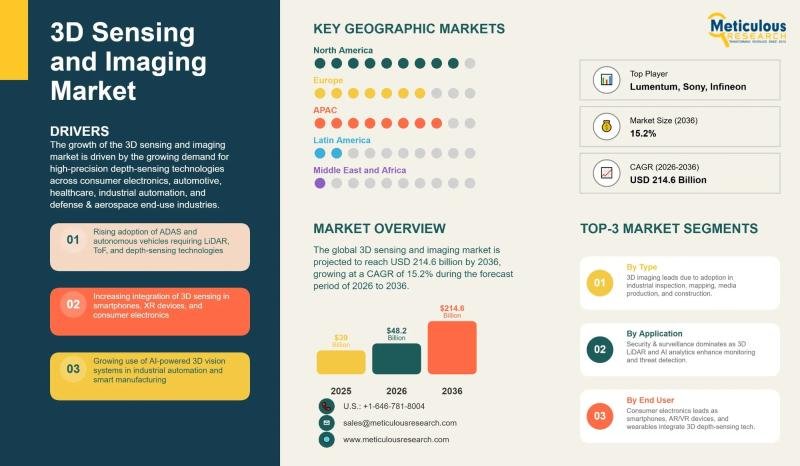
The global 3D sensing and imaging market was valued at USD 39.0 billion in 2025 and is projected to reach USD 214.6 billion by 2036, growing from USD 48.2 billion in 2026 at a CAGR of 15.2% over the forecast period. This exceptional growth rate reflects just how broadly and rapidly three-dimensional sensing and imaging technologies are being adopted across industries that range from consumer electronics and automotive to healthcare, industrial automation, and defense.
The most significant demand drivers are the push for high-precision depth sensing in autonomous vehicles and ADAS systems, the rapid integration of 3D sensing into smartphones and extended reality headsets, and the transformative role AI and edge computing are playing in how spatial data is captured and understood. LiDAR, Time-of-Flight, and structured-light sensing systems are all seeing growing deployment, while the commercial launch of spatial computing devices is accelerating demand for the compact, high-performance depth-sensing components that make these products work.
Download Sample Report Here : https://www.meticulousresearch.com/download-sample-report/cp_id=5358
Market Segmentation and Insights
The 3D sensing and imaging market covers hardware components, software platforms, and integrated systems used to capture, process, and analyze three-dimensional spatial data about objects, environments, and biological structures. The distinction between the two main categories is worth understanding clearly. 3D sensing technologies capture length, width, and depth information to enable human-machine interaction, biometric authentication, gesture recognition, and environmental perception in autonomous systems. 3D imaging technologies create digital three-dimensional representations of objects or spaces using specialized cameras, laser scanners, or computational imaging techniques, supporting applications in industrial inspection, medical diagnostics, architectural modeling, media production, and geospatial mapping.
Rising Proliferation of 3D Sensing in Consumer Electronics and Spatial Computing
The integration of 3D sensing into consumer electronics is generating large-scale demand for compact depth-sensing modules at a pace that shows no sign of slowing. Smartphones, tablets, and wearables increasingly incorporate structured-light and Time-of-Flight sensors to support facial recognition, gesture detection, augmented reality, and computational photography. These features have moved from premium flagships into mid-range devices, dramatically expanding the addressable market for sensing components.
Spatial computing and extended reality platforms are pushing demand further. Devices like Apple Vision Pro and the XR headsets being developed by Meta and Samsung require advanced sensing systems for spatial tracking, gesture recognition, and environmental mapping. In August 2025, VoxelSensors announced a collaboration with Qualcomm Technologies to integrate its SPAES technology into Snapdragon AR2 Gen 1 platforms, targeting improved depth-sensing capabilities for XR and robotics. VCSEL illumination sources from companies including Lumentum Holdings and ams OSRAM are enabling the compact and efficient sensing architectures that make these devices practical to wear and use.
What are the Key Trends in the 3D Sensing and Imaging Market?
Browse in Depth : https://www.meticulousresearch.com/product/3d-sensing-and-imaging-market-5358
Solid-State LiDAR Scaling Across Automotive and Robotics Applications
The shift from mechanical rotating LiDAR to solid-state architectures is one of the market’s most significant transitions. MEMS-based, Flash, optical phased array, and metasurface-based beam steering solutions are reducing mechanical complexity while enabling more compact, reliable designs at cost points viable for mass automotive deployment. Leading developers including Hesai, RoboSense, Luminar, and Innoviz are advancing systems across vehicle, robotics, and autonomous navigation applications. Hesai’s announced plans to expand annual production capacity beyond four million units by 2026 illustrate the rapid shift from pilots to commercialization, while Lumotive’s Light Control Metasurface platform points toward further semiconductor-based cost and size reductions.
AI and Edge Computing Integration Enhancing Real-Time 3D Scene Understanding
The combination of AI and edge computing with 3D sensing platforms is fundamentally changing what these systems can do with spatial data. AI-powered 3D vision systems can now perform object detection, point-cloud processing, anomaly detection, and environment mapping in real time, capabilities that are critical for autonomous vehicles, industrial robots, and smart infrastructure. Edge computing allows data processing to happen at or near the sensor itself, reducing latency and improving response times in safety-critical situations where milliseconds matter.
Type Insights
Why Does the 3D Imaging Segment Dominate the Market?
3D imaging holds the largest share of the market in 2026, driven by its widespread use across industrial inspection, geospatial mapping, architectural documentation, media production, and forensic analysis. The growing adoption of cloud-based 3D imaging platforms is extending this dominance further by enabling scalable storage, collaborative analysis, and AI-assisted processing of large-scale 3D datasets that would be impractical to manage locally.
3D Sensing: Fastest-Growing Segment
The 3D sensing segment is expected to grow the fastest over the forecast period, driven by the relentless integration of depth-sensing technologies into smartphones, XR headsets, autonomous vehicles, industrial robots, IoT devices, and smart home systems. As these product categories continue to expand and improve, demand for the sensing components that power them grows in parallel.
Technology Insights
Why Does the Time-of-Flight Segment Dominate the Market?
Time-of-Flight sensors hold the largest technology share of the market in 2026, reflecting their dominant position in smartphones, tablets, and wearables. Their compact design, low power consumption, and real-time depth sensing capability make them well-suited to the space and battery constraints of mobile devices, supporting applications like facial authentication, gesture recognition, and augmented reality at scale.
LiDAR: Fastest-Growing Technology Segment
LiDAR is projected to grow at the fastest rate of any technology segment through 2036, driven by accelerating deployment in autonomous vehicles, robotics, geospatial mapping, and smart infrastructure. As production volumes increase and costs come down through semiconductor manufacturing advances, LiDAR is moving from a specialized and expensive component into a broadly deployable technology.
Application Insights
Why Does Security and Surveillance Lead the Market by Application?
Security and surveillance holds the largest application share of the market in 2026 and is also projected to grow the fastest. Deployment of 3D sensing technologies across government security systems, transportation hubs, critical infrastructure, and commercial facilities is driving demand. 3D LiDAR cameras offer improved depth perception, object classification, and situational awareness compared to conventional surveillance systems, and the integration of AI-powered facial recognition, gait analysis, and behavioral analytics is making these platforms considerably more capable.
Industrial Automation: High-Growth Application Segment
Industrial automation is another high-growth application, with 3D machine vision technologies being adopted for quality inspection, robotic guidance, dimensional measurement, and warehouse automation. Cognex, KEYENCE, SICK, and Teledyne are among the companies providing advanced 3D vision systems that support the flexible and intelligent manufacturing processes that Industry 4.0 environments demand.
End-Use Industry Insights
Why Does Consumer Electronics Lead the Market?
Consumer electronics holds the largest end-use share of the global market in 2026. Smartphones represent the single highest-volume application for 3D sensing technologies worldwide, with face authentication, augmented reality, and computational photography now standard features across premium and mid-range devices from Apple, Samsung, Xiaomi, and OPPO. The AR and VR and wearable devices segment is expected to grow the fastest, supported by the rapid development of spatial computing platforms and the immersive digital experiences they enable.
Geographical Analysis
North America leads the 3D sensing market in 2026, driven by autonomous vehicle investment, defense applications, and industrial automation, with major players including Apple, Qualcomm, Luminar, and Cognex anchoring regional innovation alongside government smart city and defense modernization initiatives. Asia-Pacific is the fastest-growing region, led by China’s rapid automotive LiDAR and smart city development, with firms like Hesai and RoboSense expanding globally and EV manufacturers including NIO, Li Auto, and Xiaomi integrating LiDAR into next-generation vehicles; Japan and South Korea contribute through semiconductor and imaging sensor expertise from Sony, Samsung, and Panasonic, while India emerges as a growing market supported by manufacturing expansion and digital transformation programs.
Buy the Complete Report with an Impressive Discount: https://www.meticulousresearch.com/view-pricing/674
Key Players
The global 3D sensing and imaging market includes a broad range of established technology companies and specialized innovators. Key players include STMicroelectronics, Infineon Technologies, Sony Group, Qualcomm Technologies, OmniVision Technologies, Lumentum Holdings, ams OSRAM, Cognex, KEYENCE, SICK, Teledyne Technologies, Trimble, FARO Technologies, Hesai Technology, RoboSense Technology, Luminar Technologies, Innoviz Technologies, Panasonic Holdings, and Viavi Solutions.
Related Reports:
Satellite Imaging Market: https://www.meticulousresearch.com/product/satellite-imaging-market-5741
Industrial X-Ray Inspection System Market: https://www.meticulousresearch.com/product/industrial-x-ray-inspection-system-market-5148
About Us:
We are a trusted research partner for leading businesses worldwide, empowering Fortune 500 organizations and emerging enterprises with actionable market intelligence tailored to drive revenue transformation and strategic growth. Our insights reveal forward-looking revenue opportunities, providing our clients with a competitive edge through a diverse suite of research solutions-syndicated reports, custom research, and direct analyst engagement.
Each year, we conduct over 300 syndicated studies and manage 60+ consulting engagements across eight key industry sectors and 20+ geographic markets. With a focus on solving the complex challenges facing global business leaders, our research enables informed decision-making that propels sustainable growth and operational excellence. We are dedicated to delivering high-impact solutions that transform business performance and fuel innovation in the competitive global marketplace.
Contact Us:
Meticulous Market Research Pvt. Ltd.
1267 Willis St, Ste 200 Redding,
California, 96001, U.S.
Email- sales@meticulousresearch.com
USA: +1-646-781-8004
Europe: +44-203-868-8738
APAC: +91 744-7780008
Visit Our Website: https://www.meticulousresearch.com/
For Latest Update Follow Us:
LinkedIn- https://www.linkedin.com/company/meticulous-research
This release was published on openPR.