Logistics Automation Market
The Logistics Automation Market reached approximately US$ 66.2 billion in 2024 and is expected to grow to around US$ 126.1 billion by 2029, expanding at a CAGR of about 14% from 2025 to 2029, as companies increasingly deploy automation technologies to enhance supply chain efficiency, reduce operational costs, and meet rising demand for faster delivery services.
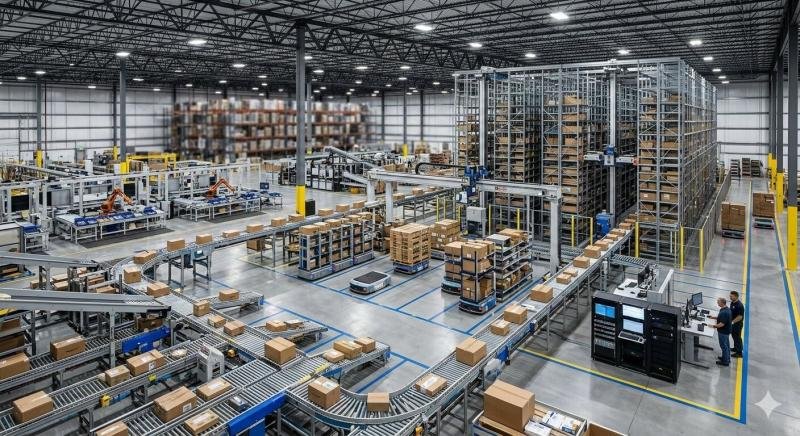
Growth is supported by increasing demand across key segments such as automated guided vehicles (AGVs), autonomous mobile robots (AMRs), automated storage & retrieval systems (AS/RS), conveyor and sortation systems, and warehouse management software, driven by the rapid expansion of e-commerce, omnichannel retailing, and global trade. Advancements in robotics, artificial intelligence, IoT, and data analytics are enabling real-time tracking, predictive maintenance, and optimized warehouse operations. Additionally, the need for faster order fulfillment, error-free logistics processes, and scalable distribution networks is encouraging industries including retail, manufacturing, food & beverage, healthcare, and automotive to adopt automation solutions. The continuous digital transformation of supply chains and increasing investments in smart warehouses further propel the global logistics automation market forward.
Download your exclusive sample report today (corporate email gets priority access):
https://www.datamintelligence.com/download-sample/logistics-automation-market?sindhuri
Logistics Automation Market: Competitive Intelligence
Daifuku Co., Ltd., Dematic, Honeywell International Inc., KNAPP AG, SSI Schaefer, Swisslog Holding AG, TGW Logistics Group, Murata Machinery Ltd., Oracle Corporation, IBM Corporation, and others.
The Logistics Automation Market is strongly driven by leading automation, robotics, and enterprise software providers such as Daifuku Co., Ltd., Dematic, Honeywell International Inc., KNAPP AG, and SSI Schaefer, which deliver advanced automation technologies including automated storage and retrieval systems (AS/RS), conveyor and sorting systems, autonomous mobile robots (AMRs), automated guided vehicles (AGVs), and intelligent warehouse management software. These solutions help organizations streamline supply chain operations, improve order fulfillment speed, and reduce operational costs across industries such as e-commerce, retail, manufacturing, healthcare, and food & beverage.
Market growth is fueled by rapid expansion of e-commerce, increasing demand for efficient warehouse operations, and rising adoption of technologies such as robotics, artificial intelligence, and the Industrial Internet of Things (IIoT). Logistics automation enables real-time inventory tracking, automated order processing, and faster material handling, significantly improving supply chain efficiency and accuracy. Additionally, increasing labor shortages and rising operational costs are accelerating the shift toward automated logistics infrastructure across global distribution centers.
These companies’ complementary strengths include Daifuku’s expertise in automated material handling and smart logistics systems; Dematic’s AI-driven warehouse automation and analytics platforms; Honeywell’s end-to-end supply chain automation and robotics solutions; KNAPP’s advanced goods-to-person systems for e-commerce fulfillment; and SSI Schaefer’s integrated warehouse management and intralogistics solutions. Additional players such as Swisslog Holding AG, TGW Logistics Group, Murata Machinery Ltd., Oracle Corporation, and IBM Corporation enhance the competitive landscape with advanced robotics, digital logistics platforms, and enterprise supply chain management software.
Strategic focus areas across the industry include development of AI-powered warehouse automation systems, expansion of robotics-based material handling technologies, integration of cloud-based logistics management platforms, and partnerships with e-commerce and retail companies to support high-volume fulfillment operations. Companies are also investing in predictive analytics, digital twin technology, and smart warehouse ecosystems to improve operational efficiency, scalability, and supply chain visibility in the rapidly evolving global logistics automation market.
Get Customization in the report as per your requirements:
https://www.datamintelligence.com/customize/logistics-automation-market?sindhuri
Recent Key Developments – United States & North America
✅ June 2025: Amazon expanded the deployment of advanced warehouse robotics and automated fulfillment systems across its North American distribution centers to improve order processing speed and operational efficiency.
✅ May 2025: Honeywell International Inc. strengthened its warehouse automation portfolio with AI-powered robotics, automated sorting systems, and real-time inventory tracking solutions for logistics providers.
✅ 2025: Rapid growth in e-commerce and omnichannel retail across the U.S. and Canada accelerated adoption of automated guided vehicles (AGVs), robotic picking systems, and smart warehouse management technologies.
Recent Key Developments – Japan & Asia-Pacific
✅ July 2025: Daifuku Co., Ltd. expanded logistics automation solutions in Asia-Pacific with advanced automated storage and retrieval systems (AS/RS) for manufacturing and distribution facilities.
✅ Early 2026: Murata Machinery Ltd. introduced next-generation automated warehouse solutions designed to enhance order fulfillment accuracy and warehouse throughput in Japan and Southeast Asia.
✅ 2025: Increasing investments in smart logistics infrastructure in China, India, and South Korea drove strong demand for robotics, automated conveyors, and digital warehouse management systems.
Recent Key Developments – Product & Technology Innovation
✅ 2025: Autonomous Mobile Robots (AMRs): Growth in AMR deployment improved material movement efficiency and flexibility within warehouses and distribution centers.
✅ AI & Data-Driven Logistics Systems: Integration of AI-powered analytics and machine learning enhanced demand forecasting, route optimization, and inventory management.
✅ Smart Warehouse & IoT Integration: Adoption of IoT-enabled sensors and connected devices enabled real-time asset tracking, predictive maintenance, and improved operational visibility in automated logistics networks.
Mergers & Acquisitions / Investments
✅ Oct 2025 – SoftBank Acquires ABB Robotics Division ($5.4B)
SoftBank Group announced the acquisition of the robotics division of ABB for approximately $5.4 billion.
The deal expands SoftBank’s robotics and AI ecosystem to accelerate automation technologies used in logistics, warehousing, and manufacturing environments.
The robotics unit generates roughly $2.3 billion in annual revenue and employs around 7,000 people globally.
✅ Jan 2026 – Unbox Robotics Raises $28M for Warehouse Automation
India-based Unbox Robotics secured $28 million in funding led by ICICI Venture to scale its AI-powered parcel sorting robots.
The funding will support expansion of automated sorting solutions for e-commerce fulfillment centers globally.
New Product Launch / Technology Introduction
✅ Feb 2026 – Dematic Introduces Next-Generation Warehouse Automation Platform
Dematic unveiled a new operational intelligence platform that integrates multiple warehouse automation technologies into a single ecosystem.
The system provides real-time operational insights, enabling faster decision-making and improved warehouse efficiency.
The company also introduced a rail-free automated storage and retrieval system (AS/RS) and high-speed robotic piece-picking technology designed for high-volume e-commerce fulfillment centers.
R&D and Pilot Programs
✅ 2025-2026 – GXO Pilots Humanoid Robots for Warehouse Operations
Logistics giant GXO began piloting humanoid robots from companies including Agility Robotics and Apptronik in warehouse environments.
Robots such as Digit are used for container movement and repetitive warehouse tasks.
These pilots aim to test the feasibility of humanoid robots performing flexible warehouse operations.
Technological Advancements
✅ May 2025 – Amazon Introduces “Vulcan” Robot with Sense of Touch
Amazon unveiled Vulcan, an AI-enabled warehouse robot capable of identifying and handling items using a sense-of-touch technology.
The robot can manage about 75% of warehouse inventory items, helping automate picking tasks and reduce manual labor requirements.
Amazon already operates more than 750,000 robots across its global fulfillment network.
Purchase Corporate License | Market Intelligence:
https://www.datamintelligence.com/buy-now-page?report=logistics-automation-market?sindhuri
Segments Covered in the Logistics Automation Market:
By Organization Size
The market is segmented into large enterprises (65%) and small & medium enterprises (35%).
Large enterprises dominate due to their higher investment capacity and the need to manage complex supply chains efficiently through advanced automation technologies. Small and medium enterprises are increasingly adopting logistics automation solutions to improve operational efficiency, reduce labor costs, and enhance supply chain visibility.
By Component
Components include storage & warehouse management (60%) and transportation management (40%).
Storage and warehouse management dominates the market due to the growing demand for automated storage systems, robotic picking solutions, and warehouse management software that improves inventory accuracy and operational efficiency. Transportation management is expanding steadily as companies adopt automated routing, fleet management, and real-time shipment tracking solutions to optimize logistics operations.
By Vertical
Verticals include manufacturing (25%), retail & e-commerce (20%), automotive (15%), food & beverage (12%), healthcare & pharmaceuticals (10%), defense & aerospace (8%), oil, gas & energy (5%), and others (5%).
Manufacturing dominates the market due to the need for streamlined supply chain operations and efficient material handling processes. Retail and e-commerce sectors are rapidly adopting logistics automation to manage high order volumes and faster delivery requirements. Automotive, food & beverage, and healthcare industries are also integrating automation technologies to improve inventory management, regulatory compliance, and operational efficiency.
By Region
North America – 35% Share
North America leads the market due to early adoption of advanced automation technologies, strong presence of logistics technology providers, and growing demand for efficient supply chain management in the United States and Canada.
Europe – 25% Share
Europe holds a significant share driven by increasing automation in manufacturing and logistics sectors, strong industrial infrastructure, and growing adoption of smart warehouses in Germany, the U.K., and France.
Asia-Pacific – 30% Share
Asia-Pacific is witnessing rapid growth due to expanding e-commerce industries, increasing investments in smart logistics infrastructure, and rising adoption of automation technologies in China, Japan, India, and South Korea.
Request for 2 Days FREE Trial Access:
https://www.datamintelligence.com/reports-subscription?sindhuri
✅ Competitive Landscape
✅ Technology Roadmap Analysis
✅ Sustainability Impact Analysis
✅ KOL / Stakeholder Insights
✅ Consumer Behavior & Demand Analysis
✅ Import-Export Data Monitoring
✅ Live Market & Pricing Trend
Contact Us –
Company Name: DataM Intelligence
Contact Person: Sai Kiran
Email: Sai.k@datamintelligence.com
Phone: +1 877 441 4866
Website: https://www.datamintelligence.com
About Us –
DataM Intelligence is a Market Research and Consulting firm that provides end-to-end business solutions to organizations from Research to Consulting. We, at DataM Intelligence, leverage our top trademark trends, insights and developments to emancipate swift and astute solutions to clients like you. We encompass a multitude of syndicate reports and customized reports with a robust methodology.Our research database features countless statistics and in-depth analyses across a wide range of 6300+ reports in 40+ domains creating business solutions for more than 200+ companies across 50+ countries; catering to the key business research needs that influence the growth trajectory of our vast clientele.
This release was published on openPR.