Market Overview
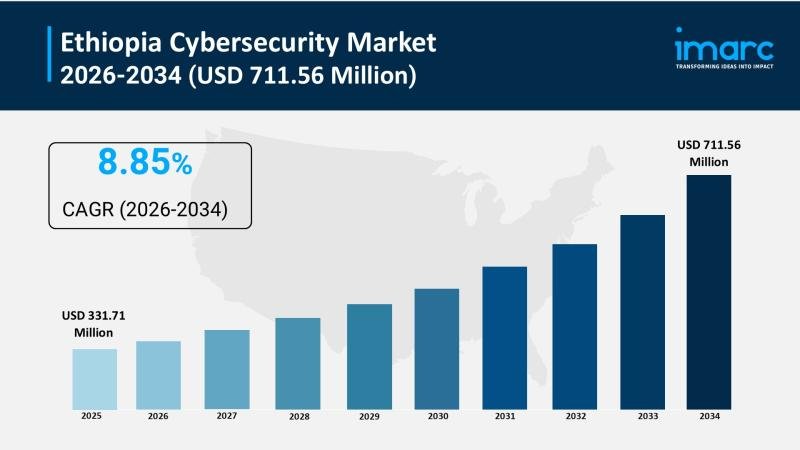
The Ethiopia cybersecurity market was valued at USD 331.71 Million in 2025 and is expected to reach USD 711.56 Million by 2034. The forecast period spans from 2026 to 2034 with a CAGR of 8.85%. Growth is driven by accelerating digital transformation initiatives, increasing cyber threat sophistication, expanding internet penetration, and growing government emphasis on national cybersecurity frameworks. The market benefits from Ethiopia’s ambitious technology development agenda, rising adoption of cloud services and mobile banking platforms, and increasing awareness of data protection requirements across public and private sectors. Regional cybersecurity cooperation and capacity building initiatives further strengthen the market’s development trajectory.
How Innovation is Reshaping the Future of Ethiopia Cybersecurity Market:
• Artificial intelligence and machine learning technologies enable automated threat detection, behavioral analysis, and rapid response to emerging cyber threats, addressing the shortage of skilled cybersecurity professionals through intelligent security automation.
• Cloud-based security solutions provide scalable, cost-effective protection for organizations transitioning to digital operations, eliminating the need for extensive on-premises infrastructure investments while ensuring continuous security updates.
• Mobile security platforms address the unique challenges of Ethiopia’s mobile-first digital ecosystem, protecting mobile banking transactions, digital payment systems, and smartphone-based services against evolving mobile-specific threats.
• Security-as-a-Service (SECaaS) models democratize access to enterprise-grade cybersecurity capabilities for small and medium enterprises through subscription-based services, lowering entry barriers and expanding market reach.
• Blockchain technology applications enhance data integrity, secure digital identity management, and provide tamper-proof transaction records for financial services and government applications requiring high trust and transparency.
• Zero-trust architecture frameworks replace traditional perimeter-based security models, providing granular access controls and continuous authentication suitable for distributed workforces and cloud-based operations.
Grab a sample PDF of this report: https://www.imarcgroup.com/ethiopia-cybersecurity-market/requestsample
Market Growth Factors
The rapid digital transformation across Ethiopia’s economy fundamentally drives cybersecurity market expansion as organizations digitize operations and migrate critical services online. The Ethiopian government’s Digital Ethiopia 2025 strategy promotes technology adoption across sectors including finance, healthcare, education, and public administration, creating extensive digital infrastructure requiring robust security protection. Financial sector digitization, particularly mobile money platforms and digital banking services, generates critical cybersecurity needs to protect financial transactions and customer data. E-government initiatives delivering public services through digital channels require comprehensive security frameworks ensuring citizen data protection and system integrity. The telecommunications sector liberalization and expansion of broadband internet access enable greater digital participation while simultaneously expanding the attack surface requiring protection. As businesses and government entities recognize that digital transformation success depends on cybersecurity foundations, investments in security solutions become non-negotiable components of technology deployment strategies.
The escalating sophistication and frequency of cyber threats targeting Ethiopian organizations create urgent demand for advanced cybersecurity solutions and services. Ransomware attacks, data breaches, phishing campaigns, and state-sponsored cyber espionage pose increasing risks to critical infrastructure, financial institutions, and government systems. High-profile security incidents raise awareness among corporate leadership and government officials regarding cybersecurity importance, driving budget allocations for protective measures. The interconnected nature of modern digital systems means that vulnerabilities in one organization can cascade across supply chains and partner networks, compelling even smaller enterprises to implement baseline security controls. Ethiopia’s growing integration into global digital commerce and international partnerships necessitates compliance with international cybersecurity standards and data protection regulations. As threat actors develop more sophisticated attack methods specifically targeting emerging markets, Ethiopian organizations recognize that reactive approaches prove insufficient, driving proactive investments in threat intelligence, security operations centers, and incident response capabilities.
Government regulatory initiatives and national cybersecurity strategy development provide crucial market structure and momentum. The Ethiopian government has established the Information Network Security Agency (INSA) to coordinate national cybersecurity efforts, develop policy frameworks, and build domestic cybersecurity capacity. Emerging data protection regulations and sector-specific security requirements create compliance drivers compelling organizations to implement appropriate security controls and governance frameworks. Public sector cybersecurity investments in critical infrastructure protection, defense systems, and government network security establish baseline demand while demonstrating commitment to digital security priorities. International development partnerships and capacity building programs provide technical assistance, funding, and knowledge transfer supporting cybersecurity ecosystem development. Regional cooperation through African Union initiatives and East African Community frameworks facilitate information sharing, collaborative threat response, and harmonized regulatory approaches. As regulatory frameworks mature and enforcement mechanisms strengthen, organizations face increasing pressure to demonstrate cybersecurity compliance, sustaining market growth across products, services, and consulting segments.
Market Segmentation
Solution Type:
• Network Security
• Endpoint Security
• Application Security
• Cloud Security
• Identity & Access Management
• Data Security & Encryption
• Other
Service Type:
• Managed Security Services
• Professional Services (Consulting, Training)
• Integration & Implementation Services
• Support & Maintenance
Deployment Mode:
• On-premises
• Cloud-based
• Hybrid
Organization Size:
• Small & Medium Enterprises
• Large Enterprises
End User:
• Banking, Financial Services & Insurance (BFSI)
• Government & Defense
• Telecommunications
• Healthcare
• Energy & Utilities
• Education
• Other
Security Type:
• Preventive Security
• Detective Security
• Responsive Security
Region:
• Addis Ababa
• Oromia
• Amhara
• Southern Nations, Nationalities & Peoples
• Other Regions
Key Players
• Not provided in source.
Recent Development & News
• 2024-2025: The Ethiopian government strengthened the Information Network Security Agency (INSA) with expanded mandate and resources to coordinate national cybersecurity efforts, develop policy frameworks, and respond to critical infrastructure threats.
• 2025: Major Ethiopian banks and financial institutions implemented advanced security operations centers and AI-powered threat detection systems to protect digital banking platforms and mobile money services against increasing cyber threats.
• 2024: International cybersecurity firms expanded their presence in Ethiopia through partnerships with local technology companies, providing advanced security solutions and capacity building programs to support the country’s digital transformation initiatives.
Note: If you require any specific information that is not covered currently within the scope of the report, we will provide the same as a part of the customization.
Ask an analyst for your customized sample: https://www.imarcgroup.com/request?type=report&id=42311&flag=C
Contact Us
IMARC Group
134 N 4th St. Brooklyn, NY 11249, USA
Email: sales@imarcgroup.com
Tel No: (D) +91 120 433 0800
United States: +1-201-971-6302
About Us
IMARC Group is a global management consulting firm that helps the world’s most ambitious changemakers to create a lasting impact. The company provide a comprehensive suite of market entry and expansion services. IMARC offerings include thorough market assessment, feasibility studies, company incorporation assistance, factory setup support, regulatory approvals and licensing navigation, branding, marketing and sales strategies, competitive landscape and benchmarking analyses, pricing and cost research, and procurement research.
This release was published on openPR.