AI-powered voice interfaces and biometric authentication are transforming the global speech recognition market landscape.
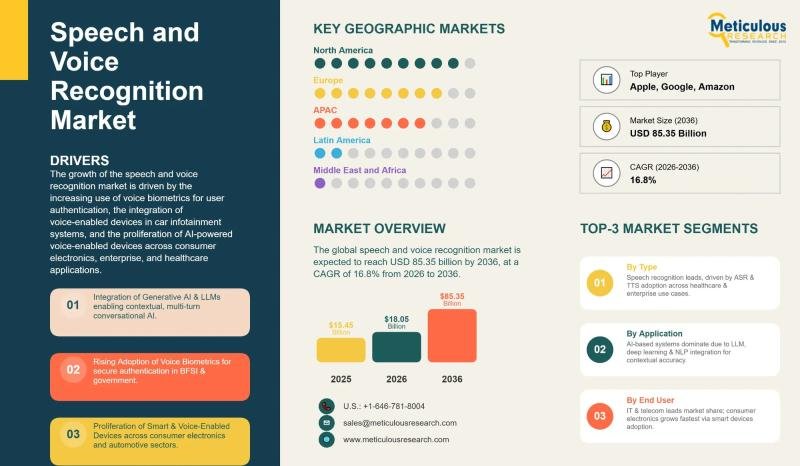
The global speech and voice recognition market is going through a period of genuine and rapid transformation as artificial intelligence continues to redefine how people interact with the technology around them. The market was valued at USD 15.45 billion in 2025 and is projected to reach USD 85.35 billion by 2036, rising from USD 18.05 billion in 2026 at a CAGR of 16.8% over the forecast period. The expansion of voice-enabled devices, rising adoption of voice biometrics for authentication, and the deepening integration of speech technologies into both enterprise and consumer applications are among the core forces driving this growth.
Download Sample Report Here : https://www.meticulousresearch.com/download-sample-report/cp_id=5038
Speech and voice recognition technologies work by enabling machines to interpret, process, and respond to human speech in ways that feel increasingly natural. They combine automatic speech recognition, natural language processing, and machine learning to convert spoken language into text, understand intent, and generate responses. Today these solutions show up across smartphones, smart home systems, connected vehicles, healthcare documentation platforms, and enterprise communication tools, and their reach is expanding rapidly.
Transforming Human-Machine Interaction Through AI-Driven Voice Interfaces
The single most influential development shaping this market is the integration of generative AI and large language models into voice recognition platforms. Traditional speech recognition systems were essentially built for command-based interactions, converting speech to text with limited ability to understand context. LLM-integrated speech systems have changed that fundamentally, enabling context-aware, multi-turn conversational interactions that feel far more natural and capable.
By early 2026, leading technology companies had moved well past experimental deployments into large-scale commercial implementations of conversational voice platforms. Amazon expanded Alexa+ with generative responses and persistent conversational memory. Apple enhanced its voice assistant capabilities through the Apple Intelligence framework, enabling Siri to execute goal-oriented tasks through natural conversation. Microsoft embedded voice-enabled Copilot across Windows, Teams, and Edge, while Google expanded Gemini Live for real-time multimodal voice interactions across supported devices. Investment activity reflects just how seriously the industry is taking this shift. Venture capital funding in voice AI grew more than sixfold between 2022 and 2024, rising from around USD 315 million to over USD 2 billion, and remained strong through 2025. AI voice platform developer ElevenLabs raised a USD 180 million Series C round in January 2025, reaching a valuation of over USD 3 billion, underscoring the accelerating commercial interest in generative voice technology.
What Makes Speech and Voice Recognition a Critical Digital Interface?
Speech and voice recognition have become essential components of modern digital life because they enable intuitive, hands-free interaction across a growing range of devices and situations. These systems allow users to control smart home devices, search for information, transcribe meetings, generate content, verify identities, and engage with conversational AI assistants, all without having to type or tap a screen. The forces driving adoption are both consumer and enterprise in nature. On the consumer side, the proliferation of smartphones, smart speakers, connected vehicles, and wearables is creating an enormous installed base of voice-enabled devices. On the enterprise side, demand for speech analytics, call center automation, and voice-enabled collaboration tools is growing consistently. Voice interaction also plays an important accessibility role, making digital services genuinely more usable for people with disabilities.
Browse in Depth : https://www.meticulousresearch.com/product/speech-and-voice-recognition-market-5038
Key Trends Reshaping the Speech and Voice Recognition Market
Integration of Generative AI and Large Language Models
The integration of generative AI and large language models represents the most transformative technological trend in the market by a considerable margin. Advanced AI models allow speech platforms to analyze tone, intent, and conversational context, manage complex dialogues, and deliver personalized responses that adapt in real time. Voice systems can now recall previous interactions, understand nuance, and adjust their responses accordingly, creating communication experiences that were not possible with earlier approaches. This capability is also stimulating innovation across vertical industries. The number of voice AI startups focused on specific domains such as healthcare, finance, logistics, and customer service grew significantly during 2024, reflecting how broadly applicable conversational voice technology is becoming.
Rising Adoption of Voice Biometrics for Authentication
Voice biometrics is emerging as one of the most practically important applications in the market. These systems verify identity using unique vocal characteristics including pitch, cadence, and speech patterns, offering a secure and frictionless authentication method that does not require passwords, tokens, or physical proximity. The technology is gaining rapid traction in banking, financial services, government, and enterprise environments where fraud prevention and digital security are top priorities. Financial institutions are integrating voice authentication into mobile banking platforms, call centers, and transaction authorization workflows. The BFSI sector accounted for 32.9 percent of voice AI adoption in 2024, a figure that speaks to how seriously financial services is taking this capability.
Why Does the Speech Recognition Segment Dominate the Market?
Speech recognition holds the largest share of the global market in 2026, driven by widespread adoption of automatic speech recognition across healthcare, customer service, education, and media production. ASR is the workhorse of the industry, powering real-time transcription, voice search, meeting documentation, and voice assistant applications across both enterprise and consumer platforms. The text-to-speech segment is growing strongly as well, fueled by the spread of voice AI agents, audiobook generation, and accessibility tools. The voice recognition segment, which covers speaker identification and verification, is projected to grow the fastest over the forecast period, driven by demand for voice biometric security systems across banking, government, and digital identity applications.
Why Artificial Intelligence Leads the Technology Segment
AI is both the largest and fastest-growing technology segment in this market, and the reasons are straightforward. AI-driven speech recognition models, particularly those based on deep learning, offer substantially higher accuracy and adaptability than traditional rule-based approaches. AI-powered voice assistants are embedded in smart speakers, autonomous vehicles, smartphones, and wearables, creating a massive global base of active voice-enabled systems. Cloud platforms are continuously improving these capabilities through advanced neural speech models and multilingual recognition systems that allow organizations to deploy voice solutions at scale.
Cloud-Based Deployment Driving Market Expansion
Cloud-based deployment is expected to grow the fastest among all deployment models. Cloud platforms provide scalable infrastructure, powerful speech processing capabilities, and flexible APIs that allow enterprises to integrate voice recognition into their applications without heavy upfront infrastructure investment. Real-time transcription, multilingual support, voice analytics, and conversational AI are all available as cloud services, making them attractive for businesses at virtually any scale. On-premise deployments remain relevant for organizations in healthcare, defense, and financial services where data security, privacy, and regulatory compliance require keeping sensitive data within controlled environments.
IT & Telecommunications Sector Leads End-User Adoption
The IT and telecommunications sector holds the largest end-user share of the market, reflecting how extensively these organizations deploy voice recognition for contact center automation, interactive voice response systems, speech analytics, and agent assistance. Speech analytics in particular is becoming an essential tool in contact centers, enabling sentiment analysis, compliance monitoring, and agent performance optimization at scale. Consumer electronics is expected to grow the fastest over the forecast period, driven by the rapid expansion of smart speakers, smartphones, AI-powered home appliances, and wearables that increasingly rely on embedded voice recognition as a core interface.
North America Leads the Global Market
North America holds the largest regional share of the market in 2026, supported by a concentration of leading technology companies, advanced digital infrastructure, and strong enterprise adoption of AI-powered solutions. The United States is the largest individual market, driven by major technology providers, high cloud services adoption, and sustained investment in artificial intelligence innovation.
Asia-Pacific is expected to grow the fastest over the forecast period, driven by rapid digitalization, expanding smartphone penetration, and government initiatives supporting digital transformation in healthcare, public services, and financial inclusion across China, India, and Japan.
Buy the Complete Report with an Impressive Discount: https://www.meticulousresearch.com/view-pricing/339
Competitive Landscape
The competitive landscape combines global cloud hyperscalers, AI-native speech technology providers, and specialized voice solution developers. Microsoft, Amazon Web Services, and Google dominate the enterprise speech ecosystem through scalable AI speech platforms, neural text-to-speech solutions, and conversational AI integration. Apple and Baidu maintain strong positions in consumer voice ecosystems, while iFLYTEK continues to lead in Mandarin speech recognition across multiple industries.
Related Reports:
Speech-to-text API Market: https://www.meticulousresearch.com/product/speech-to-text-api-market-5473
Speech Analytics Market: https://www.meticulousresearch.com/product/speech-analytics-market-5364
About Us:
We are a trusted research partner for leading businesses worldwide, empowering Fortune 500 organizations and emerging enterprises with actionable market intelligence tailored to drive revenue transformation and strategic growth. Our insights reveal forward-looking revenue opportunities, providing our clients with a competitive edge through a diverse suite of research solutions-syndicated reports, custom research, and direct analyst engagement.
Each year, we conduct over 300 syndicated studies and manage 60+ consulting engagements across eight key industry sectors and 20+ geographic markets. With a focus on solving the complex challenges facing global business leaders, our research enables informed decision-making that propels sustainable growth and operational excellence. We are dedicated to delivering high-impact solutions that transform business performance and fuel innovation in the competitive global marketplace.
Contact Us:
Meticulous Market Research Pvt. Ltd.
1267 Willis St, Ste 200 Redding,
California, 96001, U.S.
Email- sales@meticulousresearch.com
USA: +1-646-781-8004
Europe: +44-203-868-8738
APAC: +91 744-7780008
Visit Our Website: https://www.meticulousresearch.com/
For Latest Update Follow Us:
LinkedIn- https://www.linkedin.com/company/meticulous-research
This release was published on openPR.