Structural Health Monitoring Market
Market Size and Growth
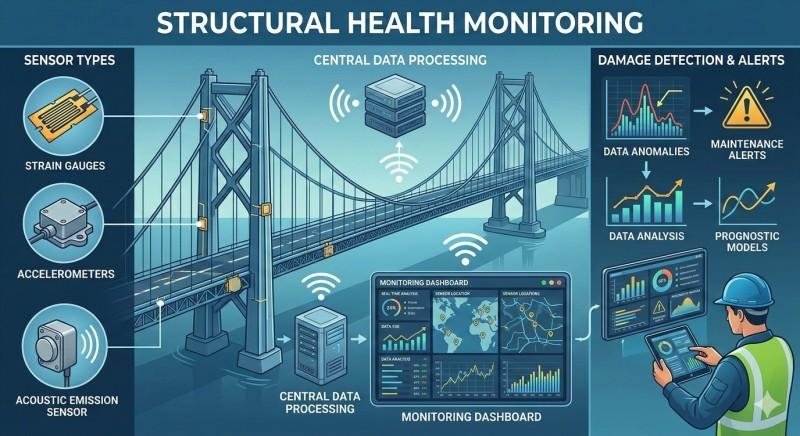
The increasing need to ensure the safety, durability, and performance of critical infrastructure is accelerating the adoption of advanced monitoring technologies worldwide. Structural health monitoring (SHM) systems, which use sensors, data analytics, and real-time monitoring tools to assess the condition of structures, are becoming essential across bridges, buildings, dams, tunnels, and energy infrastructure. According to DataM Intelligence,The Global Structural Health Monitoring Market is estimated to grow at a CAGR of 16.6% during the forecast period 2024-2031.
Request Executive Sample:- https://www.datamintelligence.com/download-sample/structural-health-monitoring-market
Key Development:
United States: Recent Industry Developments
✅ In February 2026, Trimble announced the expansion of its advanced sensor-based structural monitoring platform designed for bridges and large infrastructure projects. The solution integrates IoT sensors, cloud analytics, and predictive maintenance tools. It enables infrastructure operators to detect structural risks early and improve long-term asset management.
✅ In January 2026, Hexagon AB introduced new AI-powered monitoring capabilities within its digital reality platform to support structural health monitoring for transportation and civil infrastructure. The system combines sensor data, digital twins, and analytics to track structural performance. It enhances safety monitoring for bridges, tunnels, and industrial facilities.
✅ In January 2026, the U.S. Federal Highway Administration expanded funding programs supporting smart infrastructure projects that include structural health monitoring technologies for bridges and transportation networks. The initiative encourages deployment of connected sensors and real-time monitoring systems. It aims to strengthen infrastructure safety and predictive maintenance capabilities.
✅ In December 2025, AECOM launched a next-generation digital infrastructure monitoring service that integrates structural health monitoring sensors with advanced analytics. The platform enables continuous monitoring of bridges, buildings, and transportation systems. It supports proactive maintenance and resilience planning for large infrastructure assets.
Japan: Recent Industry Developments
✅ In February 2026, Hitachi launched an upgraded infrastructure monitoring platform that integrates structural health monitoring sensors with AI-based analytics for bridges, railways, and public infrastructure. The system enables real-time structural diagnostics and predictive maintenance. It supports Japan’s smart infrastructure modernization initiatives.
✅ In January 2026, Mitsubishi Electric expanded its infrastructure inspection solutions with advanced vibration and strain sensing technologies for structural health monitoring. The system supports continuous monitoring of large bridges and tunnels. It improves early detection of structural stress and potential failures.
✅ In December 2025, Fujitsu introduced a digital twin platform for infrastructure monitoring that integrates structural health monitoring data from IoT sensors and edge devices. The platform allows operators to visualize structural performance and simulate maintenance scenarios. It enhances long-term infrastructure reliability and asset management.
✅ In December 2025, Shimizu Corporation deployed a smart monitoring system using wireless sensors and AI analytics for structural health monitoring of high-rise buildings and construction projects. The solution enables continuous structural performance tracking during and after construction. It strengthens disaster resilience and infrastructure safety.
Buy Now & Unlock 360° Market Intelligence: https://www.datamintelligence.com/buy-now-page?report=structural-health-monitoring-market
Rising Demand from Aging Infrastructure and Smart Cities Development
One of the most significant drivers of the structural health monitoring market is the increasing need to maintain and upgrade aging infrastructure worldwide. Many bridges, highways, rail networks, and public buildings constructed decades ago are approaching the end of their design life. Governments and infrastructure agencies are investing heavily in monitoring systems to ensure structural integrity and prevent unexpected failures.
Structural health monitoring technologies enable continuous assessment of infrastructure performance by detecting vibrations, strain, temperature variations, corrosion, and structural movement. These insights allow engineers to identify potential risks before they escalate into serious structural problems.
The rapid growth of smart cities is also accelerating the adoption of SHM solutions. Smart infrastructure projects integrate sensor networks and data analytics platforms that provide real-time information about the condition of buildings, transportation networks, and public utilities. Countries such as the United States, China, Japan, Germany, and South Korea are investing heavily in intelligent infrastructure management systems, further driving demand for advanced monitoring technologies.
Competitive Landscape and Industry Leadership
The global structural health monitoring market is highly competitive, with several leading technology companies developing advanced sensing solutions, data analytics platforms, and monitoring software. Major companies operating in the market include:
=> Campbell Scientific, Geocomp, Sixense, Pure Technologies, First Sensor, Bridge Diagnostics, Rst Instruments, Nova Metrix, Sisgeo and Geokon.
Expanding Applications Across Energy, Transportation, and Construction
Structural health monitoring systems are increasingly deployed across multiple industries where infrastructure reliability is critical. In the transportation sector, SHM systems are widely used to monitor bridges, railways, tunnels, and airports to ensure structural stability and passenger safety.
In the energy sector, structural monitoring plays a crucial role in maintaining the safety of wind turbines, offshore oil platforms, pipelines, and nuclear power plants. Sensors embedded in these structures monitor mechanical stress, fatigue, and environmental conditions to prevent equipment failure and ensure continuous operations.
Construction companies are also adopting SHM technologies in large-scale infrastructure projects such as skyscrapers, stadiums, and dams. Real-time monitoring allows engineers to evaluate structural performance during and after construction, ensuring that the structure behaves as expected under different environmental and operational conditions.
With global infrastructure investments rising rapidly, structural health monitoring solutions are becoming essential tools for maintaining the safety and reliability of critical assets.
Speak to Our Analyst and Get Customization in the report as per your requirements: https://www.datamintelligence.com/customize/structural-health-monitoring-market?sb
Key Segments:
By Technology
Wired Health Monitoring dominates the market with 58% share, owing to its high reliability, stable data transmission, and continuous monitoring capabilities in large infrastructure projects such as bridges, tunnels, and industrial facilities. These systems are widely adopted in long-term structural monitoring applications where consistent connectivity and accuracy are essential. Non-Wired Health Monitoring accounts for 42%, driven by growing adoption of wireless sensor networks, IoT-enabled monitoring systems, and easier installation in remote or hard-to-reach locations.
By Verticals
Civil Infrastructure (Bridges, Tunnels, Buildings – Commercial & Residential) leads the market with 36% share, supported by increasing investments in infrastructure safety, structural health monitoring, and smart city development projects worldwide. Energy accounts for 24%, driven by demand for monitoring systems in power plants, wind turbines, and oil & gas infrastructure. Aerospace and Defense represents 21%, supported by the need for real-time monitoring of aircraft structures, defense equipment, and aerospace components. Mining holds 19%, as monitoring technologies are increasingly used to detect structural stress and improve safety in underground mining operations.
By Offerings
Hardware dominates the segment with 64% share, driven by the widespread deployment of sensors, data acquisition systems, communication devices, and monitoring equipment used in structural health monitoring systems. Software and Services account for 36%, supported by growing demand for data analytics platforms, predictive maintenance software, and remote monitoring services.
By Region
North America leads the market with 34% share, supported by strong investments in smart infrastructure projects, advanced monitoring technologies, and aerospace industry development. Asia Pacific holds 29%, driven by rapid urbanization, large-scale infrastructure development, and increasing adoption of IoT-based monitoring systems in countries such as China, India, and Japan. Europe accounts for 22%, supported by strict infrastructure safety regulations and modernization of aging structures. Latin America represents 8%, while Middle East & Africa hold 7%, reflecting growing infrastructure investments and development initiatives.
Outlook & Opportunity Analysis (2024-2031)
The structural health monitoring market is expected to witness significant growth from 2024 to 2031, driven by increasing concerns regarding infrastructure safety, aging structures, and the need for predictive maintenance systems. The integration of IoT sensors, artificial intelligence, and real-time data analytics is transforming monitoring systems, enabling more efficient structural analysis and early damage detection. Rising investments in smart cities, transportation infrastructure, and renewable energy projects are expected to create strong growth opportunities for market participants globally.
Unlock 360° Market Intelligence with DataM Subscription Services: https://www.datamintelligence.com/reports-subscription
Power your decisions with real-time competitor tracking, strategic forecasts, and global investment insights all in one place.
✅ Competitive Landscape
✅ Sustainability Impact Analysis
✅ KOL / Stakeholder Insights
✅ Unmet Needs & Positioning, Pricing & Market Access Snapshots
✅ Market Volatility & Emerging Risks Analysis
✅ Quarterly Industry Report Updated
✅ Live Market & Pricing Trends
✅ Import-Export Data Monitoring
Have a look at our Subscription Dashboard: https://www.youtube.com/watch?v=x5oEiqEqTWg
Contact Us –
Company Name: DataM Intelligence
Contact Person: Sai Kiran
Email: Sai.k@datamintelligence.com
Phone: +1 877 441 4866
Website: https://www.datamintelligence.com
About Us –
DataM Intelligence is a Market Research and Consulting firm that provides end-to-end business solutions to organizations from Research to Consulting. We, at DataM Intelligence, leverage our top trademark trends, insights and developments to emancipate swift and astute solutions to clients like you. We encompass a multitude of syndicate reports and customized reports with a robust methodology.
Our research database features countless statistics and in-depth analyses across a wide range of 6300+ reports in 40+ domains creating business solutions for more than 200+ companies across 50+ countries; catering to the key business research needs that influence the growth trajectory of our vast clientele.
This release was published on openPR.