802.15.4 Chipset Market
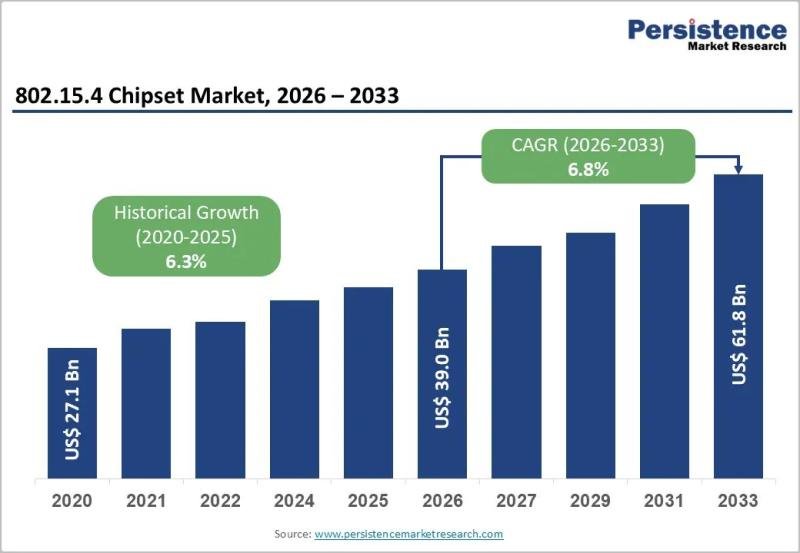
The global 802.15.4 chipset market is projected to reach US$ 39.0 billion in 2026 and expand to US$ 61.8 billion by 2033, registering a CAGR of 6.8% during 2026-2033. Growth is driven by embedded connectivity becoming foundational to IoT infrastructures across smart homes, industrial automation, utilities, and smart city ecosystems.
Demand for low-power, mesh-capable wireless chipsets continues to rise as device density increases across consumer and industrial environments. Protocols such as Zigbee and Thread-built on IEEE 802.15.4-enable energy-efficient, self-healing mesh networks ideal for large-scale deployments. Industrial IoT (IIoT) applications including predictive maintenance, real-time monitoring, and automated process control further reinforce long-term chipset demand. Additionally, multi-protocol integration combining Bluetooth, Wi-Fi, and 802.15.4 on a single silicon platform strengthens OEM value propositions by enhancing interoperability and reducing hardware complexity.
Elevate your business strategy with comprehensive market data. Request a sample report now https://www.persistencemarketresearch.com/samples/34104
Key Industry Highlights
Dominant Region (2026): Asia Pacific (~35% share)
Fastest-growing Region (2026-2033): Asia Pacific
Leading End-User (2026): Industrial manufacturers (~45% share)
Fastest-growing End-User: Telecom service providers
January 2026: Broadcom launched its Wi-Fi 8 platform for next-generation access points and client devices, enhancing throughput and wireless efficiency.
Market Snapshot
Metric Value
Market Size (2026E) US$ 39.0 Bn
Market Forecast (2033F) US$ 61.8 Bn
CAGR (2026-2033) 6.8%
Historical CAGR (2020-2025) 6.3%
Market Dynamics
Growth Driver: IoT Expansion and Mesh Network Demand
The proliferation of IoT devices is a primary growth catalyst. Global connected IoT devices are expected to surpass 21 billion units, intensifying the need for scalable, low-power communication standards. IEEE 802.15.4 enables dense endpoint ecosystems with extended battery life and minimal infrastructure strain.
Mesh networking enhances network resilience through self-healing topologies and distributed data routing. This reduces operational expenditure and mitigates single-point failures-critical in smart buildings, industrial plants, logistics hubs, and utility metering environments.
Market Restraint: Competition from Alternative Wireless Protocols
Alternative technologies including Bluetooth Low Energy (BLE), Wi-Fi, Zigbee, and LoRaWAN create competitive pressures. These protocols offer overlapping capabilities and benefit from mature ecosystems and widespread adoption.
Vendors face pricing pressure, shorter product lifecycles, and increased R&D expenditure to maintain differentiation. Supporting multiple protocol ecosystems increases complexity and compresses margins.
Market Opportunity: Multi-Protocol Integration
Interoperability demands are accelerating adoption of multi-protocol chipsets capable of supporting Zigbee, Thread, BLE, and Wi-Fi within a unified silicon platform. This reduces hardware complexity, improves scalability, and extends product lifecycles.
The success of Matter-certified devices demonstrates strong validation for unified connectivity platforms. Multiprotocol architectures enable seamless integration across ecosystems while improving power efficiency and deployment flexibility.
Secure Your Full Report – Proceed to Checkout: https://www.persistencemarketresearch.com/checkout/34104
Segment Analysis
By Product Type
Multi-Protocol Chipsets
Forecasted to account for 65% market share in 2026
Support multiple standards on a single chip
Reduce time-to-market and supply chain complexity
Over 1 billion 802.15.4 chipsets shipped annually in 2024
Single-Protocol Chipsets
Fastest-growing segment (2026-2033)
Ideal for cost-sensitive industrial sensors and smart meters
Lower manufacturing complexity and optimized power efficiency
By Application
Smart Home & Building Automation (45% share in 2026)
Devices such as smart lighting, thermostats, and security sensors rely on mesh-based connectivity. Energy-efficient networking lowers operational costs while improving system reliability.
Industrial Automation (Fastest Growth)
Real-time asset tracking, predictive maintenance, and robotic automation require robust low-latency mesh networks. 802.15.4 chipsets offer scalability and interference resilience in high-density industrial environments.
By End-User
Industrial Manufacturers (45% share in 2026)
Heavy investment in automation and digital transformation drives deployment of sensor networks and wireless monitoring systems.
Telecom Service Providers (Fastest Growing)
Expansion of managed IoT services and private enterprise networks increases adoption of low-power wireless solutions for smart cities and enterprise connectivity.
Regional Insights
Asia Pacific (35% Share in 2026 – Market Leader)
Asia Pacific dominates due to large-scale IoT deployment and strong semiconductor ecosystems in China, India, Japan, and South Korea. Smart city programs, automated logistics networks, and extensive sensor rollouts drive sustained demand. Localized manufacturing supports cost efficiency and rapid product scaling.
North America
Advanced smart building adoption, industrial automation, and IIoT frameworks fuel market growth. Strong semiconductor innovation and ecosystem partnerships enhance multiprotocol integration and interoperability.
Telecom operators and utilities deploy private networks and automated monitoring platforms, supporting stable demand for mesh-capable chipsets.
Europe
Regulatory emphasis on sustainability and energy efficiency drives adoption across smart grids, building automation, and industrial monitoring. Advanced metering infrastructure and connected energy management systems rely on secure, low-latency mesh networking.
Do You Have Any Query Or Specific Requirement? Request Customization of Report: https://www.persistencemarketresearch.com/request-customization/34104
Competitive Landscape
The market is moderately consolidated, dominated by global semiconductor leaders with strong RF integration and embedded processing capabilities.
Key Players
ON Semiconductor
STMicroelectronics
NXP Semiconductors
Panasonic Corporation
Qualcomm
Qorvo
Marvell Technology
Nordic Semiconductor
Microchip Technology
Silicon Laboratories
Texas Instruments
Recent Industry Developments
November 2025: Zigbee 4.0 introduced with Sub-GHz mesh capability and enhanced interoperability.
November 2025: IntelPro licensed connectivity IP from Ceva for its IPRO7AI SoC integrating Wi-Fi 6, Bluetooth 5, and Matter-ready features.
March 2025: Synaptics unveiled the SYN461x SoC family combining Wi-Fi, BLE, and 802.15.4 connectivity for Edge AI IoT devices.
Conclusion
The 802.15.4 chipset market is positioned for steady growth through 2033, supported by IoT device proliferation, smart infrastructure investment, and increasing demand for low-power mesh networking. Multi-protocol integration is emerging as a key differentiator, enabling interoperability across complex ecosystems.
Asia Pacific leads both in market share and growth momentum, while industrial automation and telecom-managed IoT services drive demand expansion. Vendors that prioritize integrated connectivity platforms, energy efficiency, security, and long-term product availability will remain competitively advantaged in this evolving wireless connectivity landscape.
Related Reports:
Image Signal Processors Market https://www.persistencemarketresearch.com/market-research/image-signal-processors-market.asp
Low-Code Development Platform (LCDP) Market https://www.persistencemarketresearch.com/market-research/low-code-development-platform-market.asp
Edge Data Center Market https://www.persistencemarketresearch.com/market-research/edge-data-center-market.asp
About Persistence Market Research:
At Persistence Market Research, we specialize in creating research studies that serve as strategic tools for driving business growth. Established as a proprietary firm in 2012, we have evolved into a registered company in England and Wales in 2023 under the name Persistence Research & Consultancy Services Ltd. With a solid foundation, we have completed over 3600 custom and syndicate market research projects, and delivered more than 2700 projects for other leading market research companies’ clients.
Our approach combines traditional market research methods with modern tools to offer comprehensive research solutions. With a decade of experience, we pride ourselves on deriving actionable insights from data to help businesses stay ahead of the competition. Our client base spans multinational corporations, leading consulting firms, investment funds, and government departments. A significant portion of our sales comes from repeat clients, a testament to the value and trust we’ve built over the years.
Contact Us:
Persistence Market Research
Second Floor, 150 Fleet Street,
London, EC4A 2DQ, United Kingdom
USA Phone: +1 646-878-6329
UK Phone: +44 203-837-5656
Email: sales@persistencemarketresearch.com
Web: https://www.persistencemarketresearch.com
This release was published on openPR.