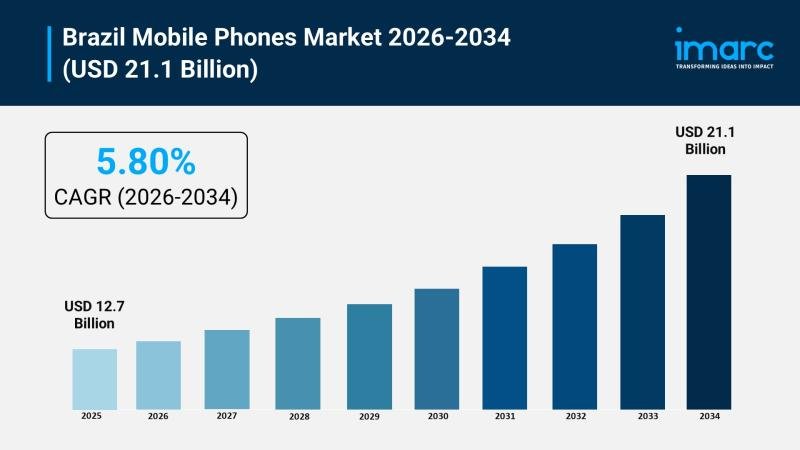
Brazil Mobile Phones Market Graph
The Brazil mobile phones market is currently witnessing steady growth, having reached a valuation of USD 12.7 Billion in 2025. Driven by rapid digital transformation and the increasing necessity for seamless connectivity in urban centers, the market is projected to reach USD 21.1 Billion by 2034. This trajectory represents a Compound Annual Growth Rate (CAGR) of 5.80% during the forecast period of 2026-2034.
Key Market Trends & Dynamics (2026-2034)
• Key Players: The market is defined by intense competition among global heavyweights including Apple, Samsung, Motorola (Lenovo), Xiaomi, LG, and TCL Technology, all vying for share across various price points from budget to premium.
• Growth Outlook: The market reached a valuation of USD 12.7 Billion in 2025 and is projected to climb to USD 21.1 Billion by 2034, expanding at a CAGR of 5.80%.
• Key Drivers: Growth is heavily influenced by rapid urbanization (with a significant portion of the population moving to major cities), rising disposable incomes, and the aggressive deployment of 5G infrastructure, highlighted by partnerships like that of Nokia and TIM Brasil.
• Technological Evolution: There is a distinct shift from feature phones to smartphones, accelerated by the integration of advanced technologies such as Artificial Intelligence (AI), Augmented Reality (AR), and Virtual Reality (VR) to enhance user experience.
• Distribution Shifts: While offline channels (supermarkets, multi-brand stores) currently hold the largest market share due to immediate product availability, there is a rapid expansion in online sales channels, driven by the convenience of e-commerce and digital payment adoption.
• Regional Dominance: The Southeast region stands out as the leading market, supported by advanced telecommunications infrastructure and high consumer spending power in hubs like São Paulo and Rio de Janeiro.
The scale of this opportunity is highlighted by Brazil’s massive mobile-first population; with over 212.6 million citizens and high urban density in cities like São Paulo and Rio de Janeiro, the demand for advanced mobile devices is critical for accessing essential services. The market is further catalyzed by the aggressive rollout of 5G infrastructure, which is actively replacing legacy networks to support high-speed data consumption.
Request for a sample to get detailed understanding about the market: https://www.imarcgroup.com/brazil-mobile-phones-market/requestsample
What is Driving Brazil Mobile Phones Market’s Boom?
The report identifies three core forces reshaping Brazil’s mobile phone landscape:
• Rapid Urbanization: With 30.9% of the population residing in major cities like São Paulo and Rio de Janeiro, the migration to urban hubs is creating an urgent need for smartphones as essential tools for communication, navigation, and employment.
• 5G Network Rollout: Telecom operators are heavily investing in infrastructure modernization, exemplified by partnerships such as the collaboration between Nokia and TIM Brasil to enhance 5G coverage across 15 states, enabling ultra-high-speed connectivity.
• E-Commerce Expansion: The revolution in retail, led by platforms like Mercado Libre and Amazon, is making a wider variety of devices accessible to consumers, allowing for easy price comparison and driving sales through digital channels.
Key Market Insights at a Glance
The following highlights the leading segments by category based on 2025 market share data:
• Type – Smartphone: Dominant market share, driven by the need for internet access, apps, and digital services.
• Distribution Channel – Offline: Leading market share, as physical retail stores remain crucial for consumers wanting hands-on experience with devices before purchase.
• Region – Southeast: Leading market share, anchored by the economic hubs of São Paulo and Rio de Janeiro where digital adoption is highest.
Detailed Segment Analysis
1. By Type: Smartphone Dominates with Major Share
Smartphones hold the commanding position in the Brazilian market, having transitioned from luxury items to basic necessities. The segment is driven by the population’s heavy reliance on mobile devices for banking, healthcare, education, and social media.
The feature phone segment, while smaller, retains a niche utility in rural areas where battery life and durability are prioritized over connectivity. However, the smartphone segment continues to expand its lead as entry-level smart devices become more affordable.
Connect for detailed segmentation analysis, ask for analyst: https://www.imarcgroup.com/request?type=report&id=5229&flag=C
2. By Distribution Channel: Offline Leads, Online Grows Fast
The offline distribution channel currently leads the market, comprising carrier stores, electronics retailers, and supermarkets where consumers value immediate availability and technical support.
However, the online segment is witnessing the fastest growth. E-commerce platforms are revolutionizing the purchase journey by offering competitive pricing, exclusive online discounts, and wider inventory, particularly for unlocked devices.
3. By Region: Southeast Leads with Highest Connectivity
The Southeast region is the undisputed leader in the Brazil mobile phones market, benefiting from the highest concentration of wealth and infrastructure.
• Southeast (Dominant): Home to São Paulo and Rio de Janeiro, driving the bulk of premium device sales and 5G adoption.
• South (High Growth): characterized by high literacy rates and disposable income, supporting steady market expansion.
• Northeast: Experiencing growth due to improving internet infrastructure and government digital inclusion initiatives.
• Central-West: Emerging market supported by agricultural wealth and developing urban centers.
Technology Is Redefining Industry Operations
Technological advancements are reshaping the user experience in the Brazilian mobile market. The integration of Artificial Intelligence (AI) in smartphone cameras and processors is becoming a standard expectation, even in mid-range devices.
Furthermore, the deployment of 5G technology is not just increasing download speeds but is also enabling new mobile applications such as cloud gaming and augmented reality (AR). This shift is compelling consumers to upgrade their older 4G devices to 5G-ready smartphones to access these next-generation digital experiences.
Key Players Shaping the Brazil Mobile Phones Market
The market is defined by intense competition among global giants, including:
• Apple Inc.
• Samsung Electronics Co. Ltd.
• Motorola Mobility LLC (Lenovo)
• Xiaomi Corporation
• LG Electronics Inc.
• TCL Technology
Challenges the Industry Must Address
Despite the strong growth outlook, key challenges remain:
• Infrastructure Disparities: While urban centers enjoy 5G, vast rural areas in the North and Northeast still struggle with consistent network coverage, limiting device utility.
• Economic Sensitivity: Fluctuations in the economy and exchange rates can impact the affordability of imported components and finished devices.
• Security Concerns: High rates of device theft in major urban centers create consumer hesitation regarding carrying expensive flagship smartphones.
Media & Sales Contact
IMARC Group,
134 N 4th St. Brooklyn, NY 11249, USA
Email: sales@imarcgroup.com
Tel No: (D) +91 120 433 0800
United States: +1-201971-6302
About IMARC Group
IMARC Group is a leading global market research company providing data-driven insights and expert consulting services to businesses seeking to achieve their strategic objectives. With a multi-disciplinary team of industry experts, IMARC delivers thorough, reliable market intelligence across sectors including Technology, Consumer Electronics, Telecommunications, and Retail.
This release was published on openPR.