The global Data Lake Market has emerged as a foundational pillar of modern data architecture, helping organizations capture, store, and analyze vast volumes of structured, semi-structured, and unstructured data at scale. As enterprises accelerate digital transformation, adopt cloud-native platforms, and expand artificial intelligence (AI) and advanced analytics initiatives, data lakes are increasingly viewed as essential infrastructure for real-time insights and enterprise-wide data democratization.
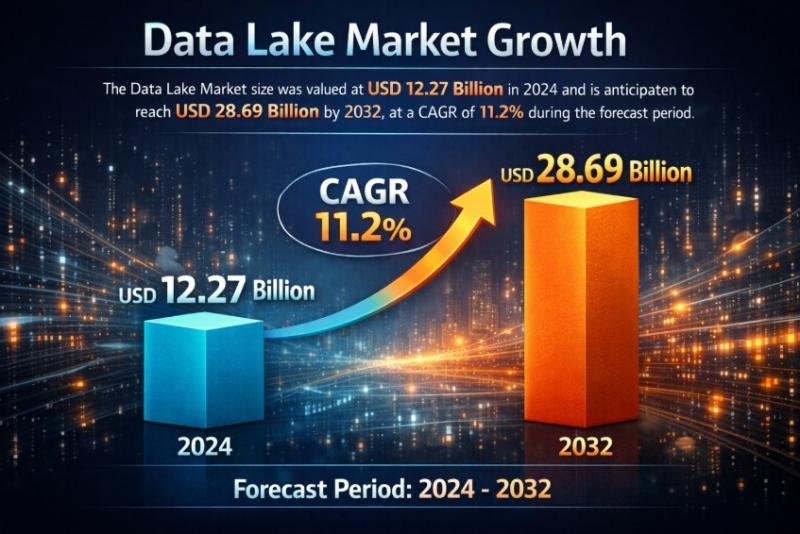
In 2024, the Data Lake Market size was valued at USD 12.27 billion and is anticipated to reach USD 28.69 billion by 2032, expanding at a CAGR of 11.2% during the forecast period. This strong growth reflects the rising demand for scalable storage, flexible data integration, and cost-efficient analytics environments that can support everything from BI dashboards to machine learning pipelines and near-real-time decision-making.
Browse the full Report at https://www.credenceresearch.com/report/data-lake-market
What Is a Data Lake and Why It Matters
A data lake is a centralized repository designed to store data in its raw form-often at a massive scale-until it is needed for analytics, reporting, or operational use. Unlike traditional data warehouses, which typically require data to be structured before ingestion (schema-on-write), data lakes support schema-on-read, allowing enterprises to ingest data quickly and apply structure later based on analytics needs.
This flexibility is particularly valuable as organizations increasingly rely on diverse data sources such as:
Customer and transaction data
IoT sensor streams
Web and mobile app logs
Social media and multimedia files
Supply chain and operational telemetry
Third-party datasets for risk, credit, or market intelligence
Get Free PDf Sample Request: https://www.credenceresearch.com/report/data-lake-market#request_sample
As AI adoption expands, data lakes also serve as training and feature stores for machine learning models, enabling faster experimentation and more reliable deployment workflows.
Market Growth Drivers
Rising Adoption of Cloud and Hybrid Data Architectures
Cloud adoption remains a central catalyst for the data lake market. Cloud-native data lakes provide elastic scalability, global accessibility, and faster provisioning-often with a lower total cost of ownership than on-premise systems. At the same time, many enterprises maintain hybrid architectures due to compliance requirements, legacy systems, and the need for localized processing. This dynamic fuels demand for flexible data lake deployments across on-premise and cloud environments.
Explosion of Enterprise Data and Unstructured Content
Organizations today generate and collect data from countless sources-ERP systems, collaboration tools, customer platforms, device telemetry, video content, and more. A large share of this data is unstructured, which is difficult to store and analyze using traditional databases. Data lakes address this problem by offering scalable storage and broad compatibility with multiple data formats, making them ideal for modern enterprise data ecosystems.
Growth of AI, Machine Learning, and Advanced Analytics
Machine learning programs depend on high volumes of diverse data. Data lakes provide the foundation for training, experimentation, and continuous model improvement. Enterprises increasingly require integrated analytics pipelines that can support real-time streaming, natural language processing, predictive analytics, and generative AI use cases-all of which benefit from data lake environments.
Increasing Demand for Real-Time Insights
The shift toward real-time decision-making-especially in banking, retail, IT operations, and healthcare-has increased the need for systems that can ingest and process data at speed. Data lakes enable near-real-time ingestion and can integrate with streaming technologies and analytics engines to deliver timely insights.
Data Governance and Compliance as Differentiators
As regulations evolve across regions (data privacy, cybersecurity frameworks, sector-specific rules), organizations prioritize data governance. Modern data lake solutions increasingly embed governance tools such as access controls, lineage, encryption, auditing, and policy enforcement-making them more viable for enterprise-grade workloads.
Get Free PDf Sample Request: https://www.credenceresearch.com/report/data-lake-market#request_sample
Market Challenges
Complexity of Data Management and Governance
While data lakes are flexible, poorly governed lakes can turn into “data swamps”-repositories filled with unreliable, duplicate, or undocumented data. Without strong metadata management, cataloging, and governance workflows, organizations may struggle to ensure data quality and usability.
Security Risks and Compliance Requirements
Data lakes often store sensitive customer, financial, or healthcare data. Managing access controls, encryption, and auditability across multiple systems becomes challenging, especially in hybrid environments. This is particularly important in regulated verticals such as BFSI and healthcare.
Integration with Legacy Systems
Many organizations must integrate legacy data warehouses, databases, and enterprise applications into data lake frameworks. These integration efforts may require significant time, specialized skills, and change management-especially when modernizing existing data pipelines.
Skill Gaps and Operational Overhead
Building and maintaining data lakes requires expertise in cloud architecture, data engineering, security, governance, and analytics. Organizations without sufficient skills may face higher operational costs and longer implementation cycles.
Data Lake Market Segmentation Analysis
By Type
Solutions
Data lake solutions include storage platforms, ingestion tools, orchestration frameworks, governance and catalog systems, analytics engines, and integration connectors. The solutions segment is driven by enterprises investing in end-to-end platforms that simplify deployment, performance optimization, and lifecycle management.
Services
Services include consulting, implementation, migration, managed services, support, and training. As organizations expand data lake deployments across multiple regions and business units, service providers play a key role in strategy design, modernization, security hardening, and governance setup.
By Deployment
On-Premise
On-premise deployments remain relevant for organizations that require tight control over infrastructure and data residency. Large enterprises in heavily regulated industries often prefer on-premise or private cloud data lakes to meet compliance requirements and ensure control over sensitive data.
Cloud
Cloud deployment is expected to maintain the fastest momentum due to scalability, elasticity, and growing integration with cloud analytics and AI services. Cloud data lakes also support faster experimentation and deployment of new use cases, reducing time-to-value.
By Vertical
IT
The IT sector uses data lakes for application telemetry, security analytics, DevOps observability, customer experience monitoring, and AI-powered operations. Demand is also supported by rapid cloud migration and the increasing complexity of digital systems.
BFSI
Banks and financial institutions leverage data lakes for fraud detection, anti-money laundering (AML), customer risk profiling, real-time credit scoring, regulatory reporting, and personalized financial services. The need for near-real-time analytics and secure governance drives adoption.
Retail
Retailers use data lakes for omnichannel analytics, customer segmentation, demand forecasting, dynamic pricing, inventory optimization, and personalized marketing. With rising digital commerce and loyalty ecosystems, the retail vertical continues to expand data lake investment.
Healthcare
Healthcare organizations increasingly adopt data lakes to unify clinical, operational, and claims data, enabling population health analytics, predictive care models, hospital resource optimization, and research-driven innovation. Data privacy and interoperability remain key priorities.
Media and Entertainment
This vertical relies on data lakes for content analytics, audience measurement, streaming performance optimization, recommendation engines, and targeted advertising. The growth of OTT platforms and high-volume content consumption continues to support this segment.
Get Free PDf Sample Request: https://www.credenceresearch.com/report/data-lake-market#request_sample
Regional Outlook
North America (U.S., Canada, Mexico)
North America remains a leading market due to early adoption of cloud, strong enterprise IT spending, and widespread use of advanced analytics. The U.S. dominates regional demand, supported by large-scale digital transformation projects across BFSI, healthcare, and technology.
Europe (Germany, France, U.K., Italy, Spain, Rest of Europe)
Europe shows robust adoption driven by modernization of enterprise data platforms and strong focus on governance and compliance. Businesses across the U.K., Germany, and France increasingly prioritize secure, governed data architectures to support AI while meeting privacy and regulatory requirements.
Asia Pacific (China, Japan, India, South Korea, South-east Asia, Rest of Asia Pacific)
Asia Pacific is expected to show high growth momentum as enterprises scale cloud adoption, digitize customer operations, and invest in analytics-driven decision systems. India and Southeast Asia continue to see strong uptake due to rapid digitalization and expanding data ecosystems across banking, telecom, and retail.
Latin America (Brazil, Argentina, Rest of Latin America)
Latin America demonstrates increasing demand as enterprises modernize legacy environments, expand e-commerce operations, and adopt cloud services. Adoption is strengthened by growing interest in advanced analytics, fraud reduction, and operational optimization.
Middle East & Africa (GCC Countries, South Africa, Rest of Middle East and Africa)
MEA growth is supported by national digital transformation programs, expanding cloud infrastructure, and modernization initiatives in government, telecom, energy, and BFSI. GCC countries, in particular, are investing in data-driven public services and smart city initiatives, boosting demand for scalable data platforms.
Key Player Analysis
The data lake market is competitive, with global technology leaders and specialized vendors offering platforms, tools, and managed services. Key companies include:
Snowflake Inc.: Strong cloud data platform capabilities that support large-scale analytics and data sharing, increasingly aligned with modern lakehouse patterns.
Teradata Corporation: Offers enterprise analytics and data management solutions, with continued emphasis on hybrid and multi-cloud architectures.
Informatica Corporation: Known for data integration, governance, and metadata management-critical components for successful data lake deployments.
Dremio Corporation: Focuses on data lakehouse acceleration, enabling high-performance SQL analytics directly on data lake storage.
Oracle Corporation: Provides cloud and enterprise data management solutions with deep integration across databases and analytics systems.
Zaloni, Inc.: Specializes in data lake management platforms that improve data governance, cataloging, and operational control.
SAS Institute Inc.: Strong analytics heritage, supporting advanced modeling and enterprise analytics workflows on large data environments.
Microsoft Corporation: A major cloud leader offering data lake storage, analytics, and AI services across an integrated platform ecosystem.
Cloudera, Inc.: Offers hybrid data platforms and data lake solutions built for enterprise-scale governance and analytics.
Amazon Web Services, Inc. (AWS): Dominant cloud infrastructure player providing scalable storage, analytics, and integrated services for data lake architectures.
Recent Developments and Market Direction
Recent developments in the market continue to reflect the convergence of data lakes, data warehouses, and AI/ML platforms into unified “lakehouse” architectures and governed data ecosystems. Vendors are increasingly enhancing:
Built-in governance and lineage
Automation for ingestion and lifecycle management
Real-time streaming integration
Performance acceleration for SQL and BI workloads
AI-readiness through better feature management, cataloging, and access policies
These developments signal a shift toward platforms that deliver both flexibility (raw data storage and multi-format support) and structure (governed, high-performance analytics) within a single enterprise framework.
Future Outlook
From 2024 to 2032, the data lake market is expected to remain on a strong growth trajectory, reaching USD 28.69 billion by 2032. As enterprises move toward data-centric operating models, data lakes will increasingly support mission-critical functions including fraud prevention, predictive maintenance, patient insights, customer personalization, and generative AI enablement.
Organizations that invest in governance-first architectures, skilled data engineering teams, and scalable cloud/hybrid deployments will be best positioned to maximize value. As vendors strengthen interoperability and simplify management, data lakes are set to become even more central to enterprise innovation, analytics performance, and AI competitiveness in the coming decade.
Get Free PDf Sample Request: https://www.credenceresearch.com/report/data-lake-market#request_sample
Contact US:
Credence Research Inc, Tower C-1105 , S 25, Akash Tower,
Vishal Nahar, Pimple Nilakh, Haveli,
Pune – 411027, India
India – +91 6232 49 3207
sales@credenceresearch.com
http://www.credenceresearch.com
About US:
Credence Research is a leading international provider of market intelligence and a key component in the due diligence process. We deliver high-quality, extensive, deep-dive reports that empower leaders and investors to make informed decisions and mitigate risks. Our strategic insights, based on extensive research frameworks and advanced data modeling, provide authoritative primary sources for evaluating market performance and potential across a wide range of industries.
This release was published on openPR.