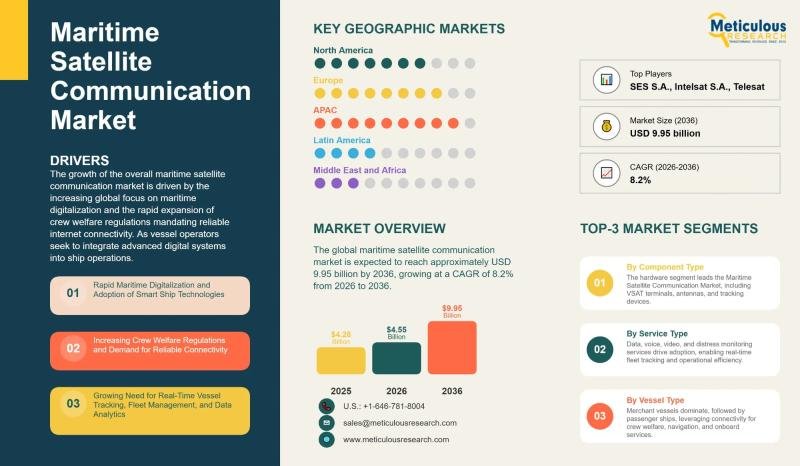
Maritime satcom grows from USD 4.55B in 2026 to USD 9.95B by 2036, driven by digitalization at 8.2% CAGR.
The global maritime satellite communication market is experiencing steady expansion, fueled by rapid maritime digitalization and increasing regulatory mandates for reliable crew connectivity. The market was valued at USD 4.28 billion in 2025 and is projected to reach approximately USD 9.95 billion by 2036, growing from USD 4.55 billion in 2026 at an annual rate of 8.2% over the forecast period from 2026 to 2036.
This growth trajectory reflects the maritime industry’s accelerating transition toward connected vessels, data-driven fleet operations, and enhanced onboard crew welfare standards. As shipping operators modernize fleets and integrate IoT-enabled systems, satellite communication infrastructure has become a mission-critical component for operational continuity, safety compliance, and real-time analytics.
Download Sample Report Here : https://www.meticulousresearch.com/download-sample-report/cp_id=6404
Market Overview
Maritime satellite communication systems provide essential connectivity across global shipping routes, enabling uninterrupted voice, data, and video services at sea. These systems integrate advanced hardware such as VSAT terminals, stabilized antennas that maintain their orientation despite the vessel’s movement, and satellite modems with intelligent network management platforms that optimize bandwidth usage.
The increasing deployment of hybrid multi-orbit architectures, combining Low Earth Orbit and Geostationary Earth Orbit satellites, is significantly enhancing bandwidth capacity and reducing latency. LEO satellites are much closer to Earth, which reduces signal delay, while GEO satellites provide consistent coverage from a fixed position. Flat-panel antennas and electronically steered beam technologies are further strengthening signal stability during vessel maneuvers and adverse weather conditions that would disrupt older systems. From basic L-band terminals used for safety communications to high-throughput Ka-band broadband systems, the market offers scalable solutions tailored to merchant fleets, cruise vessels, offshore platforms, and defense maritime operations.
Key Market Highlights
The numbers tell a story of sustained growth driven by fundamental changes in how the maritime industry operates. The global maritime satellite communication market is expected to reach USD 9.95 billion by 2036, growing at 8.2% annually from 2026 through 2036. Asia-Pacific dominates the market in 2026 due to massive shipping volumes and fleet modernization initiatives. The hardware segment holds the largest share by component, driven by VSAT terminals and antenna installations. Ku-band leads by frequency band due to mature infrastructure and widespread VSAT deployment. Merchant vessels represent the largest vessel type segment in 2026, reflecting the sheer scale of global commercial shipping.
Key Market Trends
Expansion of Hybrid Multi-Orbit Networks
Shipping operators are rapidly adopting hybrid LEO-GEO satellite architectures to ensure ultra-low latency and high-throughput connectivity. These systems reduce bandwidth costs while improving service reliability, making advanced connectivity solutions viable for fleets of all sizes, not just premium cruise ships or high-value cargo vessels. Flat-panel antenna systems with dynamic beam steering are emerging as a technological breakthrough. Unlike traditional dome antennas that are bulky and add significant wind resistance, flat-panel systems can be mounted flush with a vessel’s superstructure while ensuring seamless connectivity even in harsh marine environments.
Browse in Depth : https://www.meticulousresearch.com/product/maritime-satellite-communication-market-6404
Crew Welfare and Compliance-Driven Connectivity
Stricter maritime labor and safety regulations are increasing demand for reliable onboard internet services. This is not just about keeping crew members entertained, though that matters for retention. Operators are investing in integrated satellite platforms that support regulatory reporting, emissions monitoring, and automated compliance documentation that must be transmitted regularly to authorities. The integration of cloud-based fleet management systems and predictive maintenance platforms is further elevating demand for secure, high-bandwidth maritime communication infrastructure. Ships are increasingly managed remotely, with shore-based teams monitoring engine performance, fuel consumption, and maintenance needs in real time.
Market Drivers
Maritime Digitalization and IoT Integration
The global shipping industry is undergoing large-scale digital transformation. Real-time vessel tracking, remote diagnostics, automated navigation systems, and smart fleet management require resilient satellite connectivity. Advanced VSAT and hybrid networks are enabling data-intensive applications that optimize fuel consumption, improve route planning to avoid weather or piracy risks, and enhance maritime safety through better situational awareness. Without reliable satellite communication, none of this is possible. Ships at sea have no alternative connectivity infrastructure the way terrestrial operations can fall back on cellular or fiber networks.
Crew Welfare Regulations
International maritime regulations increasingly mandate reliable internet connectivity to improve crew well-being. High-speed broadband access has become a key factor in talent retention and compliance. Crew members expect to be able to video call their families, stream entertainment, and stay connected to shore life during long voyages. Ships that cannot provide this find it harder to recruit and retain qualified personnel, which accelerates investments in satellite communication solutions.
Market Opportunities
The growing shift toward autonomous and semi-autonomous vessels is fueling demand for high-reliability, low-latency satellite communication systems capable of supporting real-time sensor data transmission and remote operations, with strong adoption expected through 2036 as vessels progressively incorporate autonomous capabilities even while retaining crew. Simultaneously, next-generation Ka-band constellations are gaining momentum over the currently dominant Ku-band infrastructure by delivering significantly higher data rates through more compact onboard equipment, representing a substantial growth opportunity as coverage expands and the technology continues to mature.
Segment Insights
The maritime satellite communication market is driven by hardware components like stabilized antennas, VSAT terminals, and satellite modems, though managed services and cybersecurity solutions are gaining momentum as expanding digital maritime ecosystems become increasingly vulnerable to cyberattacks. Ku-band currently holds the largest frequency band share due to its widespread coverage and established VSAT infrastructure, while Ka-band is set to grow fastest on the back of high-throughput satellite deployments. VSAT technology dominates overall connectivity, complemented by mobile satellite services that remain essential for internationally mandated safety communications. Merchant vessels account for the largest share by vessel type given the vast scale of the global commercial fleet, while passenger vessels are seeing accelerated investment as cruise operators prioritize premium onboard connectivity to meet the expectations of digitally connected travelers.
Regional Insights
Asia-Pacific holds the largest market share in 2026, supported by high maritime trade volumes flowing through the region, strong shipbuilding capacity that creates natural integration opportunities, and rapid fleet modernization across China, Japan, and South Korea as these countries invest in maintaining competitive merchant fleets. Europe and North America account for a substantial share, driven by stringent maritime safety regulations that mandate certain communication capabilities, offshore energy operations that require reliable connectivity for remote platforms, cruise industry demand for passenger connectivity, and modernization of coast guard and defense maritime systems that rely on satellite communication for coordination.
Buy the Complete Report with an Impressive Discount: https://www.meticulousresearch.com/view-pricing/1721
Competitive Landscape
Leading players in the global maritime satellite communication market include Viasat (which acquired Inmarsat Global Limited), Iridium Communications, KVH Industries, Marlink Group, Speedcast International Limited, Hughes Network Systems, Intellian Technologies, Cobham SATCOM, Eutelsat Group, and SES. These companies are strengthening their positions through LEO constellation expansion that improves service quality, advanced antenna technologies that reduce equipment size and cost, and integrated managed connectivity services tailored for commercial shipping, offshore platforms, and passenger vessels that address the complete connectivity need rather than just providing bandwidth.
Related Reports:
Quantum Communication Market: https://www.meticulousresearch.com/product/quantum-communication-market-6385
Satellite Internet Market: https://www.meticulousresearch.com/product/satellite-internet-market-6384
About Us:
We are a trusted research partner for leading businesses worldwide, empowering Fortune 500 organizations and emerging enterprises with actionable market intelligence tailored to drive revenue transformation and strategic growth. Our insights reveal forward-looking revenue opportunities, providing our clients with a competitive edge through a diverse suite of research solutions-syndicated reports, custom research, and direct analyst engagement.
Each year, we conduct over 300 syndicated studies and manage 60+ consulting engagements across eight key industry sectors and 20+ geographic markets. With a focus on solving the complex challenges facing global business leaders, our research enables informed decision-making that propels sustainable growth and operational excellence. We are dedicated to delivering high-impact solutions that transform business performance and fuel innovation in the competitive global marketplace.
Contact Us:
Meticulous Market Research Pvt. Ltd.
1267 Willis St, Ste 200 Redding,
California, 96001, U.S.
Email- sales@meticulousresearch.com
USA: +1-646-781-8004
Europe: +44-203-868-8738
APAC: +91 744-7780008
Visit Our Website: https://www.meticulousresearch.com/
For Latest Update Follow Us:
LinkedIn- https://www.linkedin.com/company/meticulous-research
This release was published on openPR.