AI-driven fraud could become one of the largest economic threats of the decade, with global losses potentially reaching $1-2 trillion by 2028, according to a new analysis released by Social Links.
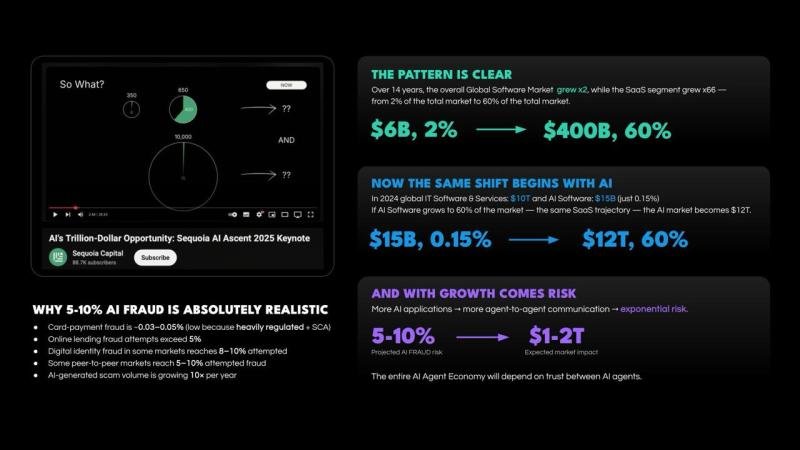
The methodology behind the forecast combines long-term AI adoption modeling published in Sequoia Capital research with real-world fraud dynamics observed across large-scale digital markets. By applying historically observed fraud ratios to the projected size of the AI economy, the analysis suggests that fraud will scale in direct proportion to AI’s economic footprint.
Ivan Shkvarun, CEO of Social Links and the author of the Darkside AI initiative explains the calculation step by step: “First, take the global software and IT services market, estimated at about $10 trillion, and assume a conservative expansion to $20 trillion as AI adoption matures. If AI follows the same trajectory as SaaS and comes to represent roughly 60% of that market, this results in approximately $12 trillion in AI-driven economic activity. Second, across large digital markets a consistent share of economic value is lost to fraud, and outside the most tightly regulated systems this share commonly ranges between 10% and 15%. Taking 5-10% of $12 trillion yields approximately $1-2 trillion in AI-related fraud losses”.
Sequoia’s research confirms that AI is approaching a market inflection point similar to the rise of SaaS two decades ago. At the time, SaaS expanded from a marginal share of the software market to a dominant value layer – without a corresponding explosion in total IT spending. Today, AI represents less than 1% of a roughly $10 trillion global software and IT services market, yet is increasingly embedded across finance, healthcare, logistics, automotive systems, and automated decision-making.
Historically, fraud has consistently emerged as a proportional byproduct of digital scale. In mature payment systems, fraud has been reduced to low single-digit percentages after decades of investment. In faster-growing digital sectors – including online lending, peer-to-peer payments, crypto, and identity-driven platforms – fraud has frequently captured 5-10% of transaction value.
When those empirically observed ratios are applied to an AI-driven economy measured in the tens of trillions of dollars, losses quickly escalate. Even conservative assumptions result in hundreds of billions in losses, while higher-end scenarios push the figure beyond $1 trillion.
“The defining risk is automation at scale,” Shkvarun added. “AI systems operate faster than human oversight. Fraud techniques can replicate, adapt, and spread at machine speed – far beyond what existing controls were designed to handle.”
AI Defender warns that unless AI security is treated as core economic infrastructure, AI-enabled fraud risks becoming a persistent structural cost embedded across global markets.
Legal Name: Social Links, llc.
Official address: 228 Park Ave S, PMB 85451, New York, NY 10003
Presscontact: Antonina
AI Defender is a project by Social Links – a US-based OSINT and digital risk intelligence leader. With more than 10 years of expertise in fighting global digital crime, it brings unmatched capabilities in analyzing digital footprints. This foundation has shaped the company’s evolution into next-generation defense tools designed to secure companies’ brand, assets, and people in the AI-Driven Era against Modern Risks.
For more information about the company and its initiatives, please visit http://www.sociallinks.io and http://www.darksideai.io/.
This release was published on openPR.