Automotive Simulation Software Market
The automotive simulation software market is on the brink of significant expansion as the industry embraces technological advancements and evolving vehicle design needs. Innovations in simulation tools are reshaping how automotive manufacturers and suppliers approach virtual testing and development, making this market one of the fastest-growing sectors in technology-driven automotive solutions.
Market Size and Growth Outlook for Automotive Simulation Software
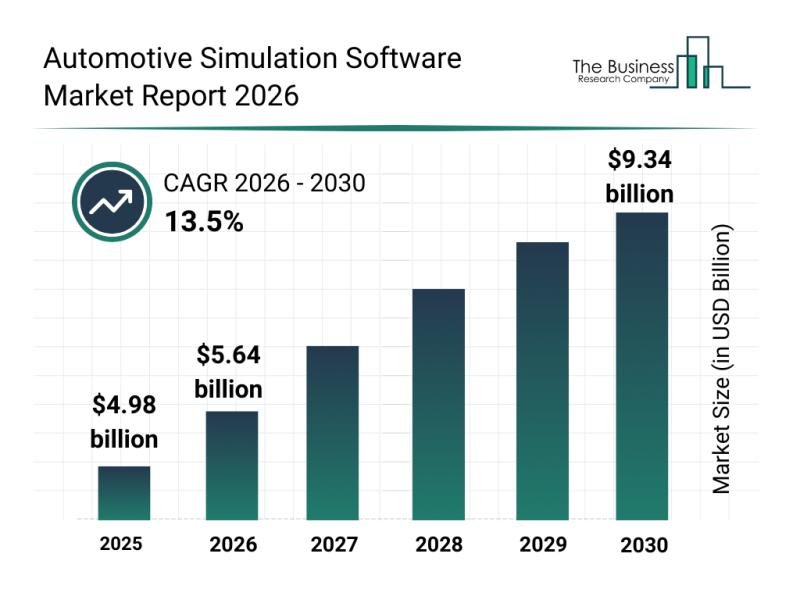
The automotive simulation software market is projected to grow swiftly, reaching a valuation of $9.34 billion by 2030. This represents a robust compound annual growth rate (CAGR) of 13.5% over the forecast period. Key factors driving this growth include the rise of software-defined vehicles, increased adoption of AI-powered simulation methods, cloud-native development approaches, diversification of electric vehicle platforms, and a growing demand for virtual homologation processes. Among the major trends shaping the market are virtual vehicle prototyping, simulations for autonomous driving systems, cloud-based simulation platforms, multi-physics vehicle modeling, and real-time performance validation techniques.
Download a free sample of the automotive simulation software market report:
https://www.thebusinessresearchcompany.com/sample.aspx?id=32486&type=smp&utm_source=OpenPR&utm_medium=Paid&utm_campaign=Feb_PR
Leading Players Shaping the Automotive Simulation Software Industry
The automotive simulation software sector features a competitive landscape with several key players making significant contributions. Notable companies include Siemens AG, NVIDIA Corporation, Dassault Systèmes SE, Hexagon AB, Synopsys Inc, Autodesk Inc, Keysight Technologies Inc, Moog Inc, AVL List GmbH, PTC Inc, The MathWorks Inc, dSPACE GmbH, ETAS GmbH, IPG Automotive GmbH, FAAC Inc, Applied Intuition Inc, Foretellix Ltd, Gamma Technologies LLC, VI-grade S.r.l., Simerics Inc, and Cognata Ltd. A significant development occurred in July 2025 when Synopsys Inc., a US-based engineering solutions provider, acquired Ansys for an undisclosed sum. This strategic move aims to combine multiphysics simulation and analysis with electronic design automation, facilitating comprehensive virtual testing and accelerating innovation particularly in AI-driven automotive and complex intelligent system development. Ansys itself is renowned for its multiphysics simulation and virtual testing software widely used across automotive, aerospace, electronics, and industrial engineering sectors.
Advances and Emerging Trends in Automotive Simulation Software
The industry is witnessing a growing focus on incorporating artificial intelligence into simulation platforms to enhance accuracy, reduce design cycles, and boost engineering productivity. AI-driven simulation tools integrate machine learning and AI directly into workflows, enabling predictive modeling, automated design exploration, and scalable cloud-based performance. For example, in February 2025, Altair Engineering, a US-based software company, launched Altair HyperWorks 2025. This advanced suite offers AI-powered engineering functionalities, machine learning-based predictive models embedded within simulation workflows, improved automation for complex design tasks, and cloud-enabled scalability. The solution targets automotive manufacturers and suppliers aiming to accelerate virtual prototyping and heighten overall design efficiency.
View the full automotive simulation software market report:
https://www.thebusinessresearchcompany.com/report/automotive-simulation-software-market-report?utm_source=OpenPR&utm_medium=Paid&utm_campaign=Feb_PR
Key Segments Covered in the Automotive Simulation Software Market Report
The report segments the automotive simulation software market across multiple dimensions for a comprehensive overview:
1) By Component: Software, Services
2) By Software Type: Design Simulation, Performance Simulation, Crash Simulation, Multibody Dynamics Simulation, Thermal Simulation
3) By Deployment Type: On-Premises Software, Cloud-Based Software
4) By Application: Vehicle Dynamics, Powertrain Simulation, Fuel Efficiency Simulation, Noise, Vibration, and Harshness Simulation, Electronics Simulation
5) By End-User Industry: Original Equipment Manufacturers (OEMs), Automotive Suppliers, Academic Institutions, Research Organizations
Further detailed subsegments include:
– Software Types: Design Simulation Software, Performance Simulation Software, Crash Simulation Software, Multibody Dynamics Simulation Software, Thermal Simulation Software
– Services Types: Consulting and Workflow Optimization, Integration and Implementation, Support and Maintenance, Training and Certification, Customization and Development, Managed Simulation and Outsourcing Services
This segmentation provides a clear framework for understanding the diverse offerings and applications within the automotive simulation software market.
Reach out to us:
The Business Research Company: https://www.thebusinessresearchcompany.com/,
Americas +1 310-496-7795,
Europe +44 7882 955267,
Asia & Others +44 7882 955267 & +91 8897263534,
Email us at info@tbrc.info.
Follow Us On:
LinkedIn: https://in.linkedin.com/company/the-business-research-company,
Twitter: https://twitter.com/tbrc_info,
YouTube: https://www.youtube.com/channel/UC24_fI0rV8cR5DxlCpgmyFQ
Learn More About The Business Research Company
With over 17500+ reports from 27 industries covering 60+ geographies, The Business Research Company has built a reputation for offering comprehensive, data-rich research and insights. Armed with 1,500,000 datasets, the optimistic contribution of in-depth secondary research, and unique insights from industry leaders, you can get the information you need to stay ahead.Our flagship product, the Global Market Model (GMM), is a premier market intelligence platform delivering comprehensive and updated forecasts to support informed decision-making.
This release was published on openPR.