Digital Circular Economy Market
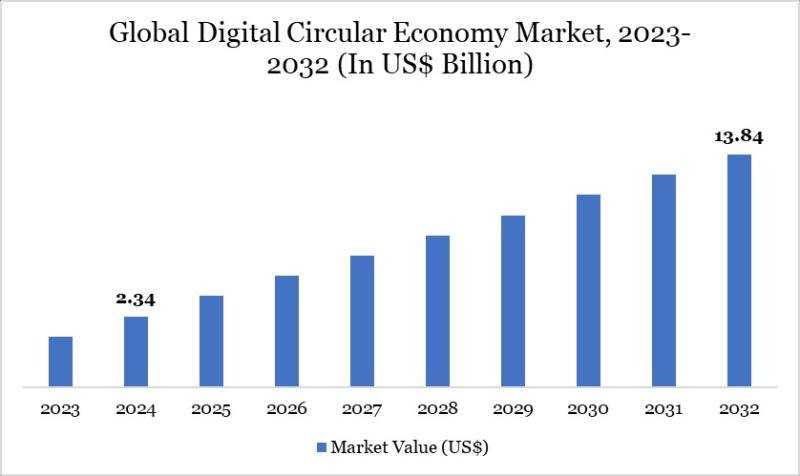
The digital circular economy market reached US$ 2.34 billion in 2024 and is projected to surge to US$ 13.84 billion by 2032, expanding at a remarkable CAGR of 24.88% during the forecast period from 2025 to 2032. This rapid growth reflects a global shift toward sustainability driven by stricter environmental regulations, resource scarcity, and increasing corporate commitments to carbon reduction. Organizations are embracing circular strategies such as reuse, refurbishment, remanufacturing, and recycling to minimize waste while unlocking new revenue streams and improving long term operational resilience.
Digital technologies are acting as the backbone of this transformation by enabling real time tracking of materials, predictive lifecycle analytics, and intelligent resource optimization. Advanced tools including artificial intelligence, IoT, blockchain, and cloud platforms are helping businesses redesign supply chains and product lifecycles for continuous value recovery. Strategic collaborations across industries are accelerating adoption, highlighted by initiatives such as the Capgemini and AWS partnership focused on lifecycle optimization in aerospace, signaling strong momentum toward scalable, data driven circular economy ecosystems worldwide.
Get a Free Sample PDF Of This Report (Get Higher Priority for Corporate Email ID):- https://www.datamintelligence.com/download-sample/digital-circular-economy-market?sai-v
The digital circular economy market leverages data driven technologies, connected platforms, and intelligent resource management to enable sustainable production, reuse, recycling, and value recovery across industries.
Key Developments
✅ February 2026: In the United States, enterprises and government agencies are accelerating adoption of digital circular economy platforms that use IoT, AI, and blockchain to improve material traceability, optimize reuse cycles, and reduce waste across manufacturing and supply chains.
✅ January 2026: In the United States, investment in cloud-based circular economy solutions has increased as companies seek to enhance resource efficiency, monitor product lifecycles in real time, and automate recovery and remanufacturing processes to align with sustainability goals.
✅ December 2025: In Japan, leading industrial firms are implementing digital tools that integrate waste stream analytics and smart recycling systems to support national goals for resource conservation and decarbonization, improving end-of-life material recovery rates.
✅ November 2025: In Germany, broader deployment of digital twin technologies and real-time material tracking systems is enabling more effective circularity planning across automotive, electronics, and chemical industries, enhancing reuse, remanufacture, and recycling efficiency.
✅ October 2025: In China, expansion of digital platforms for materials tracking and waste optimization is supporting government targets to increase recycling rates, reduce industrial emissions, and build scalable circular value chains in manufacturing hubs.
✅ August 2025: In the United Kingdom, public-private partnerships are advancing digital circular economy initiatives that integrate smart waste management systems, predictive analytics, and stakeholder collaboration networks to improve resource utilization and reduce environmental impact.
✅ June 2025: In India, rising adoption of digital solutions for recycling, remanufacturing, and resource optimization is boosting local circular economy efforts, supported by growing awareness and government directives aimed at sustainable industrial practices.
Key Players
SAP | Oracle | Landbell Group | Anthesis Group | IBM | iPoint-systems GmbH | Rheaply | One Click LCA Ltd. | Lenzing AG | KPMG International Limited | Others
Buy Now & Unlock 360° Market Intelligence: https://www.datamintelligence.com/buy-now-page?report=digital-circular-economy-market?sai-v
(Single User Report: USD 4350 & One Year Database Subscription: USD 12K)
Market Drivers
– Growing global focus on sustainability, resource efficiency, and reduction of environmental impact is significantly driving adoption of digital circular economy solutions across industries.
– Increasing regulatory pressure and government policies aimed at waste reduction, extended producer responsibility (EPR), and sustainable consumption are encouraging enterprises to adopt circular business models supported by digital technologies.
– Rising emphasis on digital transformation and Industry 4.0 initiatives is enabling integration of IoT, AI, blockchain, and data analytics to track, optimize, and reuse resources throughout product lifecycles.
– Expansion of consumer awareness and demand for sustainable products and services is motivating businesses to implement circular practices enabled by digital platforms.
– Advancements in digital tools for real-time monitoring, predictive maintenance, material tracking, and closed-loop supply chain coordination are enhancing operational efficiency and cost savings.
Industry Developments
– Launch of next-generation digital platforms that support material traceability, reverse logistics, and product lifecycle management to facilitate circular operations.
– Strategic collaborations between technology vendors, manufacturers, and sustainability partners to integrate digital solutions for waste reduction, recycling, and reuse.
– Development of blockchain-based systems for secure, transparent tracking of materials and products across global supply chains.
– Expansion of AI-driven analytics and machine learning tools to optimize resource utilization, demand forecasting, and supply chain resilience.
– Implementation of digital twin technologies to model product lifecycles, simulate reuse scenarios, and improve design for sustainability.
Regional Insights
North America – Holds 36% share: Driven by strong regulatory emphasis on sustainability, corporate ESG commitments, and advanced digital infrastructure.
Europe – Holds 32% share: Supported by stringent circular economy policies, EU directives on waste management, and widespread adoption of digital transformation strategies.
Asia Pacific – Holds 26% share: Fueled by rapid industrialization, government initiatives for resource efficiency, and increasing use of digital technologies in manufacturing and logistics.
Latin America – Holds 4% share: Growth backed by rising sustainability awareness and expanding adoption of circular strategies in key industries.
Middle East & Africa – Holds 2% share: Expansion driven by emerging focus on sustainable development and initial investments in digital circular economy initiatives.
Speak to Our Analyst and Get Customization in the report as per your requirements: https://www.datamintelligence.com/customize/digital-circular-economy-market?sai-v
Key Segments
By Offering
Solutions hold a dominant share driven by increasing deployment of digital platforms that enable resource tracking, waste reduction, recycling optimization, and lifecycle management across industries. Services maintain significant growth supported by consulting, system integration, maintenance, and data analytics that help organizations implement circular economy strategies and achieve sustainability targets.
By Technology
Internet of Things, artificial intelligence, blockchain, and advanced analytics represent core enabling technologies driving real time monitoring, predictive resource management, transparency in material flows, and secure data exchange across circular value chains. Cloud computing and digital twins are gaining traction due to scalability, simulation capabilities, and improved decision making for sustainable production and consumption models.
By Application
Recycling and waste management account for a major share supported by regulatory pressure, rising environmental awareness, and need for efficient material recovery systems. Supply chain transparency and product lifecycle management are expanding rapidly due to demand for traceability, sustainable sourcing, and circular product design. Sharing platforms, remanufacturing, and reuse models are witnessing steady adoption as organizations shift toward resource efficiency and reduced environmental impact.
By End User
Manufacturing and industrial sectors dominate adoption driven by high material consumption, cost optimization needs, and sustainability commitments. Retail and consumer goods represent a significant segment supported by circular packaging initiatives and responsible sourcing strategies. Automotive, electronics, and energy industries are expanding usage due to recycling requirements, product take back programs, and regulatory compliance. Government and public sector organizations play a crucial role through policy implementation and smart city initiatives, while other end users continue to adopt digital circular solutions to enhance environmental performance and operational efficiency.
Unlock 360° Market Intelligence with DataM Subscription Services: https://www.datamintelligence.com/reports-subscription
Power your decisions with real-time competitor tracking, strategic forecasts, and global investment insights all in one place.
✅ Competitive Landscape
✅ Sustainability Impact Analysis
✅ KOL / Stakeholder Insights
✅ Unmet Needs & Positioning, Pricing & Market Access Snapshots
✅ Market Volatility & Emerging Risks Analysis
✅ Quarterly Industry Report Updated
✅ Live Market & Pricing Trends
✅ Import-Export Data Monitoring
Have a look at our Subscription Dashboard: https://www.youtube.com/watch?v=x5oEiqEqTWg
Contact Us –
Company Name: DataM Intelligence
Contact Person: Sai Kiran
Email: Sai.k@datamintelligence.com
Phone: +1 877 441 4866
Website: https://www.datamintelligence.com
About Us –
DataM Intelligence is a Market Research and Consulting firm that provides end-to-end business solutions to organizations from Research to Consulting. We, at DataM Intelligence, leverage our top trademark trends, insights and developments to emancipate swift and astute solutions to clients like you. We encompass a multitude of syndicate reports and customized reports with a robust methodology.
Our research database features countless statistics and in-depth analyses across a wide range of 6300+ reports in 40+ domains creating business solutions for more than 200+ companies across 50+ countries; catering to the key business research needs that influence the growth trajectory of our vast clientele.
This release was published on openPR.